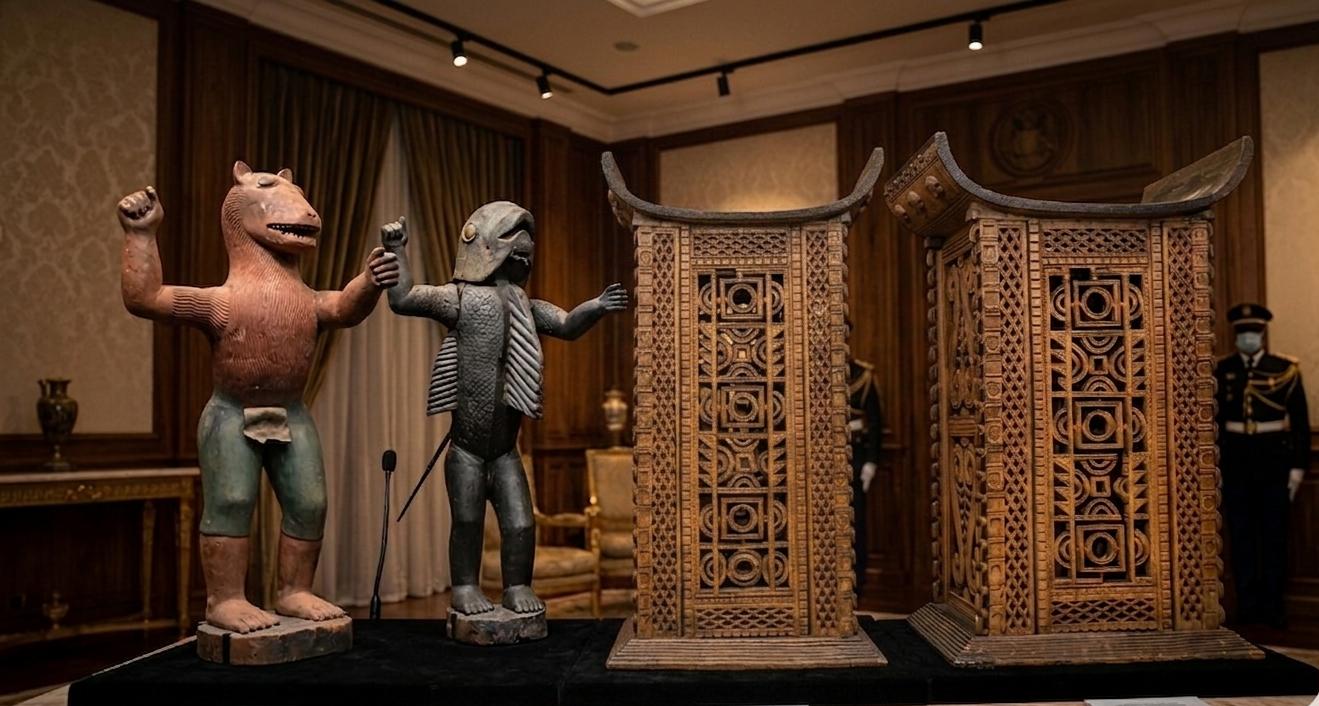
Can Benin turn the page on colonial-era losses by reclaiming 35 more cultural treasures from France? That is the question now driving relations between Cotonou and Paris, as President Romuald Wadagni formally asks his French counterpart Emmanuel Macron to return dozens of cultural goods and historical documents still held in France.
A fresh push to recover what was taken
The debate over African cultural property held in European institutions has become a permanent feature of Benin–France relations. With this new request for 35 items, Cotonou is pressing forward with a process launched years ago, aiming to bring home pieces removed during the colonial period.
Wadagni’s approach goes beyond symbolism. It forms part of a broader policy designed to let Benin repossess key chapters of its own history and make them accessible to its people. Among the items sought are objects tied to the former kingdoms of Benin, their rulers and their traditions. Their return would enrich national collections and give greater depth to the historical narrative presented in Beninese museums.
For the authorities in Cotonou, restitution is both a matter of memory and of sovereignty. For decades, a significant portion of Benin’s material history was kept outside Africa. The country now wants to reverse that trend.
Building on Patrice Talon’s legacy
Wadagni is following in the footsteps of his predecessor, Patrice Talon, who made the return of cultural property a cornerstone of Benin’s diplomacy.
The high point of that policy came in November 2021, when 26 works from the royal treasury of Abomey were officially handed back by France. Those objects—thrones, statues, sceptres and other emblematic pieces from the Kingdom of Dahomey—had been seized by French troops during the conquest of the kingdom in 1892.
Their homecoming stirred deep emotion across Benin. For many citizens, it was not merely the return of old objects but the recovery of a piece of their own story. The handover also carried international weight, helping position Benin as one of Africa’s most active voices in the global debate over African heritage held in Western collections.
With this new claim for 35 more items, Cotonou aims to keep that momentum alive and widen the movement.
Museums ready to welcome the treasures
Getting the works back is only the first step. The country also needs facilities capable of receiving, preserving and showcasing them. This is a central pillar of Benin’s cultural policy, and the government has invested heavily in building and upgrading museum infrastructure.
In Abomey, the Museum of the Epic of the Amazons and the Kings of Danxomè is intended to tell the story of the Kingdom of Dahomey and display part of its heritage. In Porto-Novo, the International Museum of Vodun project aims to shed light on a religious and cultural tradition often reduced abroad to stereotypes. In Ouidah, projects dedicated to the memory of slavery are meant to strengthen the city’s place in the country’s cultural and tourism landscape.
The strategy is clear: returned objects should not simply sit behind glass. They must be accompanied by scientific, educational and historical work that helps visitors understand their origin, meaning and the circumstances under which they left Benin.
Turning heritage into a tourism engine
This heritage policy also answers an economic ambition. Benin wants culture and tourism to contribute more to national growth. Restitution therefore fits into a wider strategy to transform historic sites, traditions and museums into genuine tourist attractions.
Abomey and its royal palaces, Ouidah and its history linked to the slave trade, Porto-Novo and its architectural heritage, Vodun traditions and the cultures of the former kingdoms all represent assets. The challenge now is to create a real tourist circuit around these sites.
A visitor could discover the royal palaces of Abomey, continue to the museums of Porto-Novo, explore the history of Ouidah and take part in cultural events such as the Vodun Days. Around these activities, hotels, restaurants, crafts, transport, guide services and a whole local economy can grow.
Heritage then becomes far more than a conservation matter: it can become an economic sector creating jobs and income.
The conservation and transmission challenge
Restitution nonetheless raises another challenge: conservation. Ancient objects require specific conditions of temperature, humidity, security and restoration. Their return must therefore be matched by appropriate skills and resources.
Benin will also need to keep training curators, historians, restorers and heritage specialists to ensure these items are passed on to future generations. The goal must not be limited to recovering objects; young generations should also be able to make them their own.
In schools, universities and museums, these works can become teaching and research materials. They can help people better understand pre-colonial kingdoms, African societies, resistance to colonial conquest and the political and cultural transformations that shaped Benin’s history.
A cultural battle that crosses borders
The request for 35 new cultural items from France also illustrates how the balance of power around African heritage is shifting. For a long time, major European museums held a considerable share of objects from the African continent. Today, several African states want to regain control of their heritage and build institutions on their own soil capable of conserving and presenting it.
Benin intends to play a leading role in this movement. After the 26 royal treasures returned in 2021 under Patrice Talon, the 35 new items claimed by Romuald Wadagni mark a further step. The process could still be long, since each object requires identification, documentation and negotiation.
But the message from Cotonou is now clear: Benin’s heritage must gradually find its place back home.
Reclaiming the past to build the future
The battle for restitution goes beyond the question of old objects. It touches on identity, memory and a country’s ability to tell its own story.
For Benin, the challenge is now to turn every restitution into an opportunity. A returning work must be studied, conserved, exhibited and explained. A museum that opens its doors must attract both Beninese citizens and foreign visitors. A historic site must benefit the communities living nearby.
Only then will restitution take on its full meaning. The 35 new items claimed from France could become another piece of a vast undertaking: recover heritage, build museums, develop tourism and turn memory into a resource for the future.
After securing the return of the Abomey treasures, Benin now wants to go further. The heritage fight is changing scale. And behind the negotiations between Cotonou and Paris lies a broader ambition: to make Beninese heritage not only a legacy to preserve but also a cultural, educational and economic force for future generations.