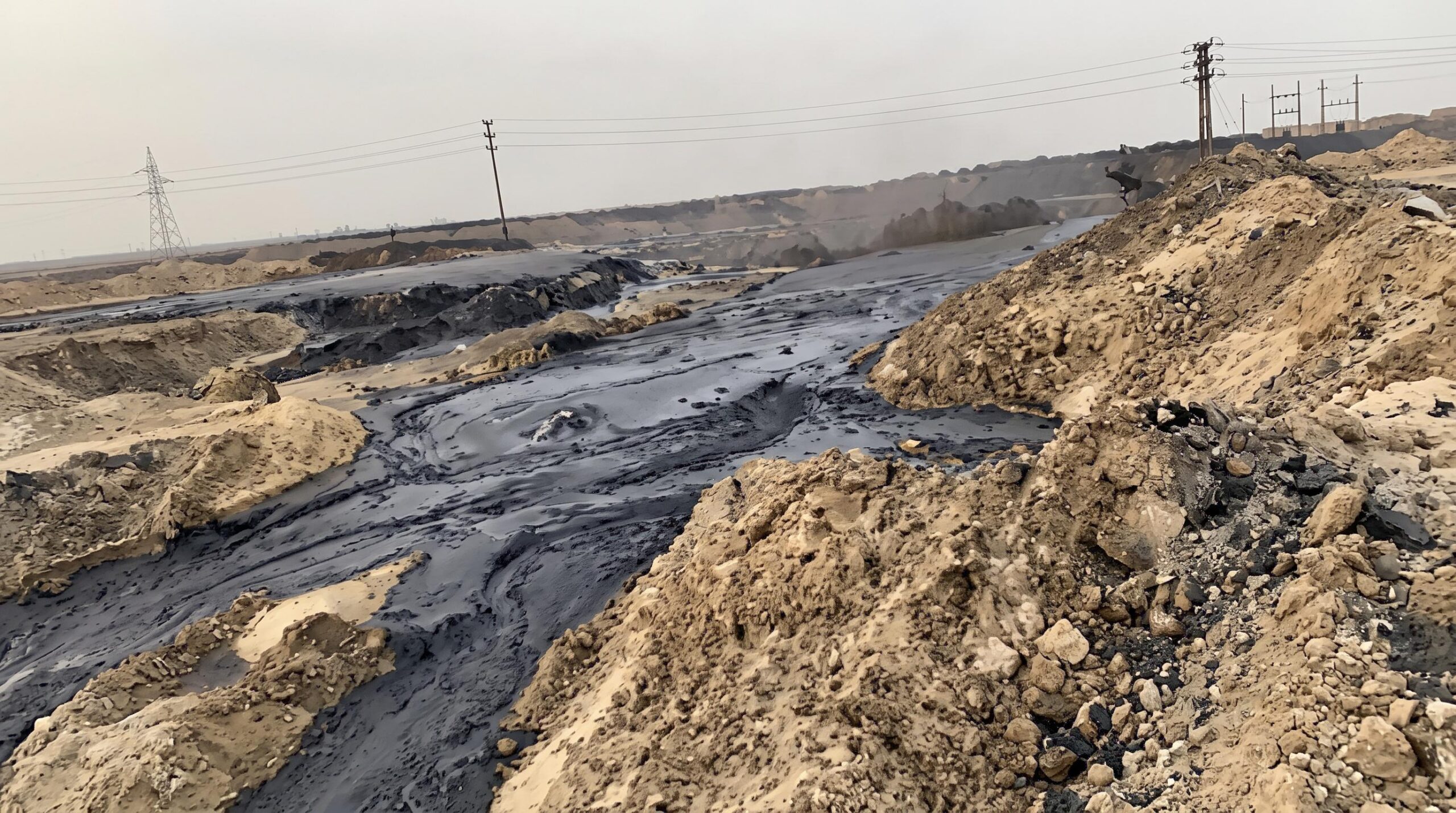
The eruption of an oil well in the Agadem basin is raising serious environmental concerns and rekindling debate over the responsibility of Nigerien authorities, the terms of the partnership with China, and tensions between Niamey and Beijing. Faced with pollution risks, transparency and the protection of local populations are now unavoidable questions.
Oil exploitation, presented by Nigerien authorities as an essential lever of economic sovereignty, is once again at the center of attention. On September 25, 2026, an eruption at the Goumeri W-8 well, in the Agadem oil basin, caused projections of crude oil and gas, raising fears of potentially serious environmental consequences. As operations to bring the incident under control continue, questions are multiplying about the risks to soil, water resources and nearby communities, but also about the authorities’ ability to guarantee responsible oil exploitation.
Beyond the technical incident, this crisis is testing the military government’s sovereignty discourse and its strategic partnership with Chinese companies.
An ecological threat in a vulnerable region
According to information communicated by Nigerien authorities, the eruption at the Goumeri W-8 well, operated by CNPC Niger Petroleum S.A., caused crude oil and gas to shoot several meters into the air. Hydrocarbon flows were also reported at the site. Two employees were reportedly injured and taken into care, while no deaths had been officially reported in initial communications.
But the danger is not limited to visible damage on the platform. In this Sahelian region, where access to water is a vital issue for communities, pastoral activities and ecosystems, an uncontrolled dispersion of hydrocarbons could have lasting consequences.
Crude oil contains substances capable of contaminating soil, disrupting vegetation and affecting wildlife. In the event of infiltration, some of its components can also degrade the quality of groundwater, on which many rural populations depend. Added to these risks are gas emissions, fire hazards and the potential exposure of workers and residents to toxic substances.
In a region already facing the effects of climate change and pressure on natural resources, poorly controlled oil pollution could worsen existing vulnerabilities. The consequences would not be solely ecological: they could also affect the livelihoods of local communities.
Emergency measures, but unanswered questions
In response to the incident, authorities announced operations to contain the flows and bring the eruption under control. Technical teams were mobilized and containment devices were reportedly put in place to limit the spread of oil. The condition of the facilities and risks to neighboring wells are also raising concerns.
These emergency measures are necessary, but they are not enough to dispel worries. Local populations need to know whether their water resources are threatened, which areas should be avoided, and what guarantees exist to prevent the situation from worsening.
The government must therefore go beyond official statements. It is up to the authorities to make inspection results public, communicate regularly on the evolution of the incident and allow an independent assessment of any damage. Without accessible and verifiable data, the authorities’ assurances risk remaining mere declarations.
The question of responsibility is just as important. The investigation must determine the technical causes of the eruption, verify compliance with safety standards and establish whether failures in maintenance, monitoring or prevention contributed to the incident. The search for responsibility must be neither sacrificed to economic urgency nor hindered by political considerations.
The Chinese partnership under pressure
At the heart of this crisis lies the oil partnership between Niger and China, which has become a pillar of Niamey’s economic strategy. China National Petroleum Corporation (CNPC), a Chinese state-owned company, plays a central role in operating the Agadem basin and developing infrastructure to transport Nigerien crude to international markets.
This cooperation, presented as a development opportunity, nevertheless raises questions about profit sharing, the transparency of contractual commitments and state control over oil activities. The agreement concluded in April 2024, involving $400 million in financing linked to oil marketing, illustrates the importance of the financial stakes in this relationship. Yet the detailed terms of some commitments remain insufficiently accessible to the public.
This opacity is all the more worrying because oil exploitation directly involves the country’s economic and environmental future. Nigeriens have the right to know what revenues their state derives from this activity, what environmental obligations operators have, and what financial guarantees are provided in the event of an accident.
The environmental responsibility of companies cannot be separated from their economic responsibility. If shortcomings are established, the operator concerned must answer for its obligations in accordance with contractual provisions and applicable law. As for the state, it must ensure that control, prevention and compensation mechanisms are effectively applied.
Niamey and Beijing: a rift that weakens oil ambitions
The Agadem incident comes amid sometimes tense relations between Nigerien authorities and their Chinese partners. Since the July 2023 coup, the military government has claimed it wants to take greater control over national resources and rebalance economic relations with foreign partners.
But this desire for sovereignty collides with a reality: Niger remains heavily dependent on its partners’ expertise, capital and infrastructure to exploit and market its oil. Disagreements that have emerged around economic interests and cooperation terms have revealed the limits of a strategy that seeks to assert the country’s independence without always having the technical and financial means to break free from its partners.
In March 2025, the expulsion of three Chinese officials linked to the oil sector had already illustrated tensions between Niamey and Beijing. That episode highlighted the fragility of a relationship that is nonetheless essential to Niger’s economic ambitions.
The Goumeri W-8 crisis now raises an additional question: could political and commercial tensions divert attention from industrial safety and environmental protection imperatives? The answer cannot be presumed. The circumstances of the accident and the decisions taken by each party will need to be examined. But one thing is certain: the protection of populations must never become an instrument of diplomatic negotiation.
The junta faces its responsibilities
For Niger’s military government, the incident is a major test. By making economic sovereignty one of the foundations of its political discourse, the junta committed to better defending the country’s interests. Yet this ambition cannot be limited to challenging conditions imposed by foreign partners or demanding a larger share of oil revenues.
Sovereignty also means having institutions capable of enforcing safety standards, monitoring operators and protecting natural resources. It requires contracts to be subject to rigorous scrutiny and citizens to have access to information about the exploitation of their heritage.
From this perspective, several measures are needed: publish the conclusions of the investigation into the eruption, carry out independent analyses of soil and water, report on containment measures and establish a transparent compensation system if harm is confirmed. Riverside communities must also be informed of the risks and involved in monitoring the situation.
The state must finally guarantee that any responsibilities will be established without complacency, whether they concern the operating company, technical contractors or public control mechanisms.
Black gold must not become a poison for Niger
The crude oil leak at Agadem is a reminder that underground wealth can become a source of vulnerability when its exploitation is not accompanied by sufficient environmental guarantees. For a country facing multiple economic and social challenges, the consequences of lasting pollution could weigh heavily on populations that do not necessarily benefit equitably from oil revenues.
The challenge therefore goes beyond controlling an industrial incident. It concerns Niger’s ability to reconcile resource exploitation, environmental protection and political responsibility.
The junta must now demonstrate that its sovereignty ambitions translate into concrete actions: contract transparency, effective monitoring of operators, accident prevention and compensation for potential damage. China, for its part, must be held to respect its obligations under its activities in Niger.
In Agadem, oil was supposed to symbolize the promise of a better economic future. It should not become the promise of an avoidable ecological disaster. For true sovereignty is not only about profiting from national wealth: it is also about protecting the land, water and populations that depend on them.