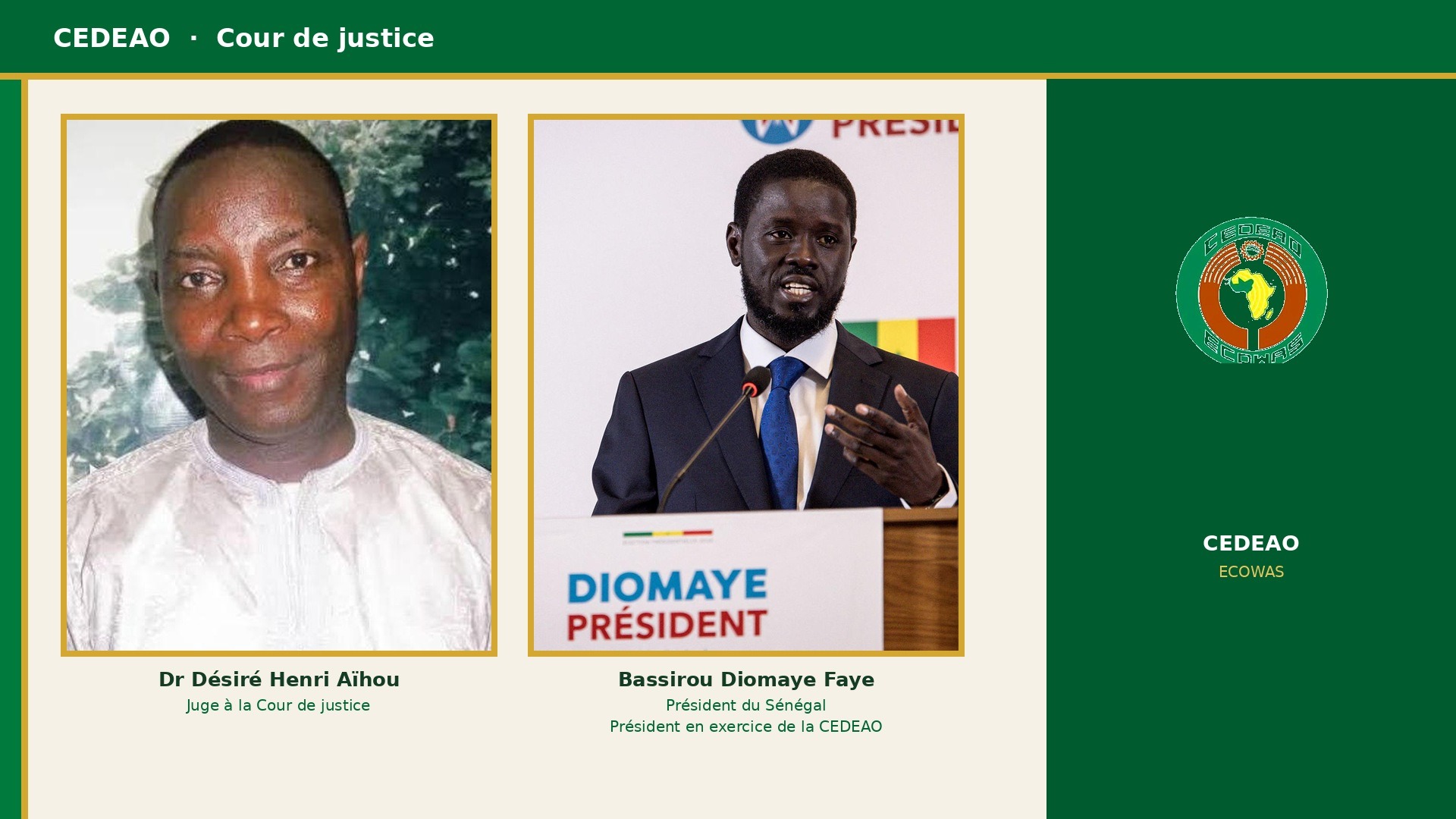
When Dr. Désiré Henri Aihou took the oath of office as a judge of the ECOWAS Court of Justice in Abuja, the moment raised a question that hangs over West Africa’s entire regional project: can a community court whose rulings are not always obeyed still anchor the rule of law across fifteen member states? The answer may depend on the five judges who swore in that day — and on whether their decisions carry real weight.
A swearing-in with more than ceremonial weight
The ceremony took place on Tuesday, 6 October 2026 at the ECOWAS Commission in Abuja, presided over by Bassirou Diomaye Faye, president of Senegal and current chair of the ECOWAS Authority of Heads of State and Government. Five new judges took the oath: Désiré Henri Aihou for Benin, Awa Bah for The Gambia, Charlyne M. Brumskine for Liberia, Henrietta Uzoamaka Didigu for Nigeria, and Yaouza Ouro-Sama for Togo.
Their appointments had been approved at the 69th ordinary session of the Authority of Heads of State and Government, held on 19 July 2026 in Lungi, Sierra Leone. The mandate runs for four years and cannot be renewed. Under the new arrangement, the Court is composed of five independent judges expected to meet high standards of legal experience and qualification.
For Benin, the nomination places one of its magistrates inside an institution that is meant to play a central role in applying community law — a role that goes far beyond representation.
What the Court actually does
The ECOWAS Court of Justice is not a symbolic body. Established under the revised ECOWAS Treaty, it is mandated to ensure that law and equity are observed in the interpretation and application of community texts. It has jurisdiction over disputes between states and community institutions, and — a crucial evolution — over certain cases brought by individuals against member states.
That human rights dimension matters in a region where governance, fundamental freedoms, constitutionalism, and institutional stability are increasingly contested. Community justice is designed to add another layer of legal protection, so that commitments made by states do not remain mere political declarations but can be tested against rules and judicial mechanisms.
Benin’s democratic heritage as a judicial export
The presence of a Beninese judge in this regional judicial architecture echoes Benin’s own institutional history. In February 1990, the National Conference of Active Forces of the Nation — held in Cotonou from 19 to 28 February — opened the way to the country’s democratic renewal. Representatives of Benin’s various social components affirmed their will to establish democracy, respect human rights and fundamental freedoms, and build new institutions.
Months later, the Constitution of 11 December 1990 enshrined that new direction, placing democracy and the rule of law at the heart of the Republic and organizing the separation of executive, legislative, and judicial powers. The creation of the Constitutional Court, operational from 1993, formed part of the same effort to make institutional regulation a central element of the political system.
That architecture was no accident. After a long period of concentrated power, the goal was to build a system in which institutions respond to one another, check one another, and exercise their powers in accordance with the Constitution.
From national separation of powers to regional judicial accountability
Thirty-six years after the National Conference, Benin’s experience finds a new resonance at the community level. Democracy does not stop at national borders. In an integration space like ECOWAS, states have gradually agreed to submit certain areas to common rules and institutions.
ECOWAS itself rests on three institutional branches: executive, legislative, and judicial. The Court of Justice forms the judicial arm of that architecture and oversees the interpretation and application of community law.
The stake is therefore to preserve, at regional scale, a principle familiar to Benin’s constitutional experience: power must be framed by law and subject to oversight mechanisms. The new Beninese judge’s mission fits into that logic. It is not about representing Benin politically within the Court, but about exercising a judicial function in a community framework. The independence of judges is precisely one of the conditions for this justice to be credible.
The enforcement problem no one can ignore
Consolidating the Court does not depend only on the quality of its judges. It also depends on whether its rulings are actually respected. ECOWAS has itself identified the execution of judgments as a significant challenge to its jurisdiction’s effectiveness. In 2024, its Judicial Council examined ways to improve mechanisms for enforcing the Court’s decisions.
That is where one of the major issues of the new mandate lies: making community justice not only independent and credible, but also concretely effective. In a West African context marked by political crises, institutional tensions, and debates over the future of regional integration, a solid community court can serve as a space for recourse, for clarifying the law, and for protecting shared principles.
What the Abuja oath really commits to
The swearing-in of Désiré Henri Aihou goes beyond the protocol of a judicial ceremony. It is a reminder that regional integration does not rest solely on economic exchange, free movement, or political decisions. It also rests on a common legal foundation and on institutions capable of guaranteeing respect for it.
For Benin, whose contemporary political history remains strongly associated with the democratic turning point of 1990, this responsibility carries particular resonance. From Cotonou to Abuja, the principle remains the same: power, whatever form it takes, must remain subject to the law.
That is one of the major lessons of the institutional culture born from the National Conference of Active Forces of the Nation. It is also one of the challenges ECOWAS now faces: turning the principles of democracy, justice, and the rule of law into institutional realities capable of withstanding crises and effectively protecting citizens.
With Désiré Henri Aihou taking office, Benin brings to the community jurisdiction a particular national experience of institution-building. The question now is how this new generation of judges will contribute, over the next four years, to strengthening the credibility and authority of West African community justice — and whether their rulings will be obeyed.