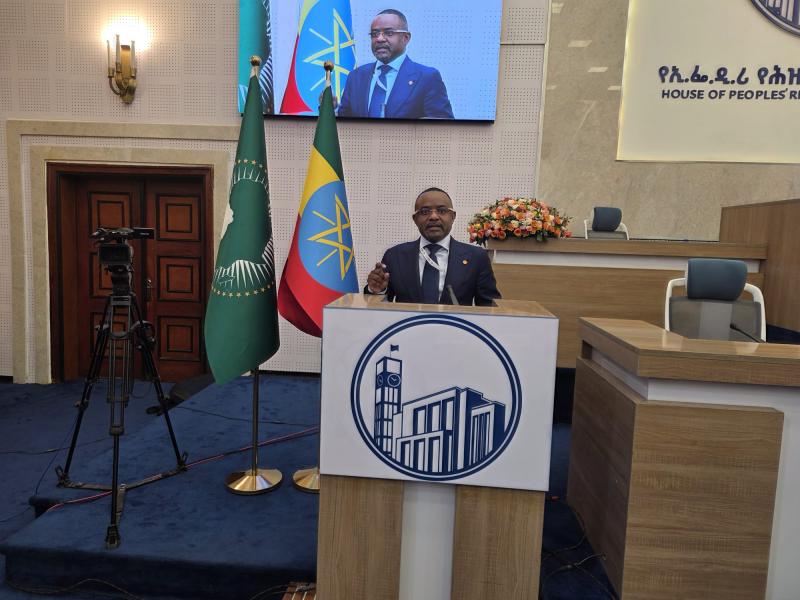
The Democratic Republic of Congo (DRC) has become a focal point for debate on democratic integrity in Africa, with Senator Salomon Kalonda Idi Della taking center stage in Addis Ababa. Speaking at the Ethiopian Parliament’s Intelligence and Security Forum on Friday, the senator from Haut-Katanga delivered a sharp critique of constitutional manipulation, warning that such practices pose an even greater threat to democracy than traditional military coups.
Kalonda’s address focused on the DRC’s ongoing electoral reforms, which he argues are designed to enable the current administration to seek a third term in office. « This isn’t just a political maneuver—it’s a constitutional coup, » he declared. « And it’s happening under the guise of legality. »
a dangerous pattern of constitutional manipulation
The senator drew a stark contrast between two forms of undemocratic power grabs: the overt military coup, universally condemned, and the more insidious « constitutional coup, » which he described as a deliberate distortion of legal processes to maintain power indefinitely. « There are no good coups and bad coups, » Kalonda emphasized. « Only coups that undermine democracy—and they all do the same damage. »
He highlighted several tactics used to manipulate constitutional processes across the continent: legally dubious third-term referendums, politically influenced judicial rulings invalidating opposition candidates, and systematic internet shutdowns during election results announcements. « When authorities cut off internet access at the very moment they announce results, » he noted, « it’s not a sign of confidence—it’s an admission of fraud. »
Kalonda also condemned the international community’s inconsistent response to these democratic backslides. « Where is the outrage? » he asked. « Silence in the face of constitutional coups is not neutrality—it’s complicity. »
four pillars for electoral integrity in africa
To combat these threats, the senator proposed a four-point plan to strengthen electoral integrity across Africa:
- Permanent African Electoral Monitoring Cell: A dedicated continental body to oversee elections and prevent manipulation before, during, and after voting.
- African Digital Sovereignty in Elections: Developing secure, continent-wide digital infrastructure to prevent interference and ensure transparent vote-counting.
- Independent Electoral Audits: Mandatory, transparent audits of election processes, conducted by credible regional organizations to restore public trust.
- Parliamentary Pre-Election Observation Protocol: A comprehensive framework for legislative oversight, covering everything from voter registration to result certification.
Kalonda did not limit his critique to political processes alone. He also addressed the economic consequences of democratic decline, arguing that the lack of genuine democratic governance in resource-rich nations like the DRC puts Western partners at a disadvantage. « When elections are rigged, » he said, « the real losers aren’t just the people—they’re the companies that play by the rules. »
a call to action from addis ababa
The timing of Kalonda’s speech was deliberate. Held in the Ethiopian capital during a high-profile continental forum, his remarks were directed at policymakers across Africa. By framing constitutional coups as the « silent assassins of democracy, » he challenged leaders to confront the erosion of electoral integrity before it’s too late.
As African nations grapple with the dual pressures of political instability and economic uncertainty, Kalonda’s message served as both a warning and a roadmap. « Democracy isn’t a luxury—it’s the foundation of stability, » he concluded. « And no amount of legal sophistry can justify its destruction. »