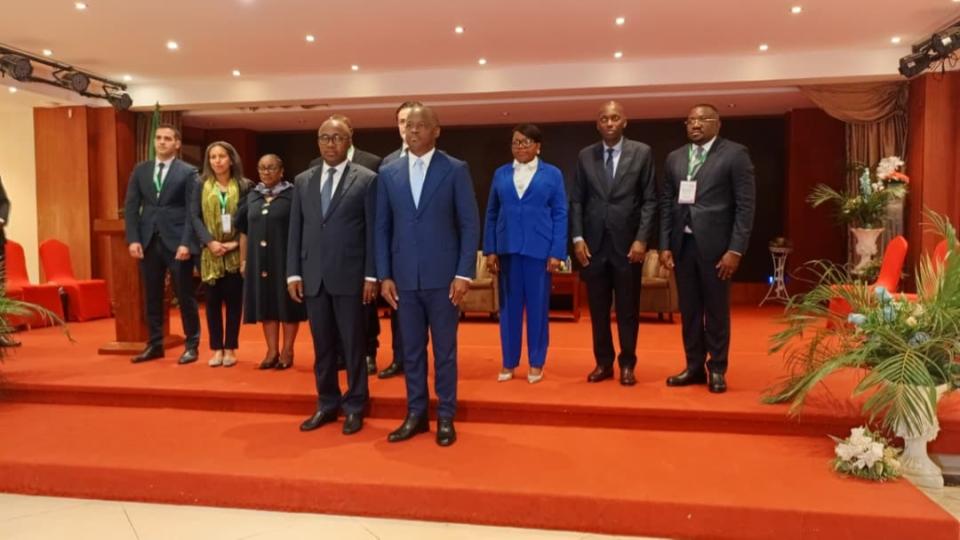
The Republic of Gabon is currently hosting a pivotal three-day review in Libreville, where international experts, national authorities, and local institutions are assessing the country’s anti-corruption measures under the United Nations Convention Against Corruption (UNCAC) second-cycle evaluation. This mission, which began on June 29, marks a significant step in reinforcing the governance framework of the Fifth Republic.
Among the key figures leading this initiative are Vice-President of the Government Hermann Immongault, Nestor Mbou, President of the National Commission Against Corruption and Illicit Enrichment (CNLCEI), and Séraphin Ondoumba, the National Focal Point for the United Nations Office on Drugs and Crime (UNODC). Together, they emphasize that this evaluation is not merely procedural but a strategic opportunity to restore public trust and strengthen institutional credibility.
Governance transformation hinges on transparency and accountability
Vice-President Immongault underscores the critical role of anti-corruption efforts in reshaping Gabon’s public sector. “Since the establishment of the Fifth Republic, Gabon has embarked on a profound transformation aimed at restoring trust between the State and its citizens,” he states. “This transformation is built on transparency, accountability, and measurable results.”
He highlights the far-reaching consequences of corruption, noting that it erodes public institutions, undermines investment, stifles economic growth, and exacerbates inequality. “Transparency is no longer just a democratic ideal—it is a competitive advantage for nations striving for sustainable development and inclusive prosperity,” he asserts.
A new era of institutional reform under CNLCEI leadership
Nestor Mbou, President of CNLCEI, frames this evaluation within Gabon’s broader institutional reforms. “This mission arrives at a defining moment for the Gabonese Republic, coinciding with a dynamic wave of institutional transformation driven by the highest authorities,” he remarks. He references the President of the Republic’s address to Parliament on June 15, which outlined the urgent need to dismantle endemic corruption, clientelism, and poor governance that have long plagued the nation.
Mbou emphasizes the President’s vision: “Gabon now deserves strong, credible institutions aligned with international standards in human rights, fundamental freedoms, democracy, and the rule of law.” These principles, he asserts, form the bedrock of the country’s anti-corruption strategy.
UNODC’s call for truth and cooperation in governance strengthening
Séraphin Ondoumba, the National Focal Point for UNODC, welcomes the international experts and underscores the collaborative spirit of this mission. “For Gabon, this exercise is of paramount importance,” he states. “It reflects our unwavering commitment to fulfilling UNCAC obligations and enhancing national mechanisms for prevention, detection, and prosecution of corruption.”
He stresses that the review will focus on preventive measures and asset recovery—two pillars essential for reinforcing the rule of law and safeguarding public resources. “This dialogue must serve as a moment of truth, progress, and renewed commitment to good governance, transparency, and the public interest,” he urges.
Three days to drive policy improvements and global cooperation
This evaluation is more than a compliance check; it is an opportunity to identify best practices, acknowledge progress, and address lingering challenges. As Mbou notes, “This is not just about assessing legal frameworks—it is about learning, adapting, and accelerating the implementation of our anti-corruption strategy.”
Over the next three days, international experts will engage with government agencies, judiciary bodies, independent oversight institutions, and civil society representatives to gauge the practical application of UNCAC standards. Through this process, Gabon aims to demonstrate that combating corruption is not just a legal obligation but a cornerstone of modern governance, state modernization, and international credibility.