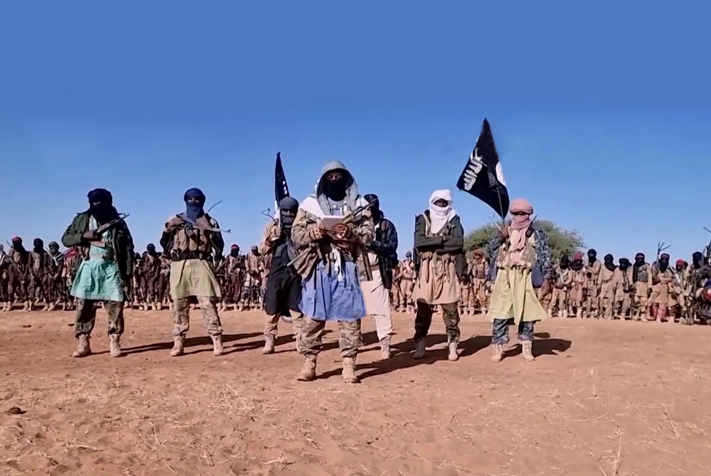
In northeastern Mali, the Islamic State’s Sahel Province continues to exert influence despite competing factions, particularly the JNIM.
The Gao region, especially the Ansongo circle, and the Ménaka region remain hotspots for the Islamic State in the Greater Sahara (ISSP), formerly known as EIGS. This area, encompassing the so-called “3T” localities—Talataye, Tin-Hama, and Tessit—as well as Labbezanga, serves as the epicenter of the group’s operational activity. Here, the ISSP maintains a firm territorial hold and exerts relentless pressure on local communities.
Leadership and strategy
The group is currently led by Abou Al-Bara, who took over after the death of Adnan Abu Al-Walid Sahraoui in 2021. While the exact command structure remains somewhat opaque, the ISSP has shifted its tactics since 2020. Gone are the days of public executions and large-scale terror campaigns. Today, the group focuses on a more calculated approach: controlling territory, governing local populations, and embedding itself within communities. This subtle shift has allowed the ISSP to operate under the radar while still maintaining a strong foothold in key regions.
The Malian Armed Forces (FAMa) have not relented in their efforts to counter this threat. In a recent operation, they neutralized a key ISSP operative during an overnight airstrike on May 14-15, 2026, in Bara, Ansongo circle. The strike also resulted in the elimination of several allied fighters, demonstrating the military’s sustained pressure on the group’s strongholds. Yet, the ISSP’s ability to regroup and maintain its logistical networks along the Mali-Niger border remains a persistent challenge.
Tactics and territorial control
The ISSP continues to target strategic localities along the Mali-Niger axis, including Talataye, Tin-Hama, Tessit, Labbezanga, and Ménaka. By controlling the movement of people and goods, the group reinforces its dominance over these regional corridors. This strategy not only strengthens its operational capacity but also extends its influence over local armed factions.
The rivalry between the ISSP and the JNIM adds another layer of complexity to the Sahel’s security landscape. While the JNIM has gained visibility through high-profile attacks—such as the coordinated strikes on April 25, 2026, near Bamako—the ISSP has not faded into obscurity. The two groups operate with distinct agendas: the JNIM favors dramatic, media-centric assaults, whereas the ISSP prioritizes quiet territorial control and community coercion.
Initially, defections from the JNIM contributed to a temporary lull in direct clashes, but since 2020, this fragile truce has eroded. Recent military offensives by Malian forces have forced both groups to redirect their focus toward a common adversary, though no formal peace accord has been established.
Ongoing threats and regional challenges
According to the latest ACLED data from May 15, 2026, 86% of Islamic State activities in the first quarter of 2026 occurred in Africa, with a marked increase in armed drone strikes, motorized attacks, and economic pressure on both urban and rural communities. The ISSP has specifically targeted civilian and military infrastructure along the Ménaka-Ansongo-Tessit axis and Labbezanga, exploiting local weaknesses to impose its de facto governance. A February 7, 2026, attack on a civilian convoy near Kobé, 35 km from Gao, underscores the group’s evolving tactics.
International security cooperation has yielded some successes, including the neutralization of key figures like Abu-Bilal Al-Minuki on May 16, 2026, during a joint operation in the Lake Chad basin involving Nigerian and U.S. forces. However, the ISSP’s threat persists in northeastern Mali, particularly in the “3T” localities and Labbezanga, where territorial control and influence over local armed groups remain entrenched.
The ISSP’s ability to operate in the shadows, leveraging the media spotlight on the JNIM and other factions, has allowed it to strengthen its position. By focusing on community governance and logistical control, the group continues to pose a significant challenge to Malian forces and regional stability. Strengthening counterinsurgency efforts in critical zones, especially along the Niger-Mali border, is essential to curbing its influence.