A widening gap between rhetoric and reality
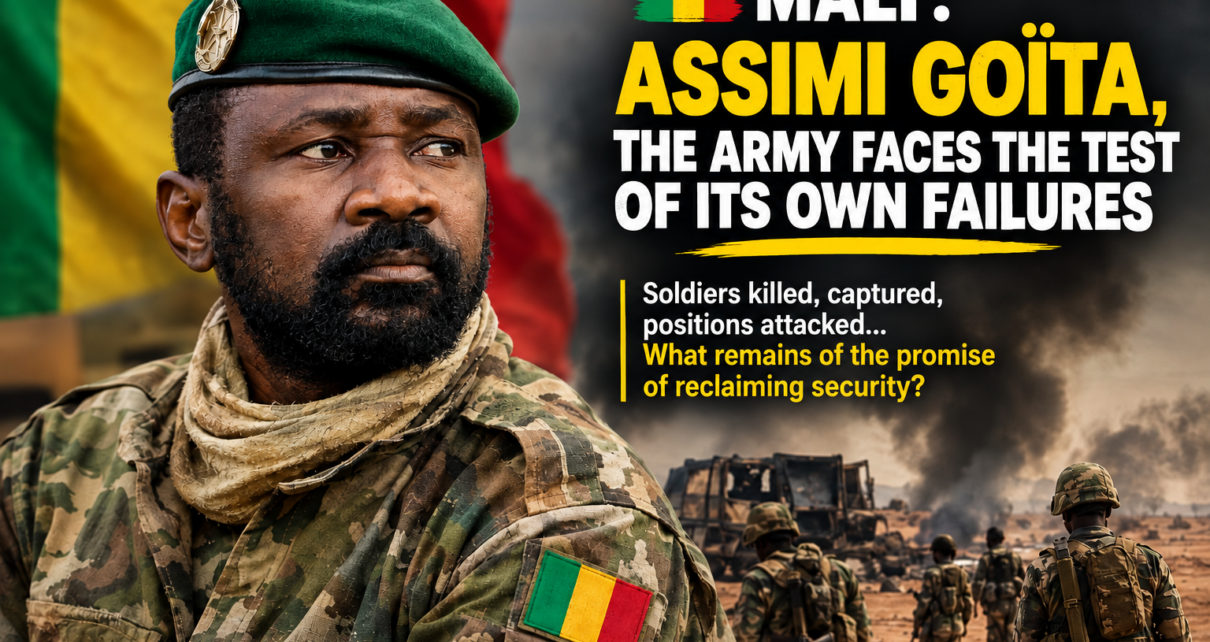
Soldiers killed or captured, positions overrun: beyond a string of military setbacks, one question persists. What remains of the security reconquest that Assimi Goïta’s government promised?
A gap has become impossible to overlook between the image of strength projected by Bamako and conditions on the ground. For months, Malian forces have absorbed severe blows at the hands of JNIM and the Azawad Liberation Front (FLA). Repeatedly blaming soldiers for a lack of courage does not explain what is happening. The facts raise a different question: that of strategy and command.
September 2026: the assault on Dioura
On 10 September 2026, the military camp at Dioura, in central Mali, was hit by a major attack claimed by JNIM. A toll compiled from military, security and local sources indicated that at least 100 Malian soldiers and five Russian members of Africa Corps were killed. JNIM, for its part, claimed to have killed more combatants and captured 93 people, though those additional figures could not be independently verified.
The Dioura affair cannot be reduced to a death toll. Losing a camp, abandoning equipment and having soldiers taken prisoner also amount to a major operational setback. Security analyses indicate that the assailants carried off a significant quantity of weapons, ammunition and vehicles, even if the full extent of the claimed haul cannot be independently confirmed.
And Dioura is not an isolated episode.
July: a column trapped in the north
On 18 July, a Malian military convoy moving through the north of the country was ambushed in the Tabrichat area, on the Anéfis-Bourem axis. A source close to the rebels spoke of more than 50 combatants killed, while other soldiers were said to have been captured. The Malian army confirmed the ambush and stated that airstrikes had enabled the convoy to break free.
More gravely still, Amnesty International documented, on the basis of analysed videos, the execution of at least 19 Malian soldiers after their capture during that attack. The organisation has called for an independent investigation into acts that may constitute war crimes.
Under such circumstances, speaking simply of “soldiers who surrender” is an incomplete reading. An army can lose a battle. But when troops are encircled, captured and, in some cases, executed, the question of their preparation, intelligence, support and chain of command becomes unavoidable.
April: the threat reaches the heart of the military system
On 25 April 2026, Mali experienced a series of coordinated attacks attributed to JNIM and the FLA. The assailants struck several strategic locations, notably Kati, Bamako, Gao, Mopti and Sévaré.
In Kati, a garrison town near Bamako, Defence Minister Sadio Camara was mortally wounded during an attack on his residence. His death was officially confirmed by the Malian authorities.
The symbolism is particularly heavy.
Kati is not an isolated position in the middle of the desert. It is one of the country’s principal military centres, in the immediate vicinity of the capital. That armed groups were able to mount a coordinated attack there is, at the very least, a serious signal about the penetration and intelligence capabilities of Bamako’s adversaries.
The problem is not the courage of the soldiers
This is where the debate should begin.
Malian soldiers deployed in the field do not decide on general doctrine, the organisation of intelligence, the deployment of units or military alliances. Those choices belong to the political and military chain of command.
Since the coups of 2020 and 2021, Assimi Goïta’s government has made military sovereignty and a rupture with certain Western partners essential markers of its policy. Cooperation with Russia and the presence of Africa Corps have accompanied this new orientation. Yet in 2026, attacks by JNIM and the FLA demonstrate that a change of alliances has not ended armed pressure. Jihadist violence has even reached particularly high levels across the Sahel this year.
This does not mean that every military defeat can be attributed personally to Assimi Goïta. A war this old and complex cannot be reduced to a single man.
But the head of state is also the supreme commander of the armed forces. In that capacity, the results of his government’s security strategy can legitimately be examined.
And the current record raises serious questions.
Soldiers fall. Others are captured. Camps are attacked. Convoys are ambushed. A defence minister was killed in an attack at the heart of a military city.
Under these conditions, demanding accountability for strategy is not an accusation against the soldiers.
It is precisely a refusal to place the weight of decisions taken at the top on the men sent to the front.
Can an army win without protecting its men?
This is perhaps the central question.
An army is not measured solely by the number of weapons it possesses or by the firm rhetoric of its leaders. It is also measured by its capacity to anticipate an attack, protect its convoys, resupply its positions, evacuate its wounded, rescue encircled units and prevent its soldiers from becoming prisoners or executed victims.
In Dioura as in Tabrichat, the images and tolls available show a reality far more brutal than political slogans.
The Malian soldier who finds himself encircled is not responsible for national strategy.
He is the one who pays its price.
And as military setbacks accumulate, the question is no longer only how many men have died.
It is why, despite changes of alliance, promises of reconquest and the resources committed, the Malian army continues to suffer such shocks.