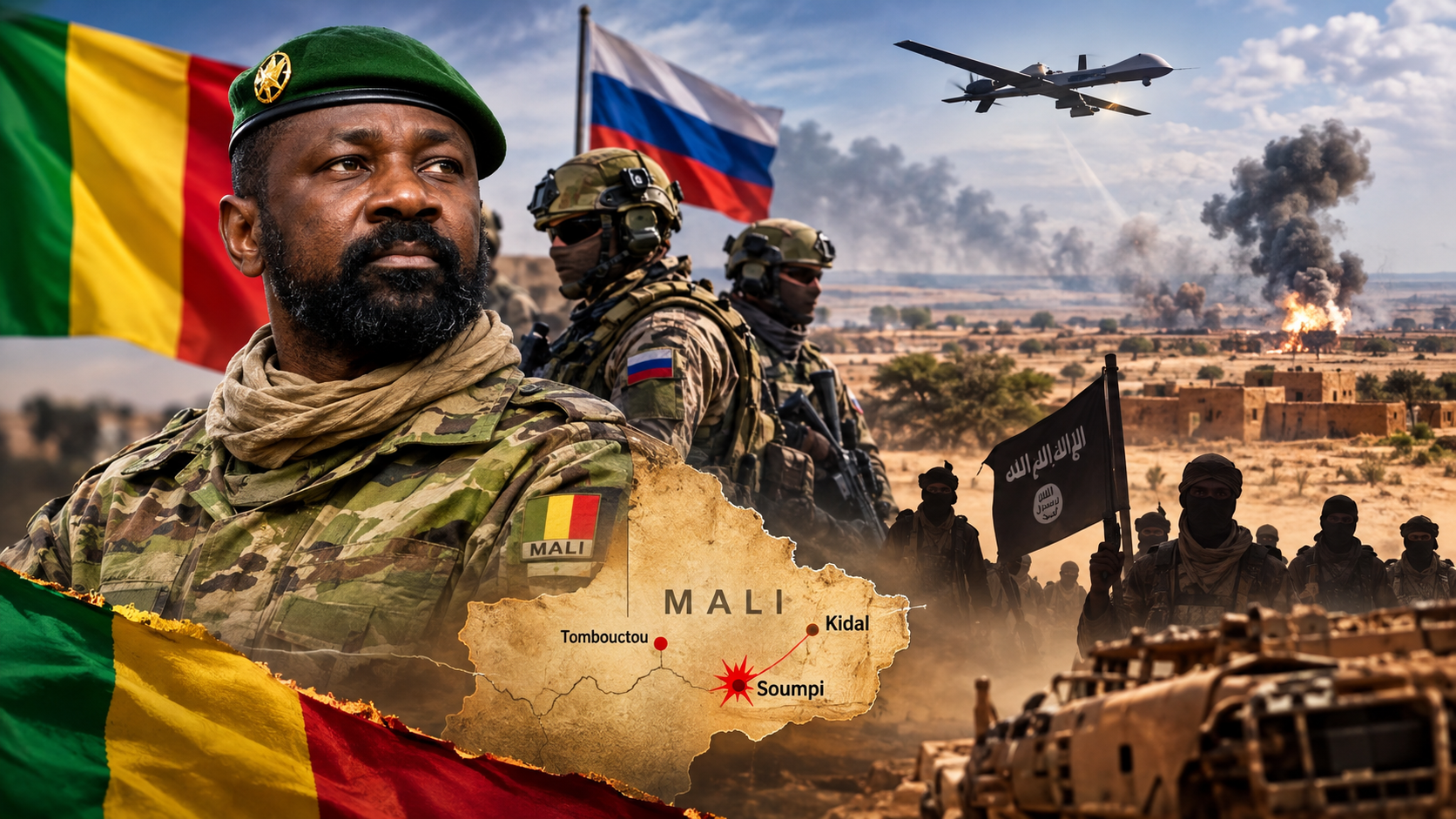
On 10 October 2026, the Azawad Liberation Army (FLA) reportedly launched a drone attack against positions held by Africa Corps and the Malian army at Soumpi, in the Timbuktu region. The episode raises a question that cannot be postponed any longer: after more than four years of unrelenting insecurity, can Mali genuinely expect to restore stability by relying chiefly on its Russian military partners?
A strategic bet that has yet to deliver
Since coming to power, Assimi Goïta has made the reorientation of military partnerships a central pillar of his security doctrine. The withdrawal of French forces and the rapprochement with Russia were presented as proof of a new sovereignty and of an enhanced capacity to defend the national territory. Yet the persistence of attacks and the vulnerability of certain military positions raise doubts about what this orientation has actually produced.
The reported strike at Soumpi is not, on its own, enough to deliver a final verdict on Russian-Malian cooperation. It nevertheless recalls an inescapable reality: the presence of foreign military partners does not by itself guarantee the end of an insurgency or the lasting restoration of security.
Can Russian mercenaries truly end Mali’s crisis?
Assimi Goïta must confront the situation directly: Mali’s problem will not be solved simply by swapping a Western military partner for a Russian one. After more than four years of military rule, the population is entitled to expect lasting results, not merely announcements of operations or isolated victories presented as decisive.
Recent events illustrate how complex the challenge remains. On 6 October 2026, the Malian army, backed by its Russian partners, retook Kidal after the Azawad Liberation Front (FLA) announced its withdrawal. The development represents a symbolic success for Bamako, but analysts consider that it does not by itself constitute a decisive victory in the fight against armed groups.
A few days later, the reported drone attack at Soumpi, in the Timbuktu region, served as a reminder that the situation remains fragile. While the exact circumstances of the operation and its toll have yet to be established, one question persists: how is it that, despite several years of military cooperation with Moscow, positions held by Malian forces and their allies remain exposed to attack?
Cooperation that must not slide into dependency
The partnership with Russia can supply equipment, operational capabilities and support on the ground. But it does not relieve the Malian authorities of the duty to define a coherent national strategy, to strengthen their own forces and to address the root causes of insecurity.
This is precisely where the debate belongs. Has Mali sufficiently reinforced its autonomous military capabilities? Do operations make recaptured localities durably secure? Can populations return to their villages without fearing fresh attacks? Can public services and administration function normally in reconquered areas?
These questions matter far more than rhetoric about sovereignty or rivalries between foreign powers.
When war can also serve those who claim to fight it
The economic interests surrounding this cooperation also deserve a clear-eyed examination. The presence of Russian military companies in Mali forms part of a relationship in which security questions and economic interests may intersect, particularly around natural resources.
It would nevertheless be imprudent to assert, without verifiable evidence, that Russian forces deliberately seek to prolong the war in order to earn more money. Such an accusation requires documented elements on contracts, payments and the interests at stake.
The real issue lies elsewhere: when a country’s security depends heavily on an external partner, it is essential to verify that this partner’s commitments serve the interests of the Malian population first. The transparency of contracts, the cost of the cooperation and the results obtained must all be open to assessment.
A military partnership cannot be considered a success simply because it allows a government to remain in place. Its value must be measured by its capacity to protect civilians, to durably reduce violence and to allow the country to return to normal life.
Assimi Goïta must rethink his strategy
Mali cannot afford to confuse the preservation of power with the restoration of security. Sovereignty does not consist merely of changing partners or displaying a break with former alliances. It also presupposes having the means to defend one’s territory, to protect one’s population and to take decisions without excessive dependence on a foreign power.
The Malian crisis demands a broader strategy: better-prepared national forces, effective intelligence, greater protection for populations, credible governance and a political response to local conflicts. Military means are necessary, but they are not sufficient on their own.
The reported attack at Soumpi should therefore be treated as a fresh warning, not as definitive proof of the failure of Russian cooperation.
Ultimately, Assimi Goïta must grasp one thing: Russia can be a partner of Mali, but it cannot substitute for a Malian strategy capable of producing lasting results. If the authorities continue to measure their success solely by the presence of their foreign allies, they risk missing the essential question: when will Malians finally be able to live in security, without every new attack casting doubt on promises of victory?
The priority must be Mali and its population, not the defence of the interests of any partner whatsoever.