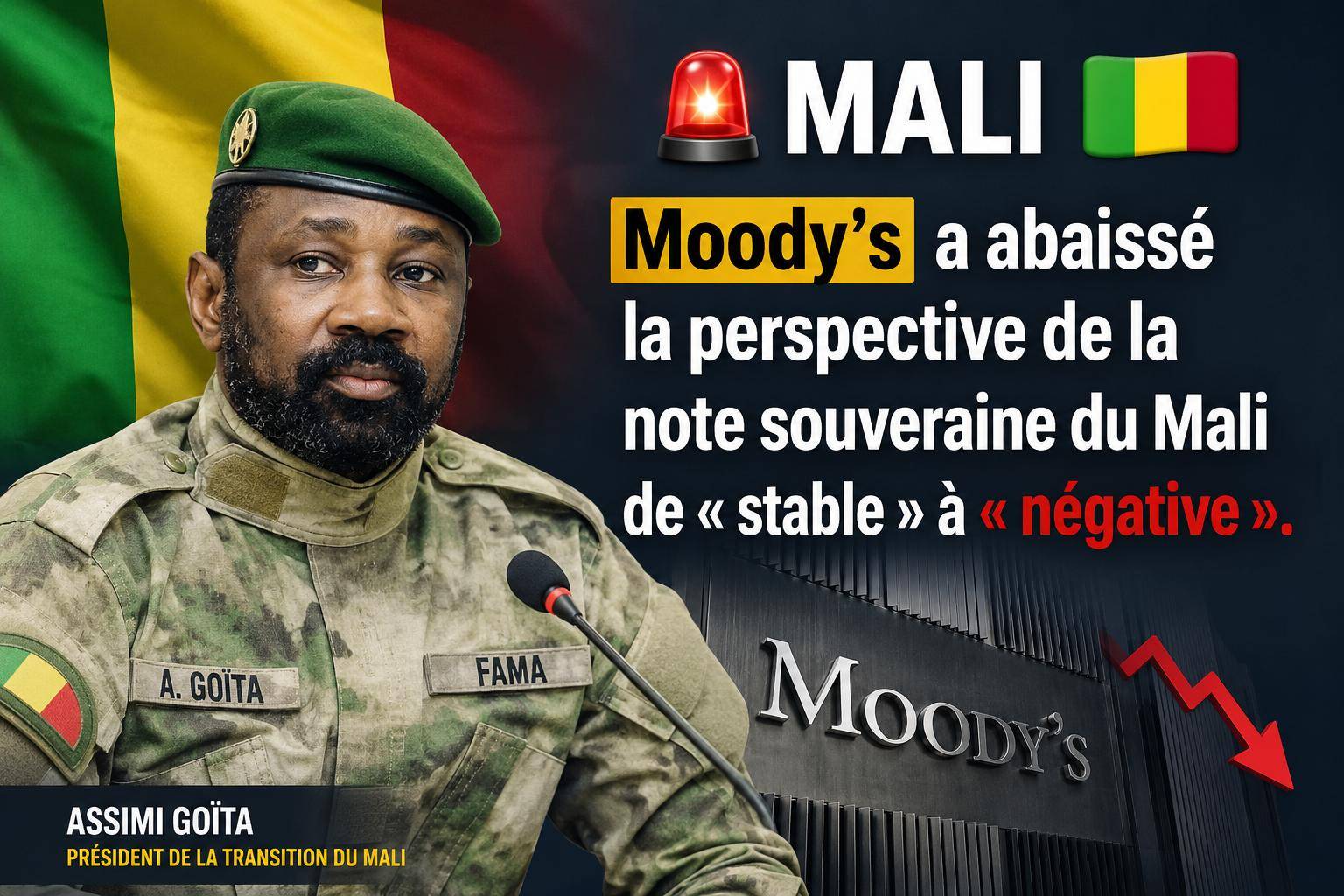
Moody’s downgrades Mali’s sovereign credit outlook as challenges mount
Global credit ratings agency Moody’s has shifted Mali’s sovereign credit outlook from stable to negative, while retaining the Caa2 rating. This adjustment reflects deepening economic vulnerabilities tied to escalating security threats, tightening regional financing conditions, and unresolved political instability. For Mali’s economy, already strained by limited access to capital, this signal further complicates efforts to secure funds for critical development initiatives.
A stark warning for investors and policymakers
The downgrade serves as a market confidence indicator, signaling a higher likelihood of a future credit rating cut. Currently rated Caa2, Mali’s sovereign debt remains classified as a highly speculative investment—an assignment that warns of significant default risks. Moody’s cited three primary concerns: worsening security conditions, strained regional financing, and political uncertainty.
Security crisis continues to stifle economic recovery
Despite ongoing military restructuring and counter-insurgency operations, Mali’s security situation remains precarious. Surge in armed attacks and expanding conflict zones have disrupted supply chains, weakened agricultural output, and eroded the state’s ability to collect tax revenues across multiple regions. These disruptions not only hinder economic activity but also reduce fiscal capacity, limiting funds available for public services and infrastructure.
Regional borrowing costs spike as UEMOA market tightens
Facing restricted access to traditional international financing due to diplomatic shifts and institutional realignments, Mali has increasingly relied on borrowing within the West African Economic and Monetary Union (UEMOA) market. However, this strategy has become costlier. The Central Bank of West African States (BCEAO) raised interest rates to curb inflation, driving up the cost of sovereign debt issuance. Recent bond sales have seen lukewarm investor participation, reflecting growing caution among regional banks about Mali’s creditworthiness. As borrowing costs rise, government spending on infrastructure and essential services comes under strain.
Political transition fuels investor unease
Mali’s prolonged political transition—marked by repeated delays in elections and uncertainty over a return to constitutional order—has further dampened investor confidence. The formation of the Alliance of Sahel States (AES) with Burkina Faso and Niger, and Mali’s withdrawal from the Economic Community of West African States (ECOWAS), has reshaped regional economic alliances. While Malian authorities frame this as a move toward greater sovereignty, global financial markets view it as a source of legal and commercial uncertainty, raising concerns over potential future trade barriers or capital flow restrictions.
Real-world consequences for Mali’s citizens
The Moody’s downgrade is not just a technical adjustment—it has tangible effects on daily life. Higher sovereign borrowing costs mean less public funding for essential services like healthcare, education, and food subsidies. For businesses, particularly small and medium-sized enterprises (SMEs), the impact is immediate. Local banks, heavily exposed to government debt, are tightening credit to the private sector, curbing investment and job creation.
Path forward: balancing security, stability, and fiscal discipline
Despite challenges, Mali’s economy shows pockets of resilience, particularly in gold mining and cotton production. Yet, to reverse the negative outlook, authorities must address structural weaknesses. Restoring security, clarifying the political transition timeline, and implementing prudent fiscal policies are essential to rebuilding investor trust and stabilizing the country’s economic prospects.