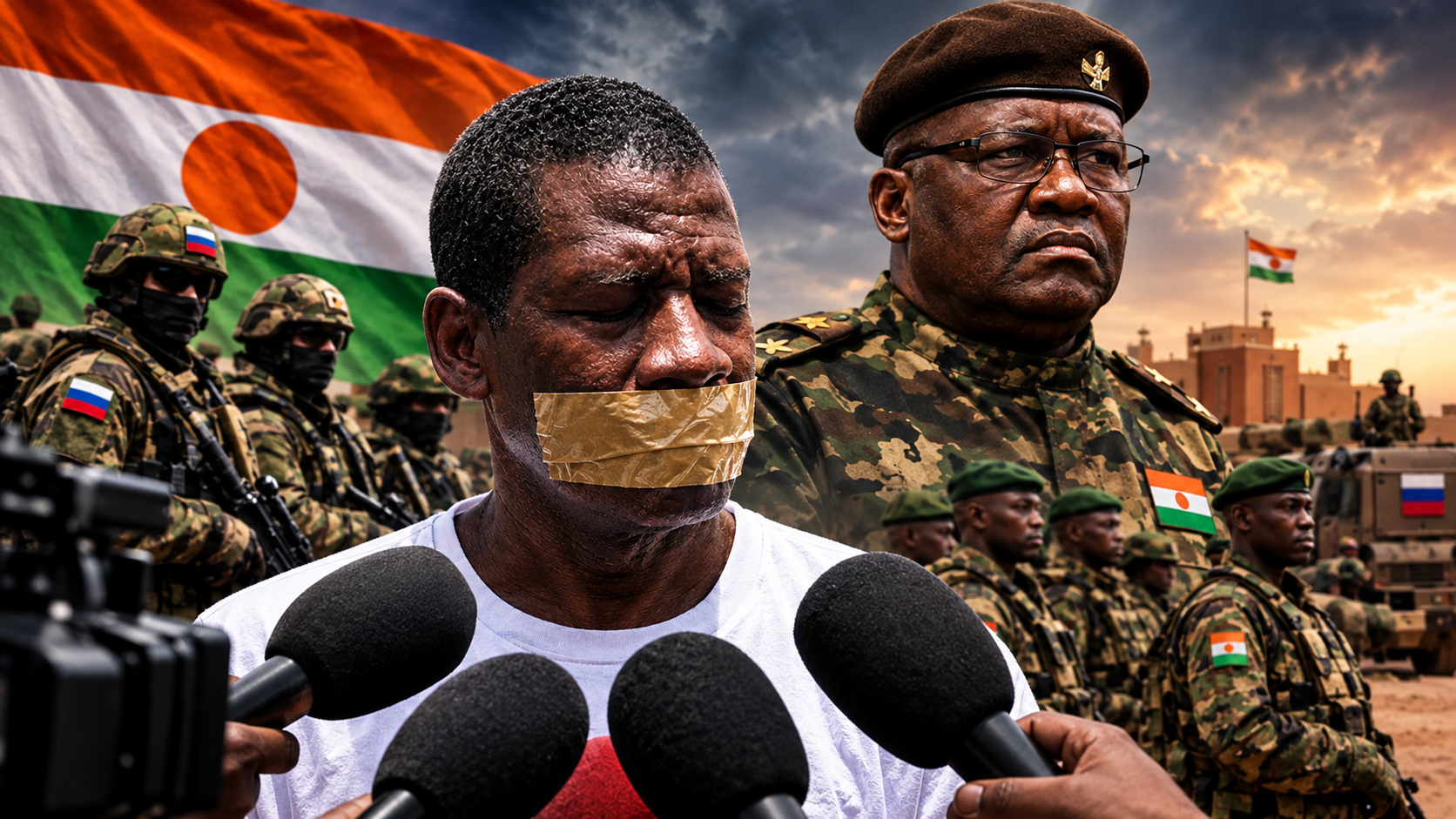
For more than a month, the fate of the Nigerien journalist Moussa Kaka remained shrouded in uncertainty. After he left the premises of Radio Télévision Saraounia in Niamey, no official word emerged about his whereabouts. On 6 October, the Nigerien Minister of Justice confirmed to Reporters Without Borders that Kaka is “alive” and “held by the authorities.” That statement marks a first crack in the official silence, but it also raises a far more troubling question: why has a veteran reporter been detained without charge, and what does the junta’s refusal to explain itself say about its commitment to the sovereignty and transparency it claims to defend?
The confirmation and the void it leaves
The minister’s acknowledgment that Kaka is in custody is significant because it ends weeks of official ambiguity. Yet it resolves almost nothing. The authorities have not disclosed where he is being held, what specific accusations he faces, or the legal basis for his detention. Reporters Without Borders has called on the government to clarify the situation and to either charge Kaka or release him. Until that happens, the confirmation of life without any accompanying legal detail only deepens the unease.
A journalist with a long record
Moussa Kaka is not a marginal figure. He is a seasoned correspondent and the director-general of Radio Télévision Saraounia. His disappearance had already prompted the International Federation of Journalists, the International Federation for Human Rights, and the World Organisation Against Torture to demand a rapid explanation. The fact that such established organisations felt compelled to intervene underscores the gravity of the case.
What information could be so sensitive?
A central question now is what Kaka knew and what he might have been preparing to reveal. Some of the material attributed to him could prove particularly embarrassing for a government that insists the security situation is under control. It is important, however, to separate established facts from speculation. At this stage, nothing publicly confirms that his detention is directly tied to specific disclosures. What is clear is that the official narrative of restored stability clashes with persistent difficulties on the ground.
A security landscape under strain
Nigerien forces continue to face deadly attacks in several parts of the country. The August mutiny in Niamey itself unfolded amid deep tensions within the army, with soldiers voicing grievances about their conditions and the hardships endured by units deployed to the front. Reports have also pointed to equipment shortages among the troops.
Russian forces at the heart of the security apparatus
Another now-documented element is the role Russia has assumed in Niger’s security architecture. Africa Corps, a Russian force operating under the authority of the Russian Ministry of Defence, maintains a presence in the country and played a direct part in the August mutiny in Niamey. According to multiple accounts, its operatives provided support to forces loyal to Tiani’s government. This development has fuelled debate about the priorities of the security apparatus. Analysts argue that Africa Corps also helps protect the regime in power, beyond its participation in operations against armed groups. This does not mean Russian forces have replaced the Nigerien army, but their presence has become a central feature of the country’s security architecture one that, critics contend, serves the safety of Tiani rather than that of all Nigeriens.
Nigerien soldiers are dying daily, victims of a lack of weapons or equipment, while new acquisitions made by Niamey are said to be earmarked exclusively for the Russians tasked with protecting Tiani.
Why the Kaka case matters far beyond one man
The journalist’s situation must be understood against a broader backdrop: continuing armed attacks, losses within the Nigerien forces, internal tensions in the army, and the deepening security partnership with Russia. The core issue remains straightforward: Moussa Kaka is being held because he is believed to possess even more compromising revelations about the Tiani junta.
The official confirmation that he is alive is an essential development. But it does not dispel the shadows surrounding his disappearance. As long as the Nigerien authorities withhold details about the reasons for and conditions of his detention, the questions will remain unanswered. In a country whose leaders claim to be restoring sovereignty, security, and transparency, the Kaka case is a concrete test: whether the government can publicly account for the fate of a journalist who vanished for more than a month.
By AMINA SALEY — Journaliste / Rédacteur