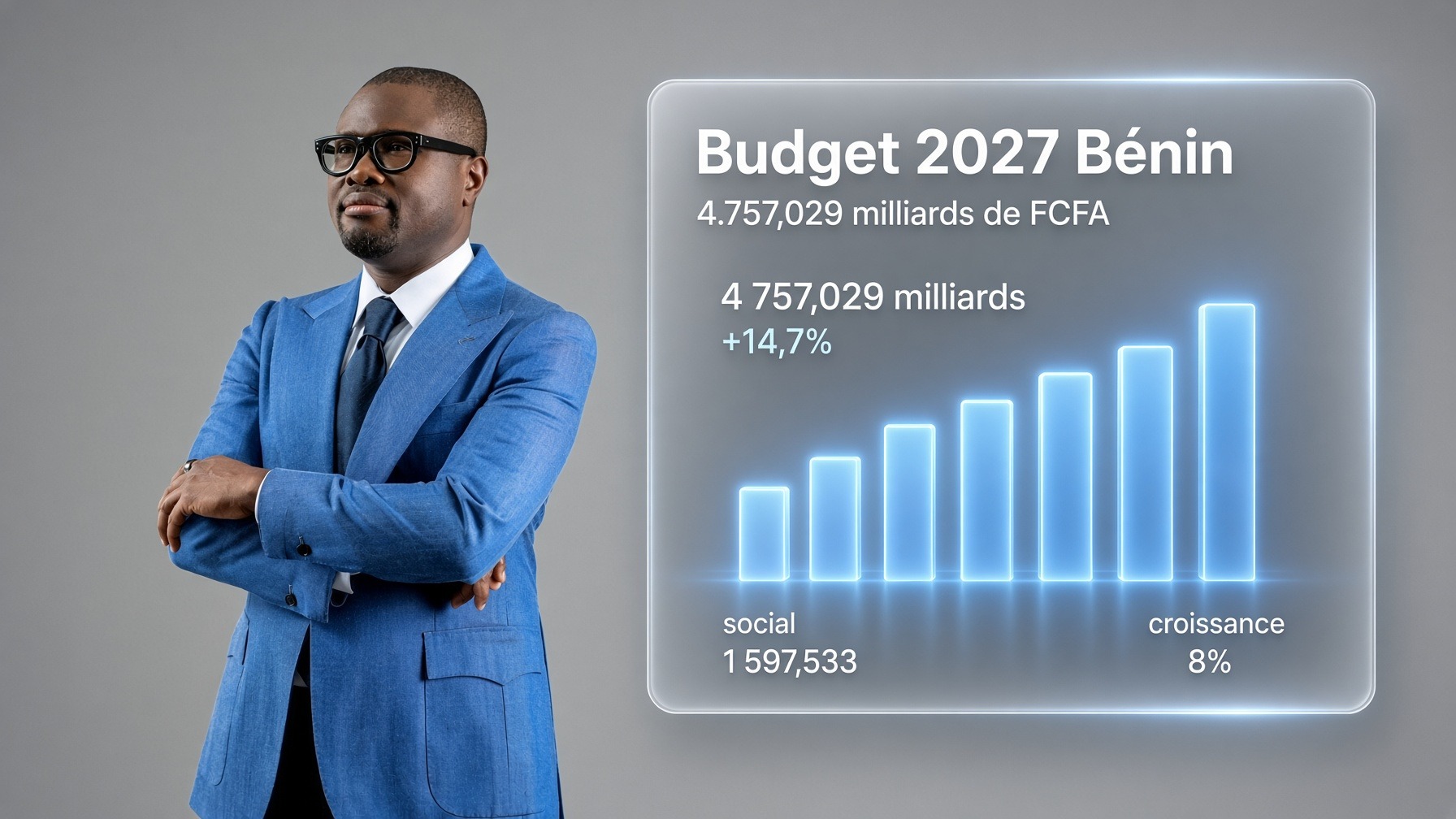
Benin’s government has taken a decisive step in preparing the 2027 fiscal year by sending its draft finance bill to the National Assembly for review and approval. Balanced at 4,757.029 billion FCFA in both resources and spending, the proposal marks a 14.7% increase over the 4,148.357 billion FCFA set in the revised 2026 budget. But the real question is whether this record envelope can turn ambitions into tangible results: a targeted 7.5% growth rate, a deficit capped at 2.8% of GDP, and heavier investment in sectors seen as pivotal for economic and social transformation.
A 14.7% jump that raises expectations
The draft finance law for 2027 represents a substantial expansion of Benin’s budgetary means. At 4,757.029 billion FCFA, resources and charges rise by 608.672 billion FCFA compared with the revised 2026 forecasts.
This increase signals the government’s intention to channel more funding into public investment and social policies while continuing efforts to consolidate macroeconomic stability.
For 2027, the executive projects economic growth of 7.5%. It also plans to keep the overall budget deficit at 2.8% of GDP, in line with the convergence criteria of the West African Economic and Monetary Union (UEMOA).
On prices, the government expects inflation of 2.0%, below the community threshold of 3.0%.
These projections reflect a balancing act: speeding up economic activity, keeping public finances in check, and protecting household purchasing power.
Five levers to accelerate economic transformation
To meet these targets, government action will hinge on five priority levers: modernizing agriculture, strengthening industrial promotion, unlocking tourism and cultural potential, promoting technological innovation, and reinforcing human capital.
Agriculture remains a strategic sector for economic transformation. Through modernization, the government aims to boost productivity, strengthen value chains, and encourage more local processing of production.
Industrial promotion is another pillar. The goal is to increase added value within the country, support business competitiveness, and create jobs.
Tourism and culture are also expected to contribute more to diversifying Benin’s economy. Technological innovation is added to these priorities, seen as a driver for modernizing the economy and improving services.
Finally, strengthening human capital is central to the government’s strategy. Education, health, social protection, and youth employment should continue to receive particular attention.
Public investment at the heart of the budget
In line with strategic orientations, public spending for 2027 will remain focused on investments with high economic and social impact.
Education, living conditions, health and social protection, as well as agriculture, energy, water, digital transformation, industry, and tourism will benefit from sustained financing.
Through these investments, the government aims to build high-quality physical and human capital capable of anchoring the structural transformation of Benin’s economy over the long term.
The objective is also to ensure fairer access to basic social services and remove barriers to youth employment.
Social spending gets a major boost
The social component features prominently in the 2027 draft budget. Socially sensitive spending is set at 1,597.533 billion FCFA, up from 1,285.37 billion FCFA planned for 2026.
This increase is meant to continue and expand several programs designed to reduce household vulnerability and improve living conditions.
The government plans in particular to continue operationalizing and expanding the ARCH program (Assurance for the Reinforcement of Human Capital).
Free tuition for girls in general and technical secondary education will also be continued and generalized, along with other free-of-charge measures.
The school canteen program should continue its path toward universal coverage. This measure aims to improve learning conditions and keep children in school.
Another major project: scaling up and consolidating the GBESSOKE program through cash transfers to households in extreme poverty. These supports are intended to help beneficiaries develop income-generating activities and gradually strengthen their economic autonomy.
The draft budget also provides for a national platform for social benefits and the institutionalization of an emergency social assistance service, conceived as an integrated national mechanism for responding to social emergencies.
Health: five new zone hospitals announced
The health sector is among the top priorities of the 2027 budget.
The government plans to expand the nutrition program to sustainably improve the nutritional status of targeted populations. Child vaccination programs will be intensified, while efforts against malaria and maternal health actions will continue.
On infrastructure, the draft budget includes the construction of five zone hospitals, plus the rehabilitation and equipping of departmental hospitals and university hospital centers.
A system for systematic management of life-threatening emergencies is also to be implemented. The aim is to strengthen the health system’s ability to respond quickly to critical situations and reduce risks linked to treatment delays.
Education: infrastructure, equipment, and jobs
In education, several projects are announced.
The government intends to continue building and rehabilitating high schools while renovating academic and social infrastructure at national universities.
Distance learning will continue to expand, and schools will benefit from the ongoing program to supply desks and other essential furniture.
The scholarship system should also be overhauled to better reflect priority fields and labor market needs.
On teacher employment, the government plans gradual recruitment by qualification of aspiring teachers, according to set procedures.
The reform of automatic career advancement for state employees must also enter its implementation phase. This change should affect career management in public administration.
Communes urged to mobilize more resources
The 2027 draft budget also gives significant weight to financing local authorities.
The government plans to strengthen this mechanism through the operationalization of the Communal Investment Fund (FIC) and the economic territorial division mechanism.
The goal is to enable communes to mobilize more resources and access diversified financing beyond state grants alone.
This system should also promote structuring projects with greater predictability, transparency, and resource equalization.
It fits within reforms on decentralization and territorialization of the public investment program.
A growth-focused budget that doesn’t neglect social needs
With an envelope of 4,757.029 billion FCFA, the 2027 finance bill places Benin at a new stage in its economic and social trajectory.
The 14.7% budget increase, combined with higher socially sensitive spending, reflects a desire to speed up investments while strengthening protection mechanisms for vulnerable populations.
But beyond the figures, the real challenge will be the ability to turn these resources into tangible results: more jobs, better infrastructure, fairer access to health and education, more productive agriculture, a more competitive industry, and a lasting reduction in extreme poverty.
The government is thus betting on 7.5% growth within a framework of controlled deficit and inflation. The transmission of the finance bill to the National Assembly now opens the way for parliamentary scrutiny and debate on the priorities chosen for Benin’s development in 2027.