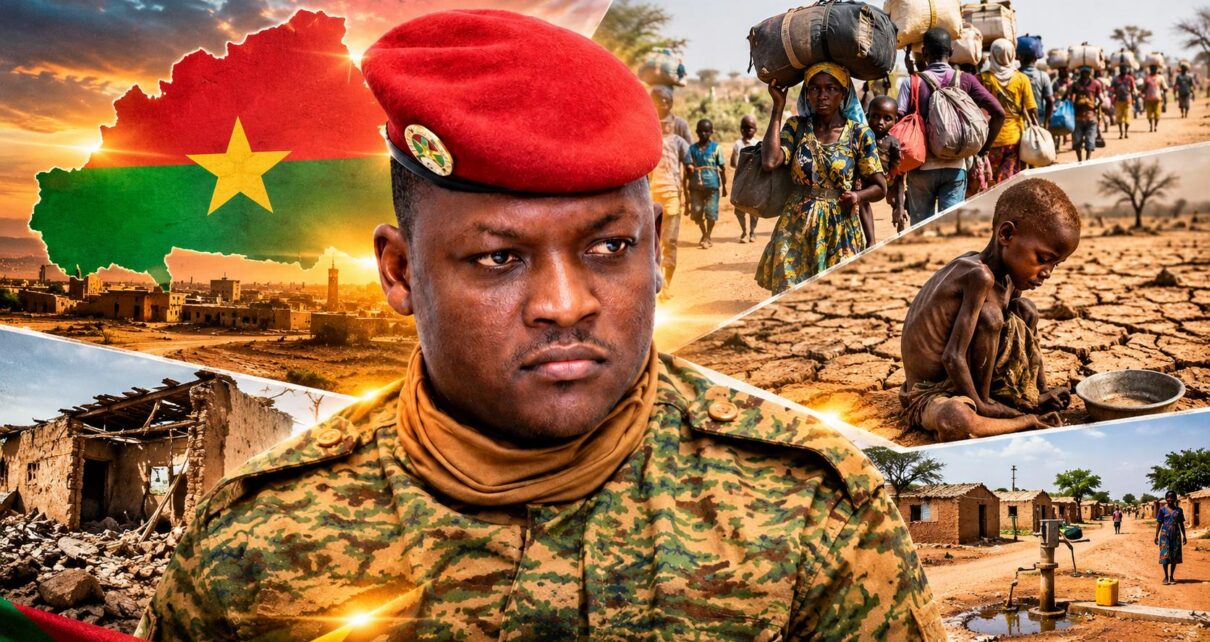
When Captain Ibrahim Traoré seized power in Burkina Faso on 30 September 2022 by toppling Lieutenant-Colonel Paul-Henri Sandaogo Damiba, he promised a radical break with the past. Four years on, the junta leader points to territorial reconquest, a strengthened army, asserted national sovereignty and a rupture with several Western partners. Yet the consequences for ordinary Burkinabè tell a more complex story — one of persistent violence, mass displacement and shrinking civic space that continues to shape daily life across the country.
An unending war and its toll on communities
From his first days in office, Traoré made the fight against jihadist groups his defining mission. His government poured resources into the armed forces and expanded the Volunteers for the Defence of the Homeland (VDP), civilian auxiliaries tasked with backing up the military.
Officials insist that several zones once controlled or threatened by armed groups have been retaken. The junta also highlights growing military capacity and popular mobilisation as pillars of its security strategy.
But four years into his rule, the violence has not faded. Armed groups continue to strike security forces and civilians alike. Data from ACLED shows that jihadist factions retain significant operational reach in Burkina Faso, with attacks on civilians remaining a central feature of the conflict.
The result is a paradox: the state claims greater territorial control, yet insecurity remains an everyday reality in many regions — a discrepancy that directly affects farmers, traders and families unable to return to their land.
More than two million displaced — and the economic strain that follows
Perhaps the heaviest consequence of the conflict is the displacement of civilians. According to UNHCR figures, more than two million people were internally displaced inside Burkina Faso by the end of 2025, in addition to refugees and asylum seekers. The agency’s October–December 2025 tally put the number of IDPs at over 2.06 million.
These movements are not solely the result of jihadist attacks. Human Rights Watch has also documented violence by government forces and VDP fighters against civilians accused of supporting armed groups. The organisation says it recorded attacks that killed at least 1,800 civilians between 2023 and 2025, while stressing that abuses are committed by multiple parties to the conflict.
The displacement crisis captures a fundamental flaw in the security record: retaking territory does not automatically mean lasting safety for the people who live there. For local economies, the loss of farmland, livestock and market access has been devastating.
Press freedom under attack
Another sharp break during Traoré’s four years concerns media freedom. The authorities justify certain measures by citing the war effort and the need to protect troop and public morale. But press advocacy groups describe a dramatic narrowing of the media landscape.
Reporters Without Borders (RSF) says several journalists have been arrested, abducted or conscripted into the armed forces. In 2025 alone, the organisation counted multiple journalists subjected to forced enlistment and eight questioned by security services in October.
The case of Atiana Serge Oulon, publication director of the newspaper L’Événement, has become emblematic. Abducted in June 2024, he was presented by authorities as having been requisitioned to serve in the army. A 2026 RSF investigation, however, claims he was secretly held in Ouagadougou rather than sent to the front as the official version suggested.
Forced enlistment: a new tool of repression?
The issue of forced conscription extends far beyond journalists. Human Rights Watch reports that dozens of government critics were requisitioned and sent to combat zones. The organisation believes the practice has targeted journalists, civil society activists, opponents and magistrates.
The phenomenon is particularly sensitive because it blurs the line between national mobilisation and political punishment. In wartime, the state has legal mechanisms for defence-related mobilisation. But human rights groups stress that such procedures must respect legal safeguards and allow those concerned to challenge their assignment.
For the business community and civil society, the effect is a climate of fear that discourages investment, independent journalism and public debate.
A sovereignty agenda with a domestic price
Traoré defends a vision rooted in sovereignty and a break from old dependencies. Burkina Faso has distanced itself from France, deepened ties with Russia and moved closer to Mali and Niger within the Alliance of Sahel States. The government also promotes policies for local processing of resources, particularly in mining.
But this assertion of sovereignty has come with a shrinking political and civic space. Journalists, activists, opponents and human rights defenders have been arrested, detained or forced into exile, according to multiple organisations.
Four years on: an open-ended assessment
Four years after the September 2022 coup, Traoré’s record defies a single narrative. His government can point to the militarisation of the fight against armed groups, the mobilisation of the VDP, a push for greater strategic autonomy and some economic gains.
Yet the displacement figures, the persistence of attacks and allegations of abuses against civilians show that the security crisis remains deep. Meanwhile, the arrests of journalists, disappearances and forced enlistments documented by international organisations raise the question of the price paid in the name of war.
In Burkina Faso, after four years of military rule, the challenge is twofold: reconquering territory, but also ensuring that reconquest does not come at the expense of rights and the protection of the population.