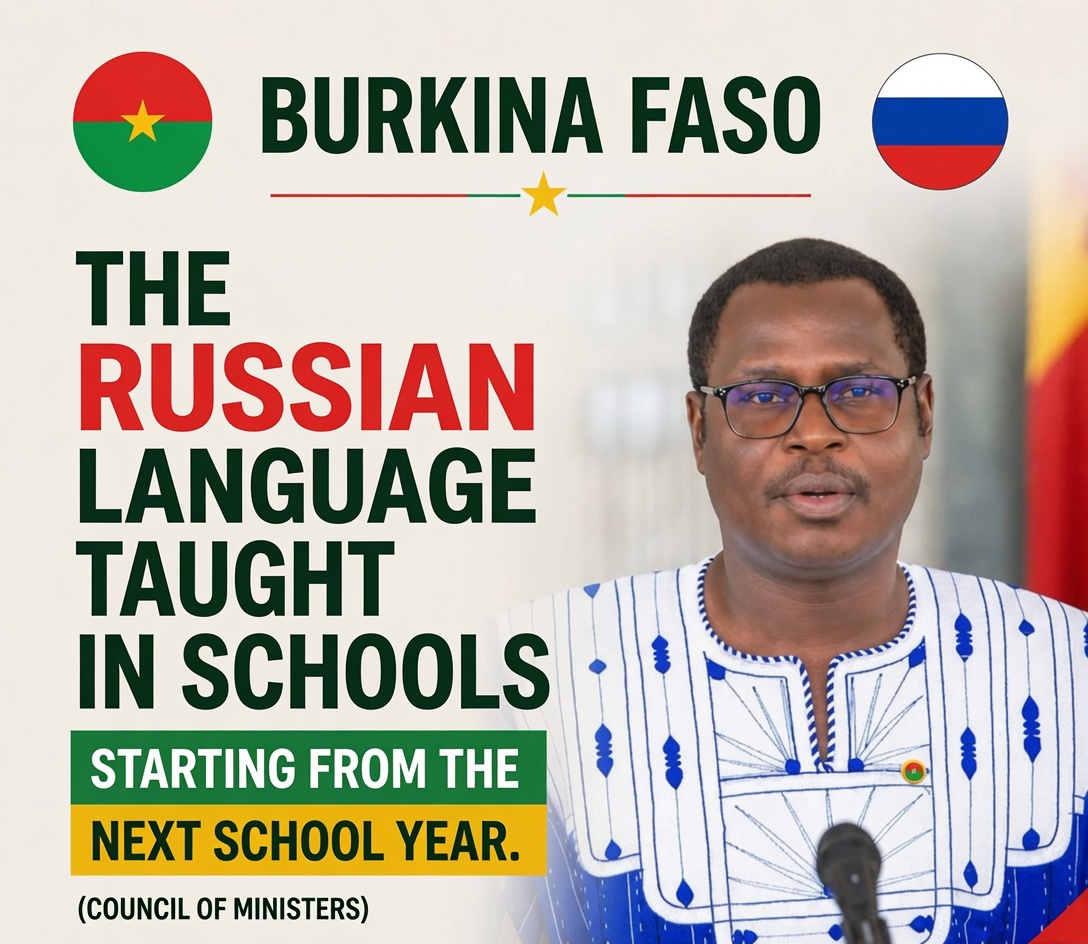
The Burkinabè transitional government has taken a decisive step in reshaping the nation’s strategic partnerships by approving a decree that mandates the inclusion of Russian language instruction in the national school curriculum starting next academic year. While authorities frame this move as a progressive cultural and economic initiative, it has ignited a heated debate over the true motivations behind the decision.
a strategic pivot or a hidden dependency?
Proponents of the policy argue that in an increasingly multipolar world, equipping the younger generation with linguistic skills aligned with key global players like Russia could unlock new opportunities in trade, technology, and academia. Given Moscow’s growing role as a military and security partner, officials contend that integrating Russian into education merely formalizes a partnership deemed essential for combating the terrorist insurgency plaguing the country.
However, critics warn that this educational reform may be the thin end of a wedge—a carefully crafted strategy to deepen foreign influence under the guise of cooperation. As Burkina Faso seeks to break free from the remnants of French colonial control and Western paternalism, the rapid expansion of Russian involvement raises concerns about replacing one form of dependency with another. True sovereignty, they argue, should not be about swapping one tutor for another.
the soft power play: from classrooms to cultural allegiance
Historical precedents suggest that language policies imposed by political decree rarely serve purely pedagogical purposes. Instead, they often serve as instruments of soft power, subtly shaping the intellectual and ideological landscape of a nation. By embedding the Russian language and culture into Burkina Faso’s education system, Moscow may be cultivating a future generation of local leaders who are not only fluent in Russian but also receptive to its narratives, media, and long-term strategic interests.
This tactic mirrors the tactics employed during the Cold War, when the Soviet Union imposed Russian as the dominant language in schools across its Eastern Bloc allies. The goal was not merely linguistic uniformity but the standardization of thought, ensuring ideological alignment with Moscow’s objectives. Observers caution that Burkina Faso’s adoption of this model could signal the beginning of a similar process in West Africa.
reciprocity absent: a one-sided partnership
A balanced educational collaboration would require mutual exchange, with both parties investing equally in language and cultural programs. Yet Burkina Faso’s current situation paints a starkly asymmetrical picture. The country, grappling with severe security threats, relies heavily on Russian military and logistical support to stabilize its territory. Introducing Russian as a core subject in this context may appear less like an autonomous strategic choice and more like a political concession to a powerful ally—one that could further entrench its influence.
Moreover, the move diverts limited resources toward a foreign language at the expense of local languages, which struggle for recognition and funding within the educational framework. While Burkina Faso boasts a rich tapestry of indigenous languages that reflect its cultural identity, prioritizing an external language risks diluting national heritage rather than enriching it.
the specter of modern colonialism
By allowing Russia to extend its reach from military bases to classrooms, Burkina Faso faces the prospect of a more insidious form of colonization—one that is less overt but equally restrictive. The decision to embed Russian language education within the national curriculum may inadvertently pave the way for deeper political, economic, and cultural subordination. As the nation stands at this geopolitical crossroads, its future hinges on the collective discernment of its citizens. Will this bold step toward independence ultimately lead to a new form of subjugation, or can it be navigated with the wisdom required to preserve true sovereignty?