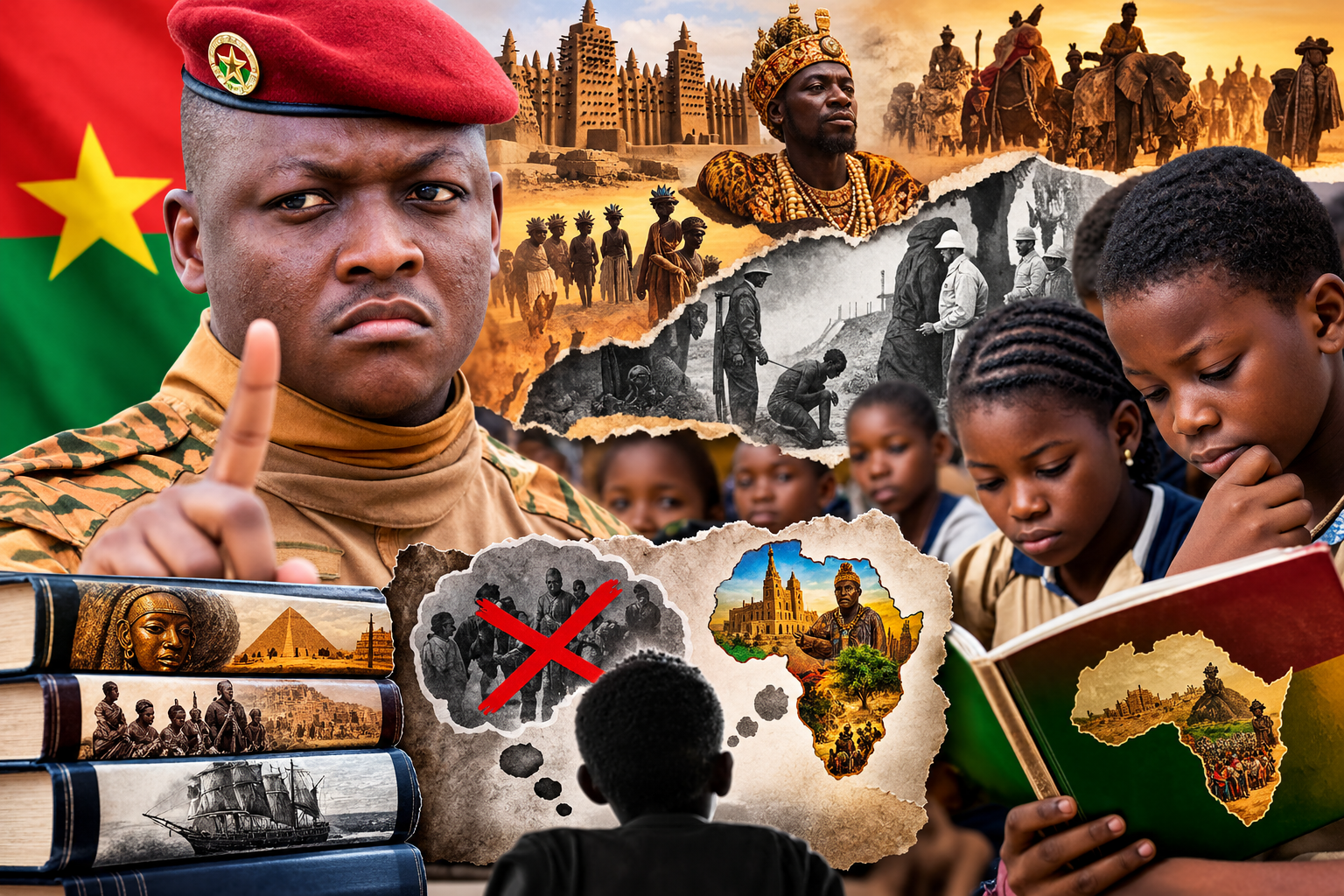
Burkina Faso is undertaking a sweeping overhaul of its geography and history curricula, aiming to ‘decolonize’ school textbooks. While this effort raises legitimate questions about the inclusion of African narratives in education, it also forces a critical reflection: rewriting syllabi must not result in confining future generations to a one-sided interpretation of their own past.
Beyond colonial wounds: why history requires more than a single narrative
History is not merely a sequence of conquests, exploitative systems, or conflicts between Africa and the West. It also encompasses the rise and fall of empires, vibrant trade networks, scientific discoveries, cultural exchanges, and profound social transformations. To present this complexity to students demands intellectual honesty a commitment to acknowledging historical injustices without reducing an entire people’s heritage to suffering alone.
If the reform is framed primarily as a corrective tool to address colonial wrongs by erasing or obscuring parts of the past, Burkina Faso may be pursuing the wrong objective. A balanced curriculum can indeed restore visibility to suppressed African resistances, highlight long-overlooked leaders, and expose the structural violence of colonization. However, textbooks alone cannot rewrite history or retroactively heal generations of trauma.
The danger of ideological curricula: when ‘correction’ creates new limitations
There is a fundamental risk that a decolonization-centered reform intended to liberate young minds could inadvertently construct a new ideological cage. By filtering history through a single lens, students may inherit a narrative that emphasizes grievance without fostering understanding. This approach risks replacing one form of exclusion with another, leaving learners ill-equipped to navigate the richness and contradictions of global history.
The stakes are high. A generation taught through a restricted curriculum may gain awareness of certain injustices but lack the analytical tools to situate those events within broader contexts such as Africa’s pre-colonial achievements, internal societal dynamics, or the interplay of global forces. True historical literacy requires more than moral positioning; it demands context, nuance, and the capacity to distinguish between causation and consequence.
Learning from Africa’s diverse educational models
Examining curricula from neighboring countries reveals that balanced history education integrates multiple perspectives without prioritizing one above the others. Such models highlight:
National narratives: the rise and governance of ancient kingdoms, regional states, and pre-colonial institutions
Africa’s global role: contributions to mathematics, astronomy, medicine, philosophy, and governance
Colonial realities: mechanisms of occupation, extraction, and resistance, including figures like Samori Touré, Rani Lakshmibai, or Béhanzin
Post-colonial transformations: state formation, economic policies, and sociopolitical shifts across the continent and the diaspora
Global exchanges: African contributions to world history, from classical antiquity to modern movements for justice and equality
These elements are not mutually exclusive. Understanding Burkina Faso’s present requires knowing its place within the trans-Saharan trade routes, the legacy of the Mossi kingdoms, and the impact of French colonial administration but also the role of African intermediaries, regional alliances, and intellectual movements that shaped resistance and adaptation.
Education must enlighten, not indoctrinate
The ultimate purpose of history education is not to cultivate resentment or pride, but to cultivate critical thinking. Students must be able to analyze:
Root causes: How did colonial systems function economically, politically, and culturally?
Human agency: Who resisted, collaborated, or adapted and why?
Systemic legacies: How do colonial structures influence governance, education, land tenure, and identity today?
Pathways forward: What lessons can be drawn to build fairer, more inclusive societies?
A curriculum that omits complexity whether in glorifying the past or demonizing it fails in its educational mission. It produces citizens who can recite slogans more fluently than they can analyze change.
The heart of the challenge: what memory do we leave to the next generation?
At its core, this debate is not about textbooks. It is about what kind of citizens Burkina Faso wants to form. Do we want a generation that perceives history as a sequence of oppressions and oppressors? Or do we want young people who can critically engage with the past, recognize both achievement and failure, and draw informed conclusions about justice, governance, and human dignity?
History cannot be repaired by concealing pages from young minds. It can only be redeemed by giving them the full text with all its ambiguities, contradictions, and lessons. Only then can education become a tool for liberation, not a weapon of ideological control.
That is the question Burkina Faso must answer not just in its classrooms, but in its national vision.
By AMINA SALEY — Journalist