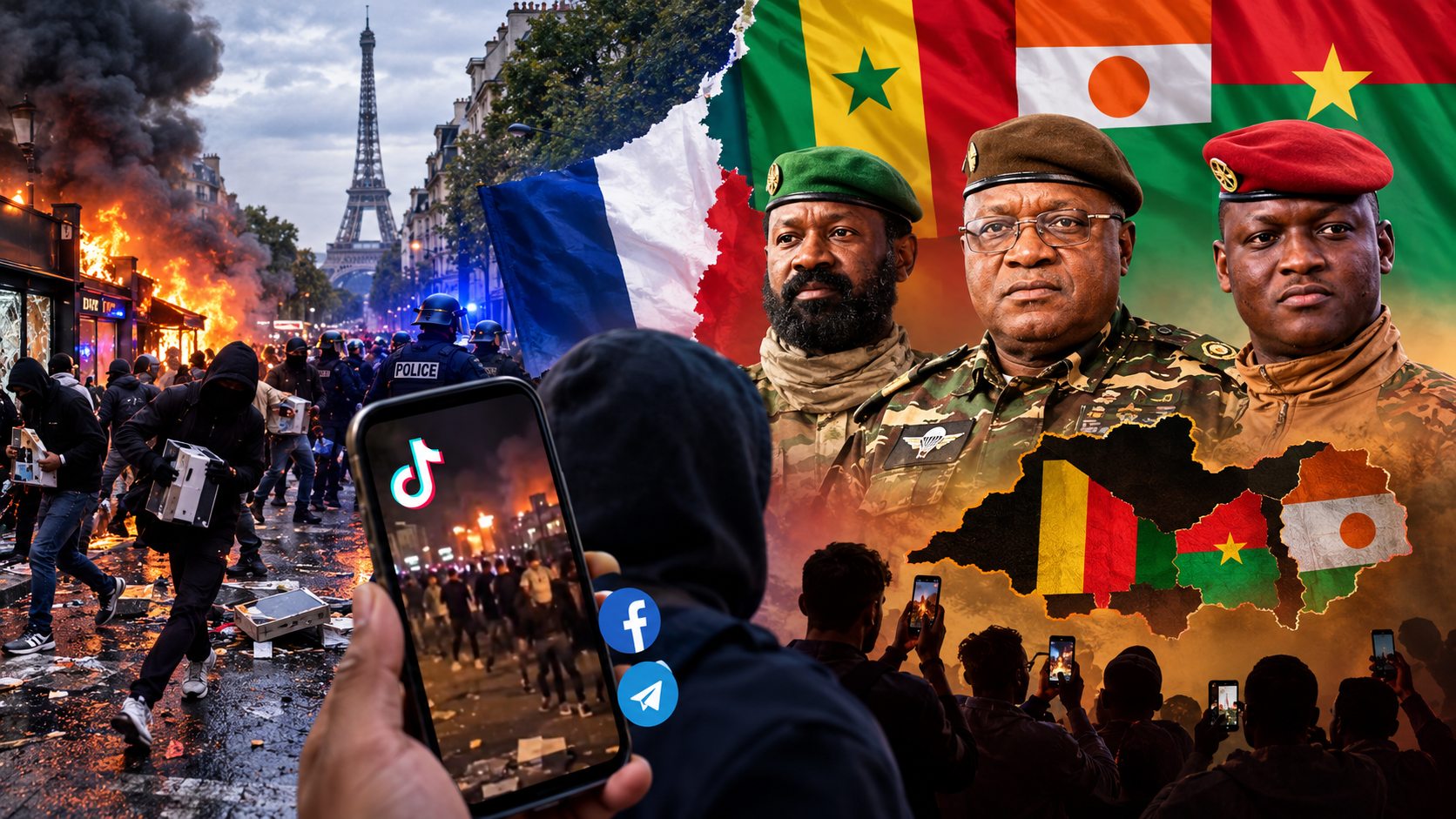
As unrest unfolds in major French cities, the repercussions extend far beyond European borders. In Mali, Burkina Faso, and Niger where relations with Paris have deteriorated under military rule the scenes of arson, looting, and clashes with law enforcement are being weaponized in a coordinated narrative against France. Social media platforms such as TikTok, Facebook, and Telegram have become battlegrounds where these images are repurposed to fuel anti-French sentiment, particularly among supporters of the Alliance of Sahel States (AES).
How political narratives are shaped by urban violence
The strategy is clear: to undermine France’s moral authority by highlighting its own domestic instability. Proponents of the AES argue that if Paris cannot maintain order within its own borders, how can it justify criticizing the governance and security policies of Sahelian governments? This line of reasoning seeks to erode trust in French leadership while positioning military regimes as viable alternatives, despite their own contested legitimacy.
The manipulation of these events is not merely opportunistic it reflects a deliberate effort to reframe global perceptions. By amplifying images of chaos, certain online communities aim to portray France as a failing state, thereby justifying their rejection of Western influence in the Sahel. Yet, this narrative hinges on selective storytelling, where isolated incidents are presented as systemic failures, while the complexities of French society are reduced to simplistic tropes of decline.
Legal accountability beyond political posturing
Amid the propaganda, a critical question remains unanswered: what happens when foreign nationals are implicated in these acts of violence? Reports indicate that individuals from AES member states some of whom may be in France without legal authorization have been identified in connection with looting and property destruction. If investigations confirm their involvement, they will face the same judicial scrutiny as any other individual accused of criminal activity on French soil.
For those found guilty, nationality offers no protection. The French justice system operates independently of political narratives, ensuring that legal consequences are determined by evidence, not rhetoric. Even individuals in irregular administrative situations will be subject to the full extent of the law, provided their actions meet the criteria for prosecution. This principle reinforces a fundamental truth: the rule of law applies universally, regardless of origin.
Procedural fairness in judicial proceedings
Investigations into these incidents will follow established legal protocols. Authorities will gather evidence, identify perpetrators, and determine individual culpability. For foreign nationals, additional considerations may arise regarding residency status, but these do not preclude criminal liability. The priority remains the establishment of facts, ensuring that justice is served without prejudice.
A double standard in international criticism?
The irony of this situation lies in the selective outrage of certain political actors. While they condemn external scrutiny of their own governments, they simultaneously exploit France’s domestic challenges to advance their agendas. This inconsistency reveals a broader pattern: the use of double standards to justify political narratives rather than uphold universal principles of justice and accountability.
It is essential to distinguish between legitimate criticism of governance and the instrumentalization of isolated events for propaganda purposes. The latter does not strengthen any political argument; instead, it exposes the fragility of the narratives being promoted. A single video of disorder does not equate to systemic failure, nor does it validate the claims of alternative governance models.
Separating fact from fiction in digital propaganda
Digital spaces have become fertile ground for disinformation, where authentic footage is often misrepresented to fit predetermined agendas. Misleading captions, recycled content, and exaggerated claims are common tactics used to amplify specific narratives. To assess whether a coordinated campaign is underway, it is necessary to examine the sources, verify timelines, and identify patterns of dissemination.
While some analyses suggest that certain accounts may be amplifying these narratives, definitive proof of a centralized operation remains elusive. Without concrete evidence linking actors to a unified strategy, such claims risk oversimplifying a complex information landscape. Responsible reporting demands rigor, ensuring that conclusions are drawn from verifiable data rather than assumptions.
The limits of collective blame
In the midst of this geopolitical chess game, it is crucial to avoid conflating the actions of a few with the broader communities they represent. The vast majority of Malian, Burkinabè, and Nigerien residents in France live law-abiding lives, contributing to society in meaningful ways. Nationality alone cannot serve as a proxy for guilt or political affiliation.
When legal responsibility is established, it must be addressed individually, without casting aspersions on entire diaspora populations. This approach preserves the integrity of justice while preventing the exploitation of ethnic or national identity for political ends.
What the rule of law demands
France’s response to these events will be measured not by the volume of online discourse, but by the actions of its judicial institutions. As investigations proceed, the outcomes will either reinforce the credibility of its legal system or fuel further accusations of hypocrisy. The challenge for French authorities lies in navigating this delicate balance upholding justice while resisting the temptation to politicize legal proceedings.
The coming weeks will reveal whether these incidents are treated as isolated criminal acts or as tools in a larger information war. One thing, however, is certain: the integrity of France’s institutions will be judged not by the narratives of its detractors, but by the fairness and transparency of its legal processes.
By AMINA SALEY — Journalist