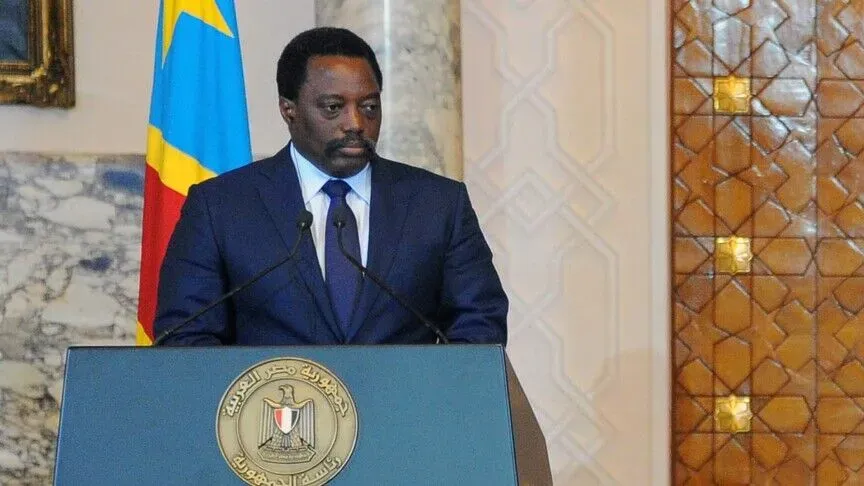
The Democratic Republic of the Congo stands at a pivotal crossroads as former President Joseph Kabila steps into the spotlight, not as a statesman, but as the leader of a newly forged politico-military alliance.
The Front for the Refoundation of the Nation (FRN), unveiled in Goma on October 12, brings together dissident factions including the Alliance of the Congo River (AFC) and the March 23 Movement (M23). Together, they declare war—not just politically, but militarily—against the administration of President Felix Tshisekedi. In a bold statement from Claude Ibalanky, FRN advisor, the coalition vows to dismantle what it calls the ‘tyranny’ of Kinshasa, by any means necessary, including armed struggle.
The FRN’s leadership is a strategic powerhouse. Kabila, who governed from 2001 to 2019, now chairs the alliance, flanked by Corneille Nangaa, former electoral commission chair and AFC leader, and Bertrand Bisimwa, M23’s political chief, as vice-presidents. Overseeing military operations is General Sultani Makenga, commander of the M23’s armed wing, now at the helm of the group’s revolutionary army. Freddy Rukema Kaniki fills the role of secretary-general, rounding out a leadership team steeped in both political and military experience.
From rival factions to united front: how the FRN reshapes Congo’s opposition
The birth of the FRN is more than symbolic—it signals the dissolution of the AFC and the integration of its resources into the new structure. While the M23’s institutional future within the coalition is yet to be clarified, its fighters and political cadre have officially joined ranks. The FRN’s founding declaration outlines a shared mission: to challenge the legitimacy of the 2023 election results, halt what they describe as systemic institutional decay, and expose widespread corruption and discrimination under the current government.
Yet, the alliance’s formation raises pressing questions. How will the FRN coordinate between political and military wings? What guarantees exist that internal divisions won’t resurface under the strain of conflict? And crucially—what vision do these leaders offer beyond resistance?
Speaking to local communities in North Kivu, FRN representatives claim strong grassroots support, particularly among youth and former security personnel disillusioned with Kinshasa’s governance. However, skepticism lingers. After years of fractured rebellion and shifting alliances, Can this coalition actually deliver change—or will it deepen the cycle of violence?
Under fire: accusations, trials, and the shadow of Rwanda
The FRN’s rise comes amid escalating violence in eastern DRC, where the M23 and allied militias have seized control of key cities including Goma. International monitors and Western governments continue to allege Rwandan support for the M23, a charge Kigali firmly denies. The FRN’s declaration accuses Kinshasa of violating ceasefire agreements and failing to release political prisoners—claims echoed by observers and humanitarian groups.
Kabila’s own role remains controversial. Though he long denied ties to the M23, Congolese authorities have accused him of backing the rebellion for years. In 2025, a military court sentenced him to death in absentia for treason, war crimes, and rebellion. Kabila dismisses the verdict as politically motivated, calling it an attempt to silence dissent before the 2023 elections.
The timing of the FRN’s launch is critical. Diplomatic efforts, including talks in Doha, have so far failed to de-escalate tensions. With Kinshasa under pressure and regional mediation stalled, the FRN’s emergence could either reignite conflict or force a new reckoning on the table.
What comes next for the FRN—and Congo?
Amidst swirling rumors and unanswered questions, one thing is clear: Joseph Kabila is no longer on the sidelines. His leadership of the FRN thrusts him back to the heart of Congolese politics, this time at the head of a movement that openly embraces armed struggle.
The FRN has pledged to intensify resistance, but its path remains unclear. Will it negotiate from a position of strength? Can it unify diverse factions—former rebels, opposition politicians, and civilian dissidents—under a single banner? And most importantly, what does this mean for the millions of Congolese caught in the crossfire?
The stakes have never been higher. As the FRN consolidates its command and the government scrambles to respond, one question looms over the nation: Is this the beginning of a new chapter in Congo’s long struggle—or the spark that ignites an even deadlier fire?