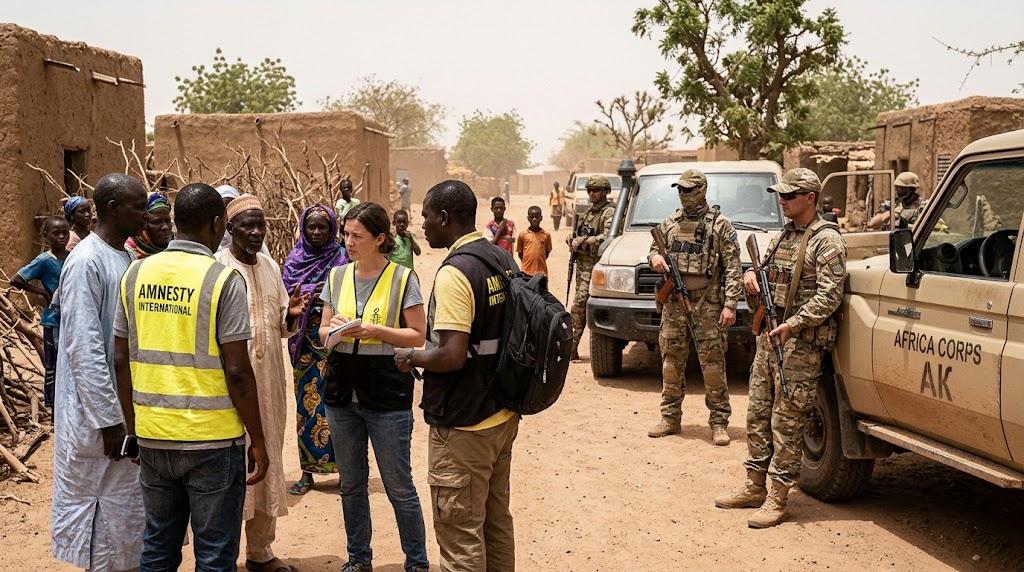
As Mali grapples with persistent insecurity, the shift from Wagner to Africa Corps was supposed to mark a turning point. Yet, a fresh investigation reveals troubling patterns that challenge this transition’s impact. How significant is this change for civilian protection in regions like Ségou, Mopti, and Tombouctou?
From Wagner to Africa Corps: Has the transition improved civilian safety?
Reports indicate that the replacement of Wagner by Africa Corps in Mali has not led to the expected reduction in human rights violations. Murders, disappearances, and torture remain a persistent concern, with legal accountability still elusive for those responsible. The transition appears to have done little to disrupt entrenched patterns of abuse in an environment where judicial oversight remains weak.
Civilian casualties raise serious questions on military operations
Between June 2023 and December 2025, at least 34 civilians were killed during military operations along the Mali-Mauritania border. Survivors describe executions after arrests, throat-cutting, and burning of victims—acts that could constitute war crimes if confirmed. Reports also highlight drone strikes that killed civilians in markets and residential areas, with no apparent military targets nearby.
Key incidents:
- A drone strike on a market in Ejdeir (March 2025) claimed 16 lives.
- A strike on a home in Tangata (November 2025) resulted in seven deaths.
- Witnesses cite arrests followed by extrajudicial killings, often under unclear circumstances.
International humanitarian law demands clear distinctions between combatants and civilians. The documented abuses suggest a failure to uphold this principle.
Torture and arbitrary detentions: A dark pattern resurfaces
Detainees in locations such as Léré and Nampala report systematic torture, including:
- Suspensions by the arms and legs.
- Simulated drowning, electrocutions, and severe beatings with batons and rifle butts.
- Sexual violence in detention.
At least five deaths are attributed to torture or inhumane detention conditions. Many detainees remain cut off from legal counsel or family contact, with no clear path to justice. Shockingly, some of these abuses allegedly involved Wagner personnel operating alongside Malian forces, raising questions about joint accountability.
Why are Peul, Arab, and Tuareg communities particularly at risk?
Certain ethnic groups face disproportionate targeting due to suspicions of collaboration with armed factions like the Group for the Support of Islam and Muslims (GSIM). Reports document:
- Looting of livestock, money, and property.
- Destruction of homes and agricultural assets.
- Widespread displacement and disrupted livelihoods.
Collective reprisals and community-based violence violate international norms, regardless of the security context.
Can Africa Corps uphold human rights amid Mali’s instability?
Africa Corps, reportedly under direct Russian oversight, began deployment in January 2025 and officially took over from Wagner in June. Yet, new allegations in July 2026 in the Peul neighborhood of Bombori expose ongoing concerns:
- Around 80 men were gathered and beaten, interrogated about armed group activities.
- Six fleeing individuals were shot; three others executed.
These incidents raise critical questions about Moscow-Bamako cooperation, the scope of Russian personnel involvement, and Mali’s legal responsibility for joint operations.
A culture of impunity: What’s next for Mali’s victims?
Since 2023, no judicial proceedings have been initiated against government forces for civilian-targeted abuses. The absence of accountability fosters a climate of fear, discouraging victims from speaking out. Limited access to conflict zones further hampers documentation of violations.
Calls for action include:
- Independent investigations into alleged abuses.
- Prosecution of responsible parties when evidence supports it.
- Transparency in defense agreements with Africa Corps and oversight of military actions.
The transition from Wagner to Africa Corps was an opportunity for reform. Its failure to curb violations suggests a deep-rooted crisis of accountability—one where justice for civilians remains an unmet promise.
What’s required to break the cycle of violence?
Sustainable security in Mali cannot come at the cost of human rights. Any suspected perpetrators—regardless of affiliation—must be investigated impartially. Accountability must be enforced, and victims must have meaningful access to justice. Without these steps, the shift to Africa Corps risks becoming just another chapter in a long history of unchecked violence.