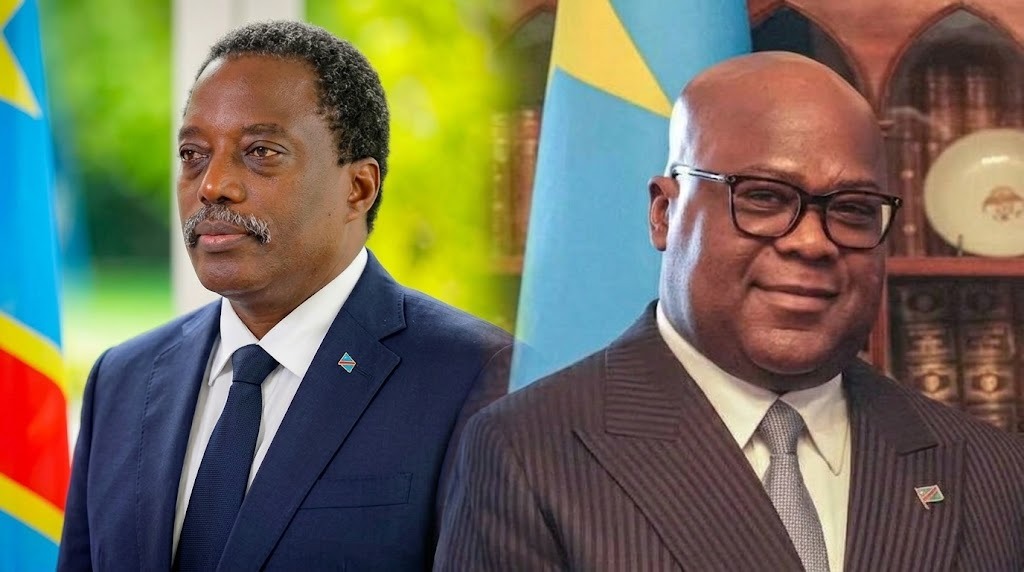
What does it mean when a former head of state takes charge of an armed movement fighting his successor’s government? That is the question now hanging over eastern Democratic Republic of Congo after Joseph Kabila assumed leadership of a new politico-military platform unveiled in Goma. The stakes could hardly be higher: the move may redraw alliances, complicate peace talks, and deepen a regional crisis that has already displaced millions.
Kabila takes charge of a new rebel platform
On Monday, 12 October, the former Congolese president was named head of the Front for the Refoundation of the Nation (FRN), a coalition announced in Goma, the North Kivu city held by the M23 since January 2025. The FRN brings together senior figures from the Alliance Fleuve Congo (AFC) and the March 23 Movement (M23), two forces whose merger now sits at the centre of a wider political and military realignment.
Alongside Kabila are several prominent names, among them Corneille Nangaa, Bertrand Bisimwa and Sultani Makenga, described as leading officials of the new structure. The lineup is striking: a man who once ran the country from Kinshasa now stands beside commanders locked in battle with government troops in the east.
Beyond a simple name change
The birth of the FRN is not merely a rebranding exercise. It signals an open bid to reorganise the political and military leadership of the movement opposed to President Félix Tshisekedi.
A statement issued in Goma says the new front succeeds the Alliance Fleuve Congo and announces a strategy of confrontation with the central government, including the use of force. What exactly becomes of the M23 within this arrangement – beyond its association with the platform – remains unclear.
The shift follows a series of signals visible since 2025. In its final report dated 11 June 2026, the United Nations Group of Experts on the DRC had already pointed to a possible restructuring of the AFC-M23 and a growing role for Kabila. The experts also noted repeated contacts between the former head of state and leaders of the movement.
The FRN announcement therefore formalises an alignment whose outlines were already being scrutinised internationally. Yet it raises a central question: will this new leadership consolidate the rebellion’s rival components, or will it breed fresh internal frictions?
Rwanda’s role in a regional crisis
The regional dimension cannot be ignored. The United Nations and several international partners consider the M23 to be militarily backed by Rwanda. Kigali denies the accusations and frames its security concerns in eastern DRC as a major issue in its relations with Kinshasa.
Kabila’s presence at the head of the FRN adds a political layer to that equation. By bringing together a figure who led the DRC from 2001 to 2019 and rebel officials, the platform may seek to broaden its appeal beyond its military base. It could also cloud the picture further, intertwining national political opposition, territorial demands and regional alliances more tightly than before.
For Kinshasa, the challenge is no longer simply containing an armed insurgency. It is also about countering an organisation that intends to contest its authority under a broader political banner. For Kigali, the movement’s consolidation comes as its role in the conflict remains at the heart of diplomatic friction with the DRC.
Pressure mounts on peace negotiations
The FRN’s emergence comes as diplomatic efforts to end the fighting continue. Talks between Congolese parties and international mediators aim to reduce clashes, restore security and create conditions for a lasting settlement.
A new politico-military structure led by a former president could complicate those efforts. It raises questions about who is entitled to negotiate, how armed groups’ chains of command operate, and whether leaders can enforce any commitments on the ground.
Kabila’s legal situation adds another source of tension. Sentenced to death in absentia in September 2025 for treason, he rejects the charges against him and denounces what he calls a politically motivated procedure.
Eastern Congo still in limbo
Beyond announcements and power plays, the people of North Kivu and South Kivu remain the first to bear the conflict’s consequences: forced displacement, persistent insecurity and disrupted economic activity.
The creation of the FRN opens a new chapter whose effects will depend on its ability to unify its components, its ties with Rwanda and the response of Congolese authorities.
One thing is clear: the crisis in eastern DRC is no longer just a confrontation between the Congolese army and the M23. With Kabila’s formal entry into this politico-military architecture, the political, military and regional strands of the conflict are more entangled than ever. Whether this realignment leads to a new escalation – or eventually opens a wider space for negotiation – remains the question.