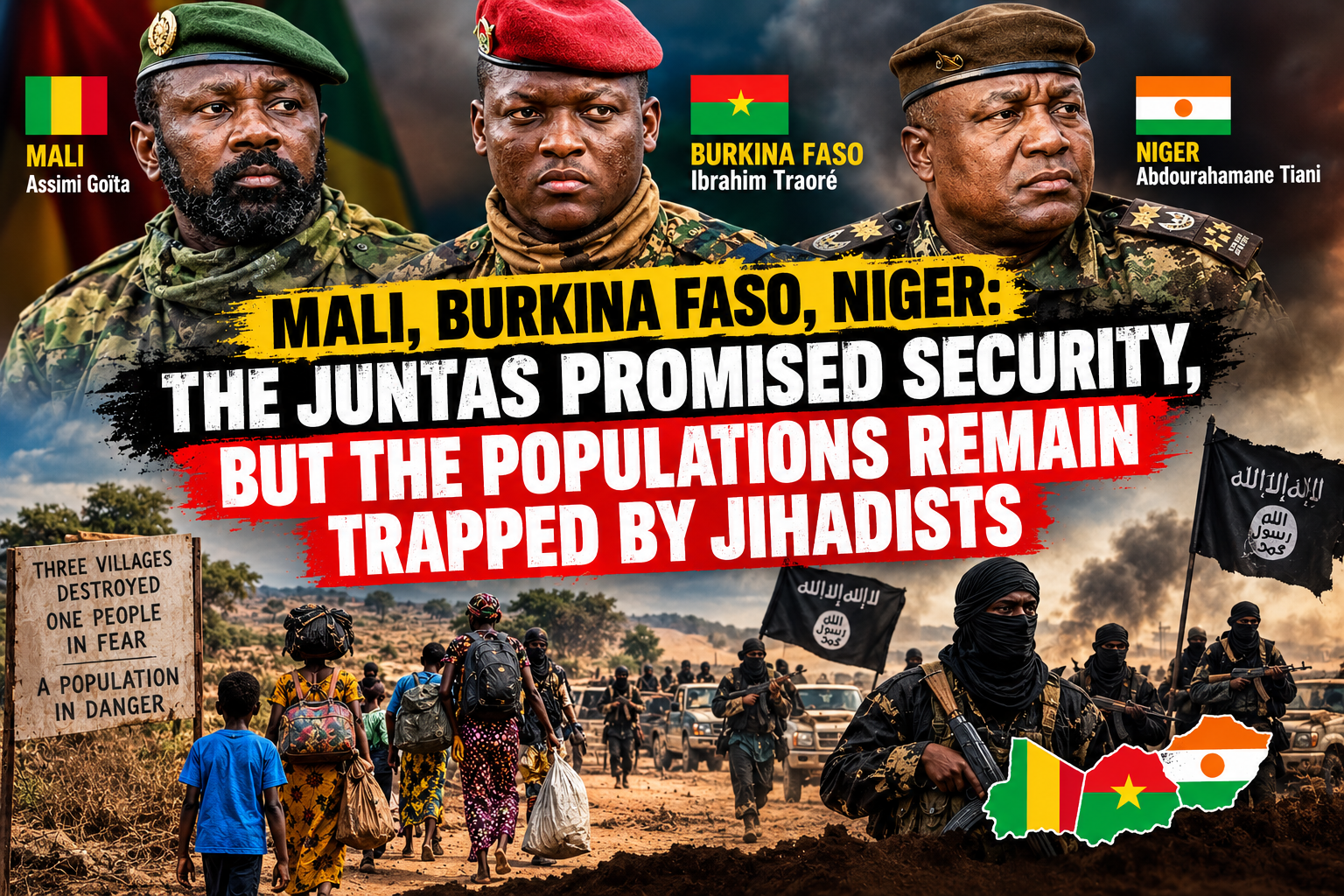
In the tri-border region shared by Mali, Burkina Faso, and Niger, Islamic State in the Sahel and the Support Group for Islam and Muslims (JNIM) — an Al-Qaida affiliate — are locked in an unprecedented battle for control. The escalating clashes between these two jihadist factions have claimed hundreds of lives in recent weeks, leaving civilians trapped in the crossfire. This surge of violence raises a critical question for the region’s military-led governments: after staking their legitimacy on restoring security, how have they failed to protect the populations most exposed to these threats?
Who controls the tri-border zone when the state falls short?
Once focused on attacking national armies and state symbols, jihadist groups now vie for dominance over entire territories, trade routes, and local resources. In this volatile landscape, civilians bear the heaviest burden. Forced displacement, severed supply chains, paralyzed economies, and the constant fear of violence have turned daily survival into an ordeal for isolated communities.
These rivalries between armed factions do more than intensify the conflict they reshape the human cost. Disputes over allegiance, resources, and territory often lead to retaliatory attacks against civilians suspected of supporting rival groups. The result? More families uprooted, markets emptied, and agricultural lands abandoned. The propaganda claims of victories and losses from these groups must be scrutinized carefully, as independent verification remains scarce in remote areas.
Military regimes face the test of accountability
A shift in alliances, but where are the dividends for civilians?
The three nations Mali, Burkina Faso, and Niger have restructured their military partnerships, distanced themselves from former allies, and emphasized sovereignty as a cornerstone of their security strategies. Yet, the persistence of violence in the tri-border region challenges the validity of these claims. If sovereignty is measured by a state’s ability to protect its people, the current reality suggests a gaping deficit.
Can a government truly claim independence if its citizens cannot move freely, cultivate their land, or attend school without fear? The military regimes argue that historical grievances, foreign interference, and operational constraints have hindered progress. While these factors are undeniable, the inability to deliver tangible security raises a troubling question: What value does strategic autonomy hold when civilians remain vulnerable?
What is the cost of ungoverned spaces?
In rural areas where state authority is weak, jihadists do more than attack intermittently they systematically undermine governance. Public services close, security forces struggle to maintain a constant presence, and communities face relentless pressure to submit or flee. The consequences are dire: abandoned villages, shuttered schools, collapsing trade, and displaced families torn between risking their lives or losing their livelihoods.
The regimes’ response often centers on large-scale military operations. But declarations of offensives alone cannot restore security if the underlying conditions intelligence sharing, civilian protection, and cross-border coordination remain unaddressed. For populations caught in the middle, rhetoric must be backed by action.
Can sovereignty exist without security?
The Sahel States Alliance: an answer in theory, but where’s the proof?
Mali, Burkina Faso, and Niger have forged the Alliance of Sahel States as a pillar of their shared security vision. This partnership, framed as a break from past failures, aims to reassert control over national destinies. However, the alliance’s success hinges on measurable outcomes: fewer attacks, safer villages, restored public services, and the possibility for displaced families to return home.
Without these results, the alliance risks becoming just another political maneuver. Citizens are not impressed by declarations of independence or denunciations of external influence. They measure governance by one standard: security. Are their roads safe? Can children go to school? Can farmers tend their fields without fear? Until these questions elicit affirmative answers, the legitimacy of military regimes will continue to erode in the eyes of those who need protection most.
The path forward: beyond military might
Facing an enemy as adaptive and far-reaching as jihadist groups, a purely military response is insufficient. Effective counterinsurgency requires more than firepower it demands intelligence networks, community trust, justice systems, and the restoration of essential services. The challenge is not just to reclaim territory but to re-establish the state’s presence in the daily lives of its people.
For Bamako, Ouagadougou, and Niamey, the path to credible sovereignty runs through the villages and towns where fear still dictates life. The test is simple: will the military regimes deliver the security they have promised, or will they remain trapped in the cycle of promises and disappointment?
By IBRAHIM OUMAROU — Journalist