
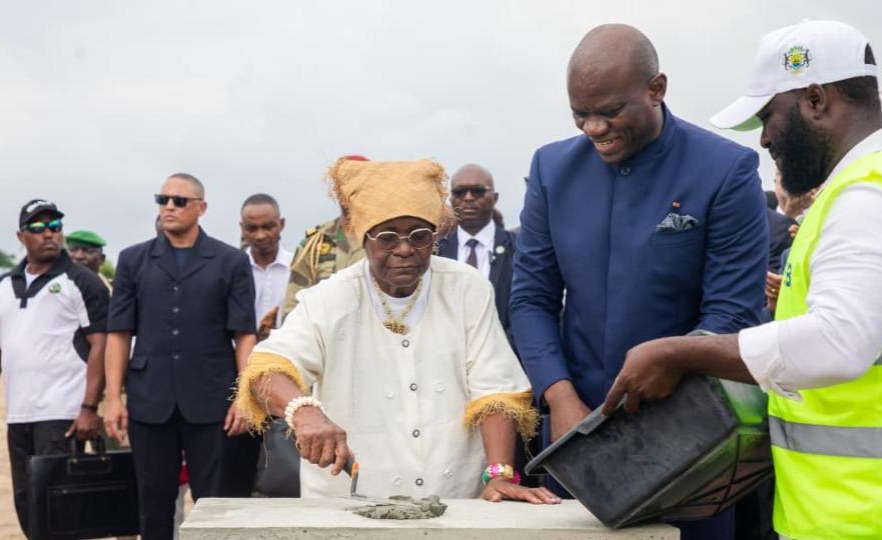
Gabon is breaking ground on a monumental initiative that will redefine its industrial landscape beyond oil dependency. Under the leadership of President Brice Clotaire Oligui Nguema, the construction of the Kobé-Kobé deep-water port has officially commenced. This ambitious integrated megaproject, anchored by one of the world’s largest untapped iron ore deposits and bolstered by new rail and energy infrastructure, is designed to revolutionize the country’s growth model by 2030.
The Gabonese coastline is on the cusp of gaining a world-class logistics hub. Situated in the Estuaire Province, the future Kobé-Kobé deep-water terminal will boast a draft depth of 14 to 16 meters, enabling it to accommodate ultra-large commercial vessels. This technical advantage will significantly enhance the port’s competitiveness, positioning Gabon as a key player in the Gulf of Guinea alongside major hubs like Cameroon’s Kribi or Congo’s Pointe-Noire.
What sets Kobé-Kobé apart is its integrated design, where the port will serve as the maritime gateway for a vast national value chain. The infrastructure is not standalone but part of a cohesive ecosystem comprising three major complementary projects:
Three pillars supporting Gabon’s industrial transformation
- Belinga iron ore mine (Ogooué-Ivindo Province): Geologists recognize this as one of the planet’s most substantial and untouched high-grade iron ore reserves;
- Innovative rail corridor: A new railway line will directly link the Belinga mining heartland to the port complex in the Estuaire Province;
- Booué hydroelectric dam: A critical energy project to ensure self-sufficiency for mining and processing facilities.
This strategic alignment aims to shift Gabon away from its historical extractive economy by prioritizing local metallurgical processing before export. The project took a major leap forward in 2026 with the signing of a strategic partnership agreement between the Gabonese government and Africa Global Logistics (AGL), a global logistics leader.
The Kobé-Kobé initiative is not just about infrastructure—it’s framed as a transformative force for social inclusion. Economic impact assessments predict the creation of up to 160,000 jobs, both direct and indirect, throughout the construction and operational phases. For Gabonese youth, this represents a rare opportunity to access technical careers in civil engineering, port operations, energy engineering, rail maintenance, and metallurgy.
The government is committed to fostering systemic benefits for the private sector by integrating local small and medium-sized enterprises (SMEs) into the project’s supply chains and service contracts. Beyond its economic dimensions, Kobé-Kobé carries significant political and geopolitical weight. Launched under President Oligui Nguema’s constitutional leadership, the project embodies a national economic sovereignty agenda focused on regaining control over critical infrastructure.
With a clear eye on the future, Libreville is proactively preparing for the eventual decline of oil reserves, which currently underpin state finances, by pivoting toward sustainable mining industries. If the project timeline remains on track, Kobé-Kobé is poised to become the driving force behind Gabon’s industrial emergence by 2030.