The Burundian President Évariste Ndayishimiye traveled to Ouagadougou on April 20, 2026, for an official visit framed as an act of friendship and cooperation. At the time, he held the rotating presidency of the African Union (AU), a role that placed him in a unique position to mediate between the continental body and the Alliance of Sahel States (AES).
The AES, comprising Burkina Faso, Mali, and Niger, is led by Captain Ibrahim Traoré. Relations between the AES and the AU have been strained since the three countries began withdrawing from AU institutions. Seeking to bridge this divide, Ndayishimiye’s visit included stops in Burkina Faso, a nation governed by a military regime that has openly declared democracy obsolete in favor of security-driven governance.
Behind the diplomatic language of dialogue and stability, a deeper pattern emerges: a shared strategy among authoritarian regimes to deflect international pressure by rallying domestic support against perceived enemies. This approach is not confined to the Sahel—Burundi, too, has mastered the art of enemy fabrication to consolidate power.
shared strategies in a fractured continent
The ties between Burundi and the AES are more than coincidental. Each country has faced sanctions from regional blocs like the Economic Community of West African States (ECOWAS) and the European Union (EU). Mali and Burkina Faso endured sanctions after coups in 2020 and 2022, while Niger followed in 2023. Burundi itself was sanctioned by the EU and the United States in 2016 after President Pierre Nkurunziza sought a controversial third term.
Such sanctions have not weakened these regimes—instead, they have fueled a narrative of resistance against foreign interference. The similarities between Burundi and Mali, despite their geographic and geopolitical differences, highlight a broader trend: the use of external threats as a tool for internal cohesion.
crafting the enemy to control the narrative
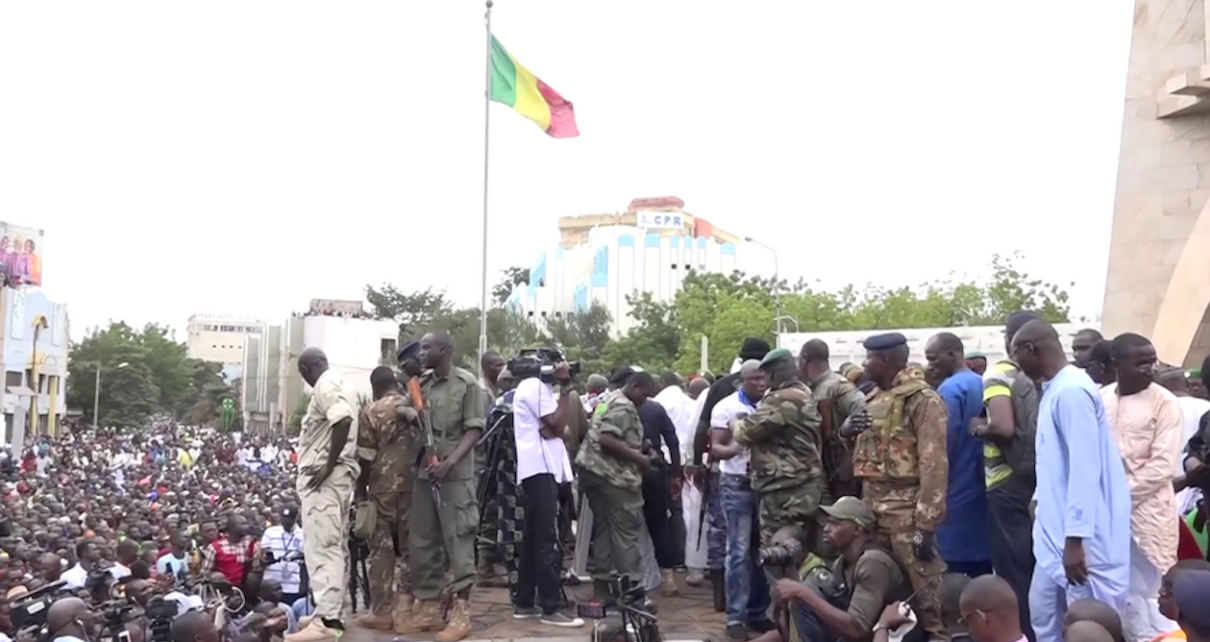
In both countries, the designation of an enemy—whether colonial powers, regional rivals, or security threats—serves as a cornerstone of legitimacy. In Mali, this strategy gained momentum in early 2022, when mass protests erupted against ECOWAS sanctions. Demonstrators gathered in Bamako, chanting slogans against France and the regional bloc, demanding a Mali free from outside influence. The junta, now backed by civilian allies, positioned itself as the sole defender against perceived foreign domination.
Burundi’s ruling CNDD-FDD party, meanwhile, has long blamed Belgium for the country’s ethnic divisions and recent instability. The former colonial power is accused of colluding with Rwanda to undermine the regime. This rhetoric allows Bujumbura to frame EU sanctions as part of a neo-colonial plot, shifting blame away from domestic failures.
regional rivalries as political fuel
Beyond colonial legacies, both regimes have turned regional actors into adversaries. In Mali, Algeria has been accused of harboring opposition figures and supporting terrorist groups. The junta went so far as to terminate the 2015 Algiers Peace Accord in January 2024, escalating tensions by closing its airspace to Algerian flights soon after.
In Burundi, the spotlight falls on Rwanda. President Ndayishimiye has repeatedly labeled Kigali a “bad neighbor,” accusing it of backing the 2015 coup attempt and supporting rebel groups like RED-Tabara. The response has been swift: Burundi sealed its borders with Rwanda in January 2024 and joined military operations in eastern Democratic Republic of the Congo (DRC) from 2022 to 2025, positioning itself as a key player in countering Rwandan-backed militias.
These actions are not merely defensive—they are designed to sustain a perpetual state of siege, ensuring that external threats remain the primary driver of political survival.
security vs. legitimacy: two sides of the same coin
Despite their shared strategies, Mali and Burundi diverge in how they leverage security narratives. In Mali, jihadist attacks—such as those on April 25, 2026—have bolstered the junta’s claim to be the only force capable of restoring order. With the promise of elections abandoned, the military has extended its rule indefinitely, arguing that only it can defeat groups like the Jama’at Nusrat al-Islam wal Muslimin (JNIM) and the Front de Libération du Azawad (FLA).
Burundi, however, faces a different calculus. Though the CNDD-FDD has long framed itself as a guardian against external threats, the 2027 elections remain a political necessity—even if tightly controlled. The regime’s focus on security is less about replacing elections and more about diverting attention from economic crises, including chronic fuel shortages and currency devaluations since 2015.
Ranked among the world’s poorest nations—with Burundi at the very bottom in 2023—these regimes rely on enemy narratives to mask internal failures. As political scientist Jean-François Bayart argues, the construction of external foes often obscures the predatory dynamics that sustain authoritarian rule.
What the Mali-Burundi comparison reveals is not just the resilience of authoritarian tactics but their adaptability. Whether through colonial scapegoats, regional rivals, or terrorist threats, these regimes have turned adversity into their greatest asset—proving that in the right hands, even the weakest narratives can become instruments of unshakable power.