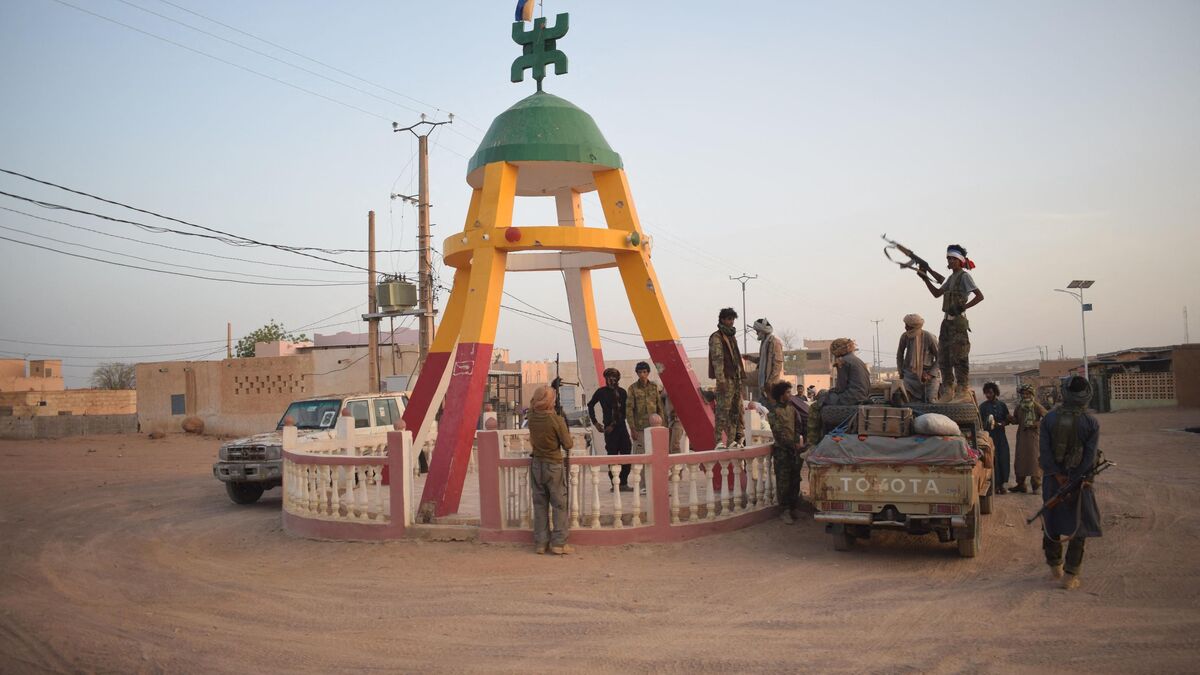
Africa Corps, the Kremlin’s latest covert military branch, has been forced to withdraw from Kidal, a strategic stronghold in northern Mali, following intense clashes with a coalition of Islamist militants and Tuareg rebels. The withdrawal marks a rare setback for the Russian paramilitary group, which has steadily expanded its influence across the Sahel over the past two years. Despite this setback, Africa Corps remains a critical asset for Moscow in its efforts to secure strategic footholds in West Africa.
The sudden retreat from Kidal comes amid a broader wave of coordinated attacks targeting Mali’s military junta. On April 25, rebel forces launched simultaneous assaults on multiple strategic positions near Bamako, including the residence of Defense Minister Sadio Camara, who was killed in the attack. The offensive underscored the growing boldness of militant groups operating in the region, testing the resilience of both Africa Corps and the Malian authorities it supports.
From Wagner to Africa Corps: a strategic pivot
The rise of Africa Corps follows the collapse of the Wagner Group, Russia’s now-defunct private military company that once dominated Moscow’s African operations. After the death of Wagner’s founders, Evgueni Prigojine and Dmitri Outkine, in a suspicious plane crash in August 2023, the Kremlin moved swiftly to consolidate its military presence on the continent under a new banner. Africa Corps was officially unveiled in November 2023, with Kremlin-aligned military analyst Igor Korotchenko and Deputy Russian Defense Minister Iounous-bek Evkourov credited with its formation.
The new group was designed to be more disciplined and centrally controlled than Wagner, which had become synonymous with human rights abuses and unchecked violence. Africa Corps has sought to distance itself from Wagner’s notoriety by focusing on state-to-state partnerships, providing military training, equipment, and combat support to allied governments. Its footprint now stretches across the Sahel, Libya, Sudan, the Central African Republic, and Niger, where it operates under the guise of counterterrorism and anti-colonial solidarity.
Rebranding with a dark legacy
The name itself is loaded with historical weight. Africa Corps draws its inspiration from the Afrikakorps, the Nazi Germany military unit that fought in North Africa during World War II. The choice of nomenclature is no coincidence: it serves as a psychological weapon, reinforcing Russia’s narrative of liberating African nations from Western domination. Igor Korotchenko, a vocal proponent of the group, has stated that Africa Corps aims to help African countries “achieve full sovereignty” by expelling Western influence and securing control over their natural resources.
Africa Corps in Mali: a fragile foothold
Since 2024, Africa Corps has played a pivotal role in shoring up the military junta in Bamako, providing critical combat support in its fight against Tuareg rebels and Islamist militants. The group’s fighters, numbering in the hundreds or even thousands, have become a defining feature of Mali’s security landscape. However, their presence has done little to stabilize the country. Instead, it has fueled tensions with neighboring nations and drawn condemnation from international observers.
In 2024, the United Kingdom imposed sanctions on Africa Corps, accusing it of “widespread human rights violations” and “exploiting natural resources for profit.” The allegations underscore the growing backlash against Russia’s expanding military footprint in Africa, where its tactics are increasingly viewed as a new form of colonialism disguised as partnership.
Despite these challenges, Africa Corps remains a key player in Russia’s broader geopolitical strategy. By entrenching itself in the Sahel, Moscow seeks to undermine Western influence, control migration routes, and secure access to critical minerals. The withdrawal from Kidal may be a temporary setback, but it is unlikely to derail Africa Corps’ long-term ambitions in the region. As the Malian junta grapples with internal instability and external pressure, the shadow of Russia’s paramilitary force looms larger than ever over the future of West Africa.