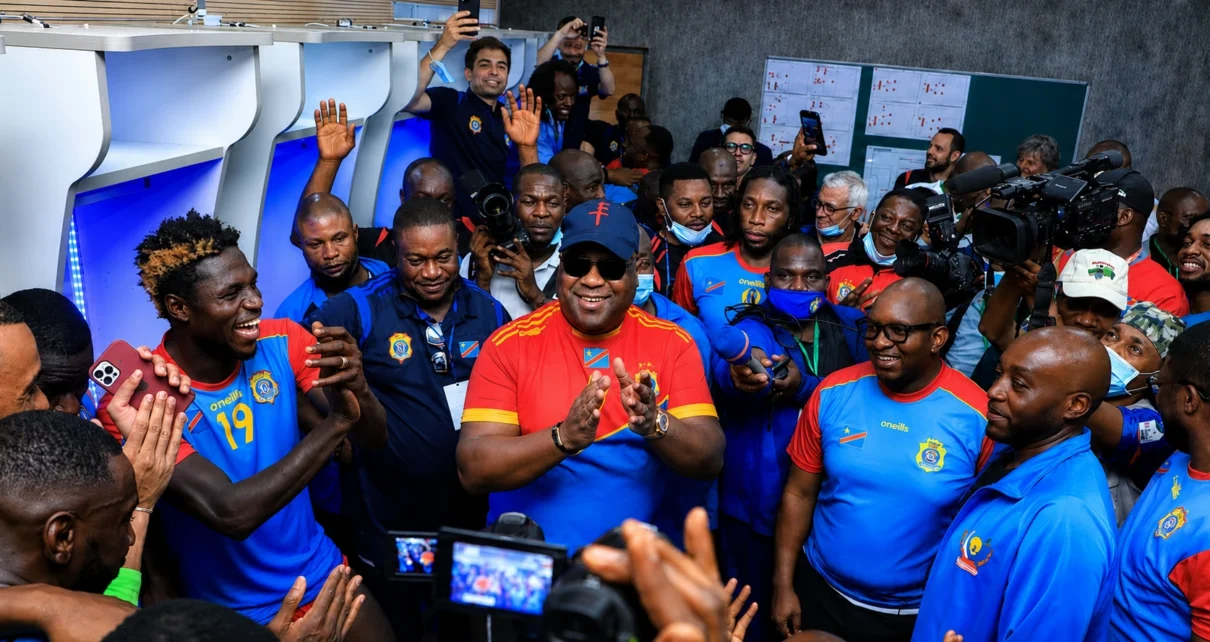
When the Léopards stormed into the Round of 16 of the World Cup, the Democratic Republic of the Congo wasn’t just celebrating another sporting triumph. It was witnessing a carefully crafted political narrative unfold: football as a unifying force, a symbol of national revival, and a testament to the return of state authority. President Félix Tshisekedi has championed this vision for years, turning the national team into more than just players on the pitch.
The scenes that followed the historic qualification on June 28 painted a vivid picture—from Kinshasa’s bustling streets to Lubumbashi’s vibrant stadiums, from Kisangani’s lively neighborhoods to the battered towns of the East. Across the country, Congolese citizens poured into the streets, their differences—whether political, regional, or communal—temporarily set aside beneath one shared flag. In a nation often overshadowed by security crises and fragmentation, this moment offered a glimpse of something new: a people rediscovering pride in their identity.
Football alone cannot resolve decades of conflict or heal deep-seated divisions. Yet, in the Democratic Republic of the Congo, the sport has become a mirror reflecting a deeper national aspiration—one of unity, resilience, and renewed self-confidence. The Léopards’ journey isn’t just about goals and victories; it’s about reclaiming a narrative that has long been dominated by war, exploitation, and external interference.
a presidential vision rooted in national pride
This transformation wasn’t accidental. In his December address to the nation, President Tshisekedi dedicated a significant portion of his speech to the role of sport in shaping the country’s future. He praised Congolese athletes, highlighted the Léopards’ qualification, and declared, “Every victory, every flag raised, builds our pride, our national identity, and the intangible foundation of our unity.”
These words weren’t merely rhetorical flourishes. They underscored a deliberate strategy: football as a tool for social cohesion. In a country frequently tested by internal divisions and external pressures, the president framed sport as a reminder that the Congolese people share a single destiny. He reiterated a core principle: the Democratic Republic of the Congo remains one and indivisible, despite the challenges it faces.
Each triumph of the Léopards thus becomes a symbolic act—proof that unity is possible, even in the most fractured of societies. The message is clear: beyond the noise of politics and the weight of history, there exists a nation capable of standing together.
sport as a pillar of sovereignty and ambition
For years, the Congolese government has invested in sport as a strategic asset. Hosting major continental events, reforming sports governance, and publicly backing national teams have all been part of a broader effort to reposition the country on the global stage. The message is simple: a nation’s influence is measured not only by its resources or military strength but by its cultural and sporting achievements.
Recent leadership changes within the Congolese Football Federation (FECOFA) reflect this commitment. The appointment of Véron Mosengo-Omba as president and Amadou Diaby as first vice-president signaled a new era—one where professionalism, performance, and international visibility go hand in hand. This leadership shift has coincided with a generation of players finally translating the country’s vast football potential into tangible success on the world stage.
‘fatshi béton’: when sport meets politics
In a climate marked by security challenges in the East and sweeping reforms nationwide, the Léopards’ achievements have provided President Tshisekedi with a powerful political symbol. It’s not about claiming direct credit for the team’s success—that belongs to the players, coaches, and technical staff. Instead, it’s about the narrative he has carefully cultivated: a Democratic Republic of the Congo reclaiming its confidence and its future.
The popular slogan “Fatshi béton”—a play on the president’s nickname and the idea of unshakable strength—captures this moment. It transcends political divides, resonating with citizens who see in football more than just a game. It’s a reflection of national pride, a shared dream, and a reminder that even in divided times, a people can come together under one banner.
a new chapter for the democratic republic of the Congo
In the halls of power and among economic leaders, a consensus is emerging: the Democratic Republic of the Congo is ready to rewrite its story. For too long, international headlines have reduced the country to conflict, resource exploitation, or instability. Now, it seeks to be defined by its progress, its reforms, and its growing influence in Africa and beyond. The Léopards’ success offers an extraordinary platform for this transformation.
Football won’t solve the country’s security dilemmas or economic hurdles overnight. But it proves something fundamental: when an entire nation rallies behind a single team, when a victory unites people from Kinshasa to the most war-torn regions of the East, it reaffirms the existence of a resilient, proud, and indivisible Congo. That, in itself, is a victory worth celebrating.