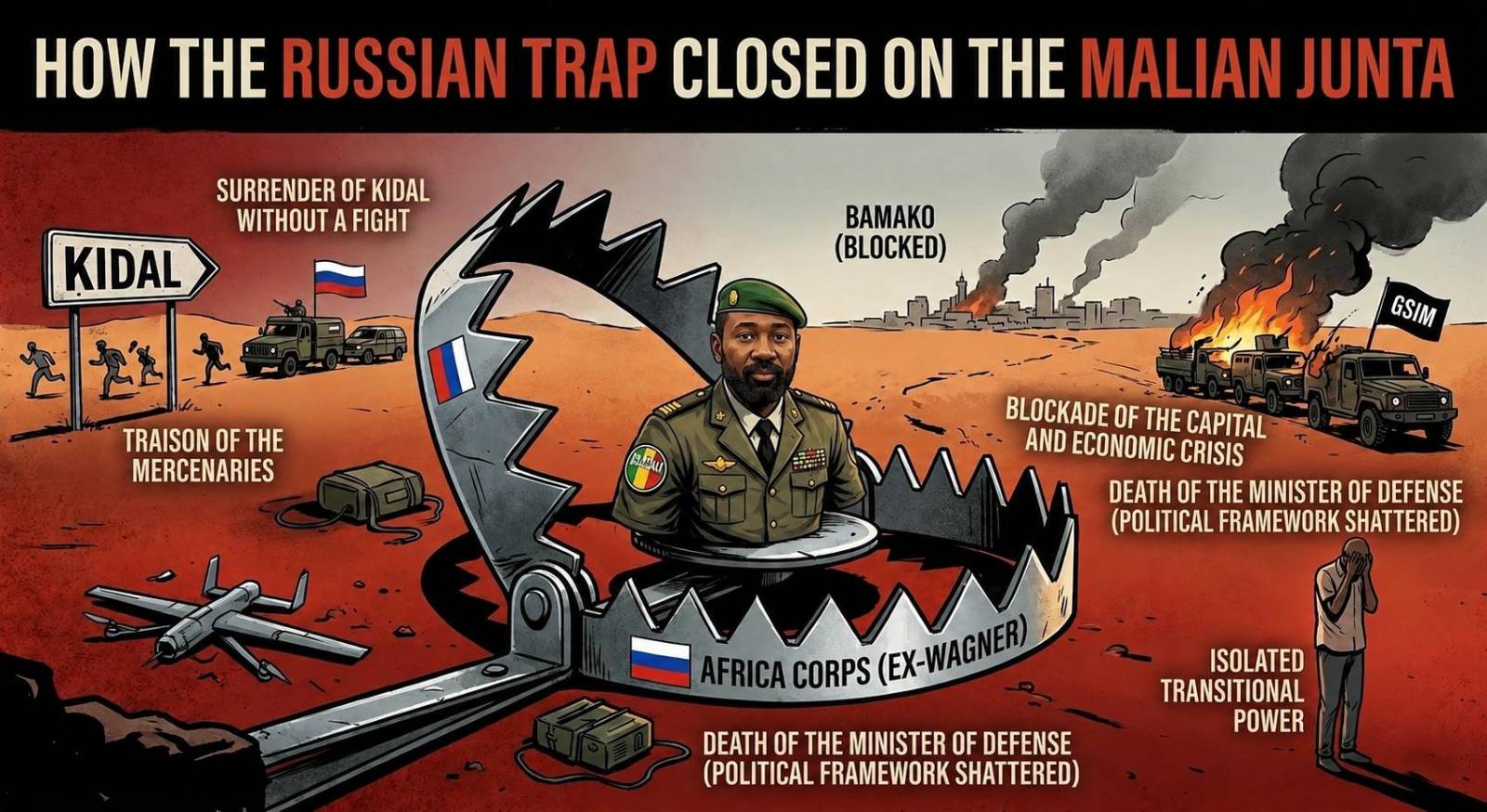
From promises of ironclad security to humiliating retreat
The Malian junta’s gamble on foreign paramilitaries has collapsed under the weight of its own miscalculations. After entrusting the nation’s security to Russian-led Africa Corps forces, Bamako now faces a crisis of legitimacy so severe that even Moscow is cutting its losses. The recent loss of key northern strongholds, including Kidal, to a resurgent alliance of rebels and jihadists has exposed the hollow nature of the junta’s security strategy.
Kidal: a negotiated surrender, not a military victory
Late April 2026 marked a turning point when Kidal, a city reclaimed by Malian troops and their Russian allies in 2023, slipped back into rebel hands with little resistance. Unlike a conventional battlefield retreat, Africa Corps forces did not make a last stand. Instead, they negotiated their own withdrawal, leaving behind heavy weaponry in exchange for safe passage. The move was less about tactical defeat and more about Moscow’s strategic pivot away from a failing mission.
A high-ranking Malian official, speaking on condition of anonymity, described the Russian withdrawal as a betrayal: “They prioritized their own survival over Mali’s sovereignty.”
Blows to the heart of the regime
The fallout from the northern reverses has reached Bamako itself. In April, coordinated attacks targeted Kati and the capital, culminating in the death of General Sadio Camara, the Defense Minister and the architect of Bamako’s alliance with Russia. His loss has left the junta decapitated at a time when the country is grappling with a humanitarian and economic collapse.
Under siege by the Group for the Support of Islam and Muslims (GSIM), the capital has been cut off from essential supplies. Fuel shortages, food scarcity, and intermittent power cuts have shut down schools and paralyzed daily life. The much-touted Russian “shield” has proven ineffective against the jihadist blockade, while drone strikes—meant to bolster Malian forces—have only deepened civilian resentment and instability.
Moscow’s retreat: from partnership to damage control
Russia’s Africa Corps is shifting its focus from territorial control to regime protection. Analysts suggest the remaining mercenaries are now concentrated around Bamako, tasked with shielding the junta rather than reclaiming lost territory. Official statements claiming to have “foiled a coup” ring hollow amid the stark reality of retreat.
The junta’s once-vaunted Alliance of Sahel States (AES) has offered no meaningful support. Rejected by regional blocs like ECOWAS and abandoned by its Russian backer, the military government in Bamako is isolated. Public discontent is fueled by the blockade, economic ruin, and the junta’s failure to deliver on its security promises.
An irreversible slide into collapse
The decision to forgo diplomacy, national dialogue, and regional alliances in favor of a private security contract has proven catastrophic. The junta’s reliance on foreign mercenaries has backfired, leaving Mali in a spiral of violence, economic collapse, and institutional paralysis. The question is no longer if the regime will fall, but how long it can cling to power before the security vacuum it created consumes it entirely.