Mounting concerns have gripped northern Mali, where a rapid deterioration in security has sent shockwaves through the nation. Within days, the country’s fragile stability has crumbled, as militant factions accelerate their advance following the symbolic fall of Kidal. The Jama’at Nusrat al-Islam wal Muslimin (JNIM) has intensified its efforts, now deploying an unprecedented political gambit by urging the overthrow of the interim government.
Military setbacks echo a grim historical precedent
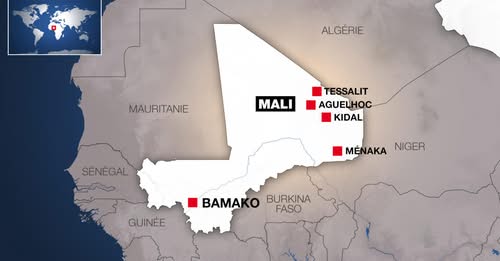
A resurgence of the 2012 crisis appears underway. On May 1, 2026, fighters from the JNIM and the Front de Libération de l’Azawad (FLA) seized critical military installations at Tessalit and Aguelhoc. The withdrawal of Malian Armed Forces (FAMa) and their Russian allies from Africa Corps paved the way for the militants’ unopposed entry. A widely circulated image captured Seidane Ag Hitta, a prominent JNIM commander, triumphantly displaying the keys to Tessalit’s military base—a stark reminder of the 2017 departure of French forces from Operation Barkhane.
Since April 25, key towns including Ber, Tessit, Hombori, and Gourma Rharous have fallen, leaving residents of Gao and Tombouctou in a state of growing dread as they await further developments.
Bamako’s counteroffensive and Moscow’s steadfast backing
Despite the severe setback, the Koulouba Palace remains resolute. General Assimi Goïta has issued a call to action, declaring that no amount of « intimidation » will divert Mali from its path forward.
The government’s military response is now concentrated on two critical fronts:
- Air and Ground Operations: The Malian army has conducted precision airstrikes on Kidal, targeting administrative buildings and suspected logistical depots. While the FLA disputes casualty figures, officials in Bamako assert that several « terrorists » have been neutralized.
- Logistical Resilience: As jihadist forces tighten their grip by blockading key roadways into the capital, a massive convoy of 800 fuel tankers broke through this encirclement on Friday, under heavy aerial and ground escort.
From Moscow, the Kremlin, through spokesman Dmitri Peskov, has reaffirmed its unwavering support for the interim authorities, dismissing speculation of a potential Russian disengagement following the losses in Kidal.
JNIM’s strategic shift: blending political rhetoric with extremist goals
The most consequential development of this crisis is ideological. In a statement released late April 30, JNIM abandoned its traditional militant discourse in favor of a calculated political narrative designed to resonate with broader segments of society.
The group has called upon « the vital forces of the nation, » political parties, and religious leaders to unite in forming a « common front » aimed at achieving a « peaceful transition » and ending the « dictatorship of the junta. » By invoking concepts of « sovereignty » and « dignity, » JNIM seeks to exploit public fatigue with prolonged conflict while simultaneously reasserting its ultimate objective: the imposition of Sharia law.
« In the face of the worst, we may seek the least harmful option, » remarked a former opposition minister, encapsulating the moral dilemma now gripping Mali’s political class: Is engagement with yesterday’s enemies the only path to halt the crisis?
Internal fractures within the transitional government
Pressure is not confined to the battlefield. The Attorney General of Bamako has confirmed the detention of several Malian soldiers, accused of complicity in last weekend’s attacks. With rebel advances, the JNIM’s deceptive political overtures, and the economic strain of the blockade, the interim regime faces its most profound crisis to date. The struggle for Mali is no longer confined to the northern deserts—it has now extended into the halls of political legitimacy in Bamako.