Peru’s elected president Fujimori backs Morocco’s Sahara autonomy plan
- Keiko Fujimori, Peru’s elected president, reaffirms support to Morocco’s territorial integrity and UN resolution 2797
- This marks a decisive break with decades of Peruvian governments’ ambiguous stance on Western Sahara
- Support for Sahara autonomy plan
- Ending decades of ambiguity
- Past flirtations with Polisario
- Morocco’s diplomatic push
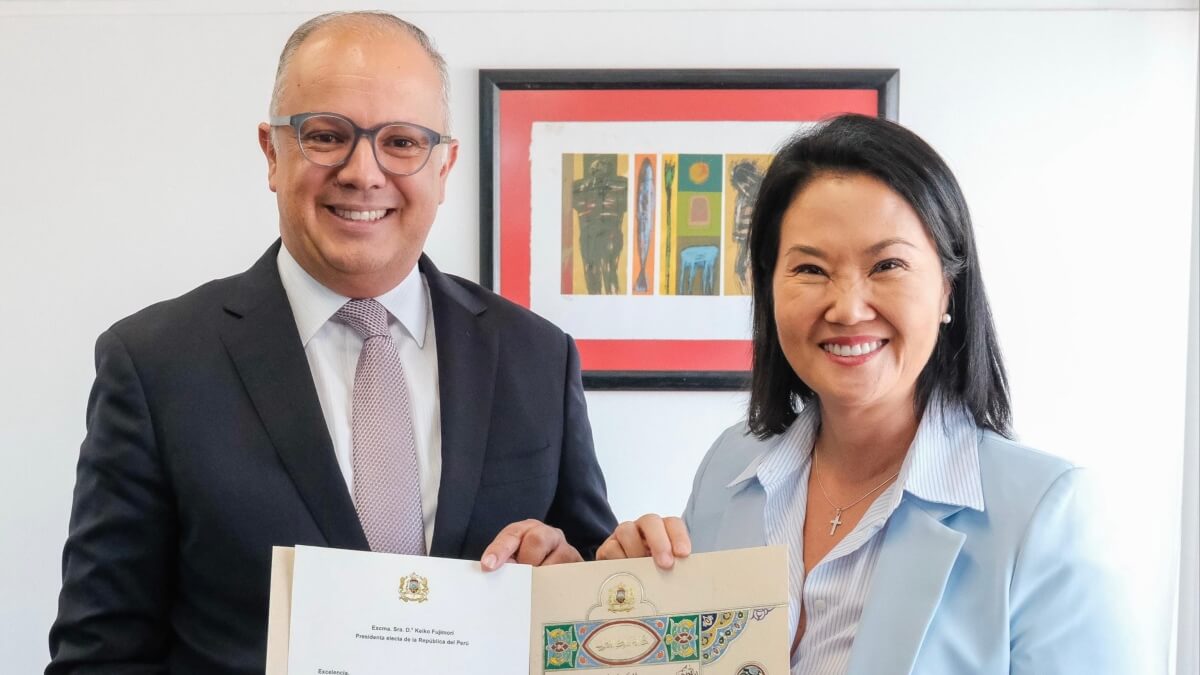
Peru’s newly elected president Keiko Fujimori has begun to lay out the foundations of her foreign policy agenda in the early weeks following her closely contested victory. One of the most significant shifts involves Peru’s stance on Morocco’s territorial integrity, a topic brought to the forefront during a meeting with Morocco’s ambassador to Peru, Amine Chaoudri, who delivered a congratulatory letter from King Mohammed VI.
Support for Sahara autonomy plan
During the meeting in Lima, Fujimori’s transition team confirmed that the president-elect’s government will support Morocco’s territorial sovereignty and endorse the autonomy plan for Western Sahara, as outlined in UN Security Council Resolution 2797.
The autonomy initiative, presented by Morocco in 2007, is viewed as a pragmatic pathway to resolving the decades-long dispute over Western Sahara. Fujimori’s endorsement aligns with the UN’s recognition of the plan as a credible basis for negotiations.
In his letter, King Mohammed VI congratulated Fujimori on her election, emphasizing the strong historical ties between Morocco and Peru. He expressed his commitment to strengthening bilateral relations and fostering a multilateral partnership that benefits both nations.
Ending decades of ambiguity
Fujimori’s position represents a clear departure from the inconsistent policies of previous Peruvian administrations, which often wavered between neutrality and tacit support for the Polisario Front. This ambiguity persisted despite Morocco’s sustained diplomatic efforts to clarify its position on territorial integrity.
Peru’s recognition of the self-proclaimed Sahrawi Arab Democratic Republic (SADR) in 1984 under President Fernando Belaúnde Terry marked the beginning of a contentious era. Diplomatic relations with the Polisario were formalized in 1987 under Alan García but were suspended in 1996 by Alberto Fujimori, Keiko Fujimori’s father, who restored Morocco’s territorial integrity as a core principle.
For the next 25 years, Peru’s policy remained frozen in this stance under successive presidents, including Valentín Paniagua, Alejandro Toledo, Alan García (second term), Ollanta Humala, Pedro Pablo Kuczynski, Martín Vizcarra, Manuel Merino, and Francisco Sagasti. However, the brief presidency of Pedro Castillo reintroduced ambiguity by restoring relations with the Polisario in 2021—only for his successor, Dina Boluarte, to reverse course in 2023.
Past flirtations with Polisario
Pedro Castillo’s decision to reconnect with the Polisario was swiftly reversed by Foreign Minister Miguel Ángel Rodríguez Mackat, who reaffirmed Peru’s respect for Morocco’s territorial integrity. Yet Castillo’s subsequent actions, including a failed attempt to extend his mandate, led to his removal from office. His successor, Dina Boluarte, maintained the status quo until September 2023, when she suspended relations with the Polisario without fully endorsing Morocco’s autonomy plan.
Presidents José Jeri and José María Balcázar, who followed, held office for such brief periods that they did not address the issue. Fujimori’s election signals a return to her father’s 1996 policy—one that goes further by explicitly supporting Morocco’s sovereignty over Western Sahara, the autonomy initiative, and UN Resolution 2797.
Morocco’s diplomatic push
Peru’s policy shift reflects Morocco’s broader diplomatic offensive across Latin America, where the Polisario had once enjoyed significant support. Through enhanced economic, cultural, and academic cooperation, Morocco has positioned itself as a key gateway to Africa, Europe, and the Arab world, persuading multiple countries to reconsider their stance on Western Sahara.
Nations that once recognized the SADR or maintained ties with the Polisario have since reversed course, including Colombia, Guatemala, Paraguay, the Dominican Republic, Haiti, Jamaica, El Salvador, Guyana, Ecuador, and Panama. This regional realignment underscores Morocco’s growing influence and the diminishing appeal of the Polisario’s separatist agenda.