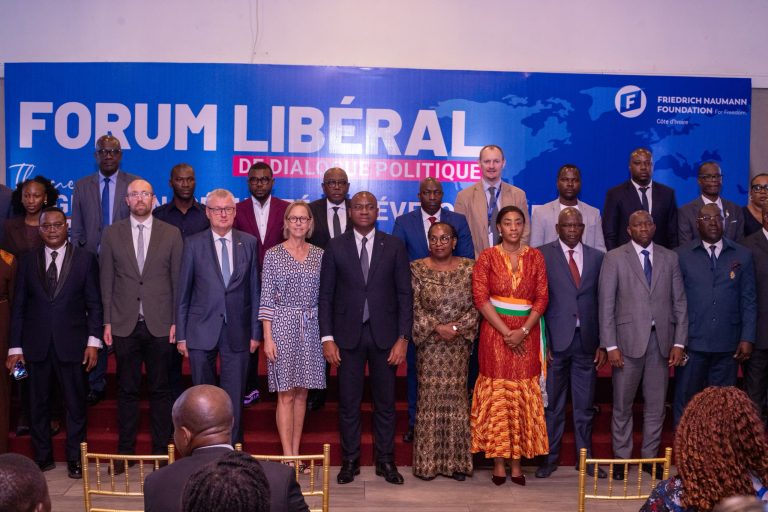
Abidjan — Two prominent voices from Africa and Europe have urged a fundamental shift in how Africa and Europe approach migration, emphasizing freedom over restriction and cooperation over division.
The call came during the opening of the Liberal Political Dialogue Forum in Abidjan, held from July 15 to 16, 2026, under the theme “Migration, Security and Development: Rethinking Africa-Europe Partnerships.”
Speaking on the first day, Sidi Touré, Côte d’Ivoire’s Minister of Animal and Fishery Resources and Vice-President of the Liberal International, challenged the narrative that frames migration as a problem rather than a natural expression of human freedom.
« Migration is not first and foremost an issue to be managed — it is a matter of liberty, » he stated. Backed by United Nations data, he pointed out that migrants make up just 3.7% of the world’s population, with over 96% of people living in the country of their birth. « The world is not overwhelmed by migration, » he emphasized, urging a move beyond fear-based security narratives.
The minister highlighted that 70% of African migration occurs within the continent itself, citing daily movement patterns at the Adjamé bus station in Abidjan as evidence. « This is not a crisis — it’s life, » he said, underscoring Côte d’Ivoire’s long-standing culture of hospitality, embodied in the welcoming term Akwaba.
Touré also expressed concern over the withdrawal of Mali, Burkina Faso, and Niger from the ECOWAS regional bloc, warning that such political fractures should not erode the principle of free movement across borders.
« Regardless of political disagreements, our peoples are brothers, our economies are intertwined, and the freedom to move is a shared heritage we must protect, » he asserted. He urged participants to produce actionable recommendations in a policy brief to guide future engagement.
From the European perspective, Alexandra Heldt, Regional Director for West Africa at the Friedrich Naumann Foundation, criticized rising xenophobic rhetoric on both continents, citing the recurring violence against migrants in South Africa since 2008 as a cautionary example.
« No nation can build a prosperous future by blaming migrants for economic hardships, » she warned. She also highlighted the paradox within Europe, where labor shortages coexist with growing hostility toward immigration.
« Migration fosters exchange, innovation, and entrepreneurship — it builds bridges between peoples, not walls, » Heldt argued, advocating for balanced partnerships rooted in shared responsibility and democratic values.
She concluded by calling on policymakers to shift the conversation from fear to trust, from exclusion to collaboration.
Touré echoed this sentiment, affirming, « Hospitality is not a sign of weakness — it is a source of strength and sound policy. Migration should be a driver of shared development. »
The forum continued with expert panels exploring the legal, geopolitical, and human dimensions of migration, fostering deeper dialogue on building equitable and sustainable partnerships.