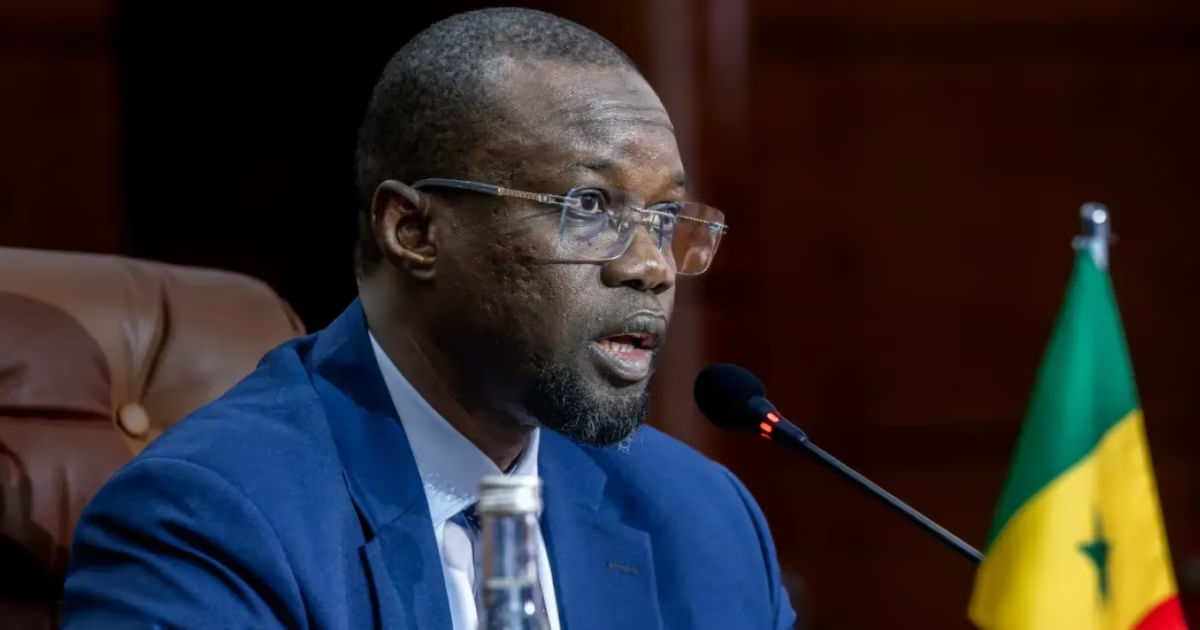
judicial appointments in Senegal: analysts question moves to sideline ousmane sonko for 2029
Recent judicial appointments in Senegal are sparking considerable apprehension regarding their potential impact on the national political landscape. According to political analyst Mamadou Wane, President Bassirou Diomaye Faye appears to be orchestrating a strategy to prevent Ousmane Sonko from contesting the 2029 elections, potentially underestimating the enduring resilience of the Senegalese populace.
The recent selection of magistrates for the Constitutional Council and the Saint-Louis Court of Appeal signifies a notable shift at the highest echelons of the state. For politologist Mamadou Wane, known as “Mao,” President Bassirou Diomaye Faye has embarked on a revisionist course, seemingly aimed at reinstating the former neo-colonial order and politically marginalizing Ousmane Sonko ahead of 2029. However, this subtle power play is expected to encounter robust popular resistance, bolstered by a Senegalese public hardened by years of struggle and a dominant political party whose current momentum remains formidable.
The political analyst suggests that Faye might seek to exclude Ousmane Sonko from the 2029 presidential election by leveraging state institutions, particularly the judiciary, through the appointment of officials from the previous administration to critical positions. Nevertheless, Wane views such an endeavor as destined for failure, as it underestimates the historical capacity of the Senegalese people to resist. He emphasizes that the current leader of PASTEF has consistently enjoyed powerful popular backing, which has thwarted his definitive exclusion in past electoral contests.
President Bassirou Diomaye Faye, via a decree dated July 13, 2023, appointed magistrate Ousmane Diagne as president of the Constitutional Council, succeeding the late Mamadou Badio Camara. Just days prior, in a move that surprised many, the head of state selected former public prosecutor Serigne Bassirou Guèye to serve as Attorney General at the Saint-Louis Court of Appeal.
Both magistrates have had public disagreements with PASTEF leader Ousmane Sonko. While the points of contention with former Justice Minister Ousmane Diagne revolved around the slow pace of accountability proceedings and a perceived lack of commitment to prosecute those responsible for crimes committed between March 2012 and February 2024, the relationship with Serigne Bassirou Guèye was overtly adversarial. Ousmane Sonko has repeatedly accused Magistrate Guèye of falsifying the gendarmerie’s investigation report while he was public prosecutor, allegedly to orchestrate a political conspiracy designed to harm him.
Mao Wane, however, refrains from prejudging the new president of the Constitutional Council, stating he awaits his actions: “I do not hold the same judgment for Ousmane Diagne; we should not accuse him of ulterior motives. In contrast, Serigne Bassirou Guèye went as far as to falsify Sonko’s trial in the conspiracy and rape case. When a magistrate resorts to such practices, they should no longer hold judicial office.”
A perceived attempt to restore the neo-colonial system
According to the political analyst, the prevailing situation aligns with a revisionist agenda, which he defines as an effort to reinstate the former order. The recent appointments reflect a resurgence of officials from the previous regime and form part of President Bassirou Diomaye Faye’s broader strategy to establish a new central political force, relying on a party composed of cadres from the former ruling coalition.
“By revisionism, I mean a desire to revert to the old order. In my view, a clear divide has now emerged between, on one side, the camp seeking to restore the neo-colonial system and, on the other, the one championing sovereignty, patriotism, and democratic revolution,” explains this seasoned observer of the West African political scene for four decades.
The sociologist, however, cautions the head of state and his supporters against any endeavor to exclude Ousmane Sonko: “Those who aim to act in this manner suffer from political short-sightedness and overlook the fact that the Senegalese people possess a rich tradition of resistance. If Diomaye and his team are in power today, it is solely because the people mobilized. To attempt to politically neutralize Sonko by believing that dissolving the Assembly to condemn a deputy under any pretext is a maneuver that will not succeed.”
The strength of PASTEF and the enduring vigilance of the youth
For Mao Wane, the extraordinary enthusiasm surrounding the sale of PASTEF membership cards serves as an undeniable indicator of the true balance of power on the ground. “Today, PASTEF stands out as the most organized, dynamic party, benefiting from the strongest leadership centered around Ousmane Sonko. This organizational prowess and its militant network make all the difference,” he analyzes.
He contends that the Senegalese people have achieved an irreversible democratic maturity since the political transitions of 2000 and 2012, further solidified by three years of intense struggle between 2021 and 2024: “In March 2021, the people did not resist for just a few days. They persevered for nearly three years. They have gained genuine experience in political resistance and learned how to push back against a regime, regardless of its means of control,” the politologist insists. This collective memory, in his estimation, renders any attempt at politically eliminating the PASTEF leader already doomed to fail.