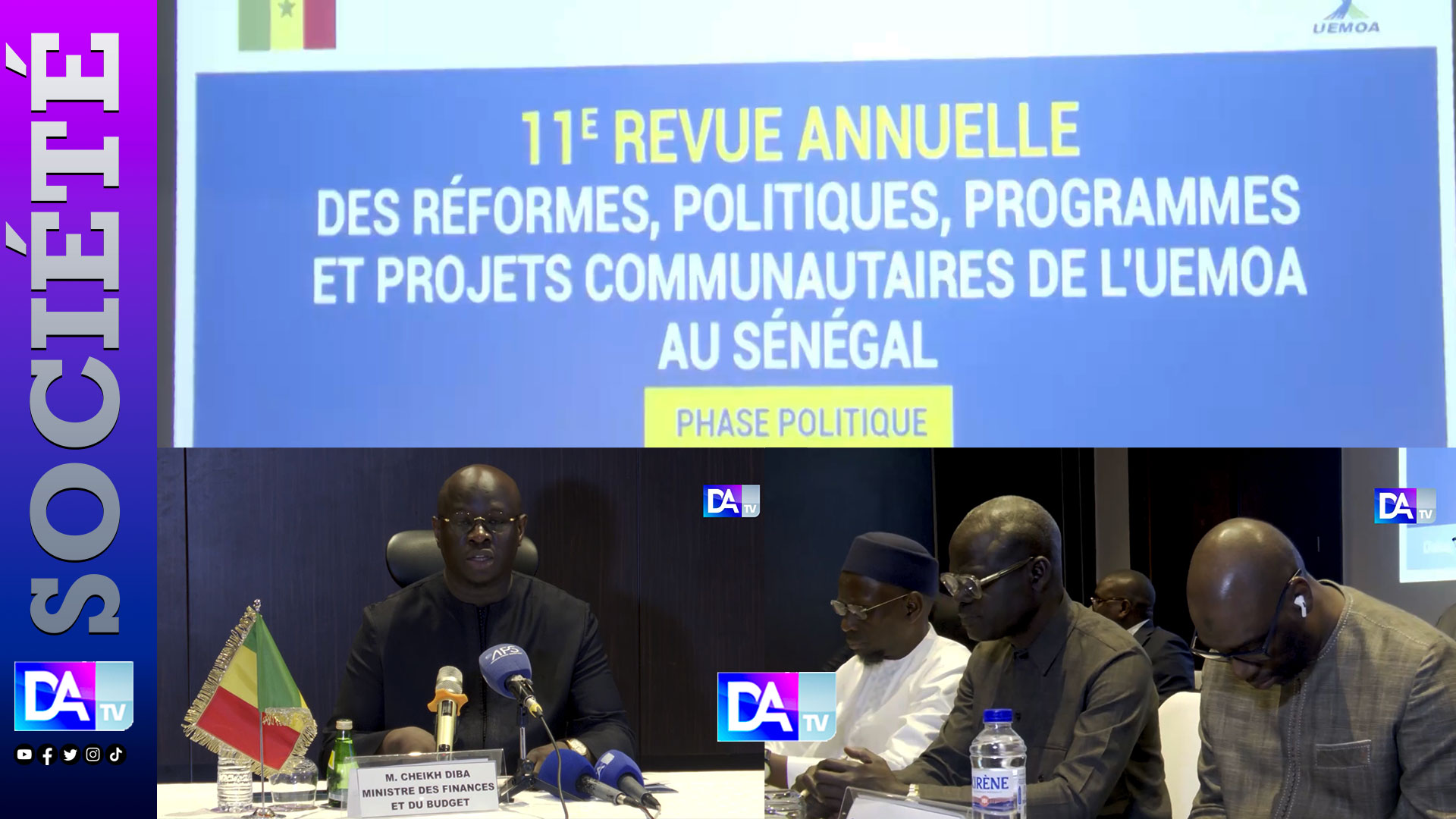
In Dakar, Cheikh Diba, the Minister of Finance and Budget, presided over the political phase of the annual review assessing UEMOA’s community reforms, policies, programs, and projects within Senegal. The event, a crucial moment for West Africa’s economic trajectory, welcomed Abdoulaye Diop, President of the UEMOA Commission, and numerous high-ranking government officials.
This eleventh edition of the review, a mechanism instituted by Additional Act n°05/2013 on October 24, 2013, has been a regular fixture in Senegal since 2014. Following a decision made in Bissau in July 2023, it now operates on a biannual cycle. Abdoulaye Diop emphasized its role as a powerful catalyst for strengthening economic integration across the UEMOA zone, enabling executive bodies to rigorously evaluate collective actions undertaken as per the Union Treaty. The political phase, held this Monday, served to validate the outcomes of the technical phase, which took place in Dakar from November 10 to 12, 2025, meticulously scrutinizing 145 reforms and 5 projects.
The overall assessment painted a largely positive picture, albeit with a slight dip in performance. Senegal recorded an average reform implementation rate of 76.45% in 2025, a decrease of 2.14 percentage points from the 78.59% achieved in 2024. This minor setback primarily stemmed from less robust results in the culture and tourism sectors, which saw a decline of 15.10 points, and in handicrafts, quality standards, and the business climate, experiencing a notable drop of 34.75 points. The delay in transmitting the 2024 GUDEF report to the Commission further contributed to these challenges. In contrast, significant advancements were observed in several critical domains: the Customs Union gained 4.55 points, human and social development improved by 6.58 points, energy and mines saw a rise of 3.33 points, and the harmonization of public finances increased by 1.88 point.
The political deliberations were preceded by thorough technical work, collaboratively conducted by Senegalese teams and Commission representatives in an atmosphere described as “fraternal, professional, and objective.” Commissioner Mahamadou Gado, responsible for Economic Policies and Internal Taxation, is set to present the comprehensive synthesis of these findings.
Minister Cheikh Diba reaffirmed the Senegalese government’s unwavering commitment to bolstering its community performance. He announced that the conclusions from this political phase would be directly conveyed to the Prime Minister during an upcoming audience, which President Diop of the Commission would also attend. Minister Diba also lauded Amadou Tchambou, the Commission’s Resident Representative in Dakar, for his pivotal role in facilitating seamless cooperation between the regional institution and Senegalese administrative bodies.
For his part, Abdoulaye Diop paid tribute to President Bassirou Diomaye Faye’s steadfast dedication to regional integration. He further acknowledged the vital support extended by Prime Minister Ousmane Sonko and the entire government in advancing the Union’s objectives.