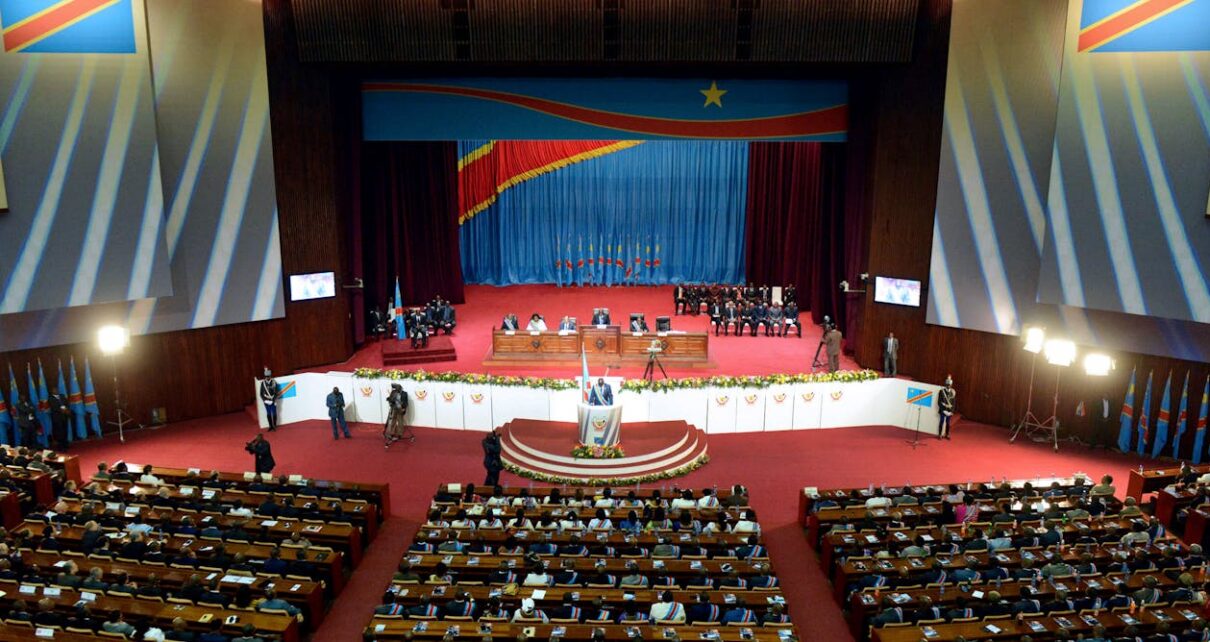
In mid-May 2026, an incident in the Democratic Republic of the Congo’s National Assembly spotlighted the entrenched sexism women legislators continue to confront. A widely circulated video showed Micheline Mpundu, a member of parliament, concluding her statement before stepping down from the podium. As she spoke, Christophe Mboso, the second vice-president temporarily presiding over the session, publicly commented on her appearance from the dais, remarking, ‘Thank you, colleague, she is very beautiful… isn’t she?’
He then continued in Lingala, ‘Look at her yourselves,’ laughing as he raised his hands to mimic her body shape, adding, ‘God made her’ and ‘she belongs to someone else.’ The chamber’s reaction—laughter and applause—suggested tacit approval, and the session proceeded as if nothing had happened.
Public outrage from political leaders, civil society, and human rights activists, along with internal pressure from his own ranks, eventually forced Mboso to issue a belated apology days later. No disciplinary action was taken. The episode underscores a persistent question: when will African parliaments—especially the Congolese one—stop functioning as hostile environments for the women they are meant to represent?
a systemic failure, not an isolated incident
My doctoral research in political science examines masculinities within Congolese legislative bodies through an African comparative lens. Far from an isolated lapse in decorum, the Mboso incident exposes a structural flaw. It reveals a gap between the Democratic Republic of the Congo’s written commitments to gender equality and the lived reality for female lawmakers.
sexist violence in parliaments across africa
Parliamentary sexism is not unique to the Democratic Republic of the Congo. Long before Mboso’s remarks circulated in Kinshasa, documented cases in other African capitals had already exposed the depth of the problem. These incidents reveal a pattern that obstructs women’s full political participation at every level of decision-making.
Women’s legislative presence surged in the early 1990s with democratization movements that brought unprecedented numbers of women into African hemicycles. Between 1990 and 2010, the number of female lawmakers tripled. Yet this progress has been met with fierce structural resistance from male colleagues—both within and outside their parties. Many openly assert that politics is a male domain, where women have no legitimate place.
Global data corroborates these local experiences. A 2016 global survey of female parliamentarians in 39 countries, conducted by the Inter-Parliamentary Union, found that 65.5% had experienced repeated verbal abuse or insults during their tenure. The African regional study published by the IPU and the African Parliamentary Union in November 2021 confirmed the persistence of these patterns, noting insufficient progress toward real political empowerment for women.
The applause in Mboso’s video is not incidental. It signals that the problem is not one individual—it is the system that normalizes and rewards such behavior. Philosopher Kate Manne describes this as a mechanism of patriarchal control that relegates women to subordinate roles even in democratic institutions. This control often operates not through physical force, but through symbolic violence: gestures, words, laughter, and ridicule that remind women legislators they are seen first as bodies, not as lawmakers.
The concept of coloniality of gender, developed by feminist theorist María Lugones, helps explain how patriarchal hierarchies persist despite formal legal equality. Women in the DRC are elected under the same constitution and universal suffrage as their male counterparts, yet they remain subject to patriarchal control that reduces them to stereotypes—mothers, educators, or decorative figures—rather than political actors.
parallels across the continent
Mboso’s video echoes incidents in other African nations. In Senegal, in 2022, Deputy Amy Ndiaye, who was pregnant, was slapped and kicked in the abdomen on the floor of the National Assembly while cameras rolled. In Nigeria in 2025, Senator Natasha Akpoti-Uduagha was suspended not for professional misconduct, but for publicly naming the sexual harassment she endured from the Senate president.
These cases are not coincidental. They reveal a disturbing truth: African parliaments may allow women’s voices, but they still deny them dignity. The presence of women in these institutions does not guarantee respect for their personhood or their contributions.
documented cases in the DRC
In the Democratic Republic of the Congo, similar episodes have been documented. On April 30, 2020, former Senate President Thambwe Mwamba publicly shamed Senator Bijoux Ngoya during a plenary session, alleging she had made advances in private meetings to secure his support for her candidacy as Senate Quaestor. The session ended in chaos, with several senators expressing outrage.
On July 15, 2021, during a constitutional debate, Deputy Christelle Vuanga dismantled a male colleague’s arguments. Deputy Nsingi Pululu interrupted her with a single phrase in Lingala: ‘You are a woman.’ The implication was clear: her gender disqualified her from speaking on such a sensitive matter.
Against this backdrop, Mboso’s remarks come as no surprise. The DRC has ratified international conventions, adopted progressive laws, and signed commitments to gender equality. Yet within the hemicycle, nothing has changed. The disconnect between legal text and lived practice is not new—yet it continues to be ignored.
toward accountability and change
French feminist Simone de Beauvoir wrote in 1949 that women are defined as ‘the other.’ In 2026, that otherness persists in the Congolese Parliament. Female deputies are still judged by their bodies rather than their legislative work. These incidents reveal how patriarchal systems undermine democracy from within.
Without consequences—illustrated by the unchecked applause in Mboso’s video—the National Assembly will remain a misogynistic space despite representing a population where women make up 51% of citizens and 13% of deputies. Underrepresentation does not justify tolerance for such behavior.
Other parliaments have taken steps forward. Campaigns such as #NotTheCost (National Democratic Institute) and #NotInMyParliament (European Parliament) demonstrate that cultural change is possible through concrete sanctions and victim protection. The DRC already has strong laws, including a 2025 Senate bill addressing violence against women. But a law left unimplemented is a mere aspiration. Silence is no longer an option. Failing to sanction Mboso sends a clear message to Congolese women considering political careers: their dignity is negotiable.