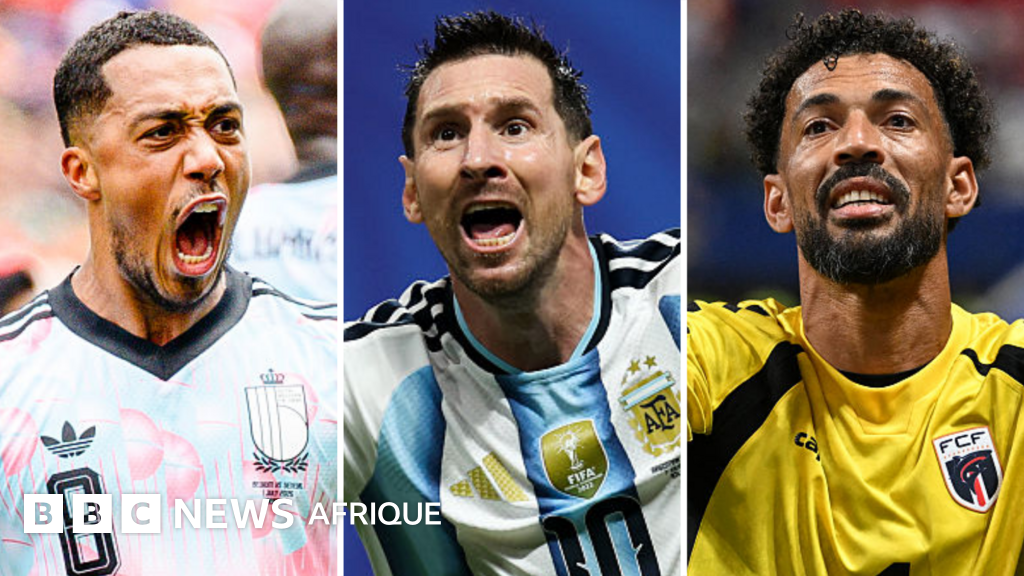
This World Cup has redefined excitement. Stunning goals, breathtaking turnarounds, nail-biting suspense until the final whistle, and unexpected results—this tournament has delivered on every front. With the quarter-finals just days away, eight more games remain in what promises to be an unforgettable summer of football.
The expanded edition—featuring 48 teams across three host nations: Canada, Mexico, and the United States—stands as the most ambitious World Cup in history. But has it also been the greatest?
Beauty lies in the eye of the beholder, and every fan carries their own definition of a memorable tournament. For some, it’s the thrill of their first World Cup experience. For others, it’s the journey of their national team. Yet, when we look at the numbers, this edition has set a new benchmark on the pitch.
Record-breaking goals and relentless action
By the time the quarter-finals kick off, 280 goals will have been scored across 104 matches—an average of 2.92 goals per game. This is the highest scoring rate since the 1970 World Cup in Mexico, where 95 goals were scored in 32 matches (2.97 goals per game).
For comparison, the 2022 World Cup in Qatar averaged 2.69 goals per match, while the 2018 edition in Russia saw 2.64. The 2014 tournament in Brazil produced 2.67 goals per game, and South Africa 2010 had just 2.27. The most prolific match so far was Germany’s 7-1 victory over Curaçao, but there have been six-goal thrillers in seven other games and five-goal contests in thirteen others.
Offensive football has been the hallmark of this tournament. A remarkable 74.6% of goals were scored in open play—the highest proportion in World Cup history. Penalties accounted for only 5% of goals, the lowest ever recorded.
Late drama and spectacular comebacks
The suspense hasn’t faded as the final minutes tick away. In the knockout rounds, eight matches were decided by a goal scored after the 85th minute. Argentina needed extra time to overcome Cape Verde, a true underdog story, and four games were decided on penalties.
The 10th-minute stoppage-time winner by Enzo Fernández against Egypt marked a historic milestone—a record 10 goals scored in the 90th minute or later during this World Cup.
July alone has delivered at least three unforgettable matches: Belgium’s 3-2 comeback against Senegal, Argentina’s identical turnaround against Egypt, and England’s dramatic 3-2 win over Mexico. Both Belgium and Argentina overcame two-goal deficits in the dying moments—a feat not seen since 1970.
England’s victory was even more remarkable given they played nearly 40 minutes with a man down after Jarell Quansah’s red card, yet still triumphed in the electric atmosphere of Mexico City’s Azteca Stadium.
The tournament has also seen eight scoreless draws—the highest number in World Cup history. Far from signaling weakness, this reflects a growing parity among teams.
Fans fill the stands and legends shine on the pitch
Early concerns about empty stadiums due to exorbitant ticket prices proved unfounded. Despite the financial strain, the FIFA reports a 99.7% attendance rate—over 4.4 million spectators during the group stage and now more than 6.2 million after two knockout rounds.
The average attendance stands at over 65,000 per match, a figure only surpassed by the 1994 World Cup in the United States, which averaged just under 69,000.
The world’s top players have also been on full display. The race for the Golden Boot is tighter than ever: Lionel Messi (Argentina) leads with eight goals, followed by Kylian Mbappé (France) and Erling Haaland (Norway) with seven each, and Harry Kane (England) with six. This is the first time in World Cup history that three players have scored seven or more goals in a single tournament.
With 48 teams in the mix, fears of one-sided games were quickly dispelled. Underdogs have delivered some of the tournament’s most inspiring moments. The tiny Caribbean nation of Curaçao, after a 7-1 loss to Germany, fought back to draw with Ecuador. Qatar, despite a 6-0 defeat to Canada, earned a 1-1 draw against Switzerland—who would go on to reach the quarter-finals.
Cape Verde, led by veteran goalkeeper Vozinha, became the surprise story of the tournament. They held Spain, Uruguay, and Saudi Arabia to draws in the group stage, advanced to the Round of 16, and pushed Argentina to the brink before falling 3-2 in extra time.
Controversies and challenges overshadow the magic
Despite the on-field brilliance, the tournament has not been without controversy. The cost of travel, accommodation, and match tickets has placed an unprecedented financial burden on fans. Hydration breaks, introduced to combat extreme heat, drew mixed reactions—welcomed in sweltering conditions, but criticized during rainy or indoor matches.
The extended schedule—spanning nearly six weeks from June 11 to July 19—has also raised concerns. With matches almost daily and club seasons resuming just weeks after the final, player fatigue and fixture congestion are real issues.
The integrity of refereeing decisions has been questioned, and allegations of political interference have cast a shadow over the competition. The case of American striker Folarin Balogun is particularly striking. Despite receiving a red card in the Round of 16 against Bosnia-Herzegovina, he was allowed to play in the next match after U.S. President Donald Trump reportedly intervened with FIFA President Gianni Infantino. Balogun invoked FIFA’s disciplinary code to avoid suspension, a decision that drew widespread criticism from football authorities and managers, including Belgium’s coach and England’s Thomas Tuchel.
Balogun became only the second player in World Cup history to avoid suspension after receiving a red card, following Brazil’s Garrincha in 1962—a decision also marred by political allegations. The incident has reignited debates about fairness and neutrality in football governance.
A thrilling finale could crown the greatest World Cup ever
As the quarter-finals approach, the stage is set for a spectacular climax. With the world’s top four ranked teams—Argentina, Spain, France, and England—all still in contention, the potential for unforgettable football is immense.
>The tournament has already delivered drama, passion, and moments that will be remembered for generations. Whether it becomes the greatest World Cup of all time may ultimately depend on the final matches. Past editions have been overshadowed by underwhelming finals, while others have been redeemed by a single, breathtaking showdown.
With the stage set for high-stakes football, one thing is certain: this World Cup has already earned its place in history.