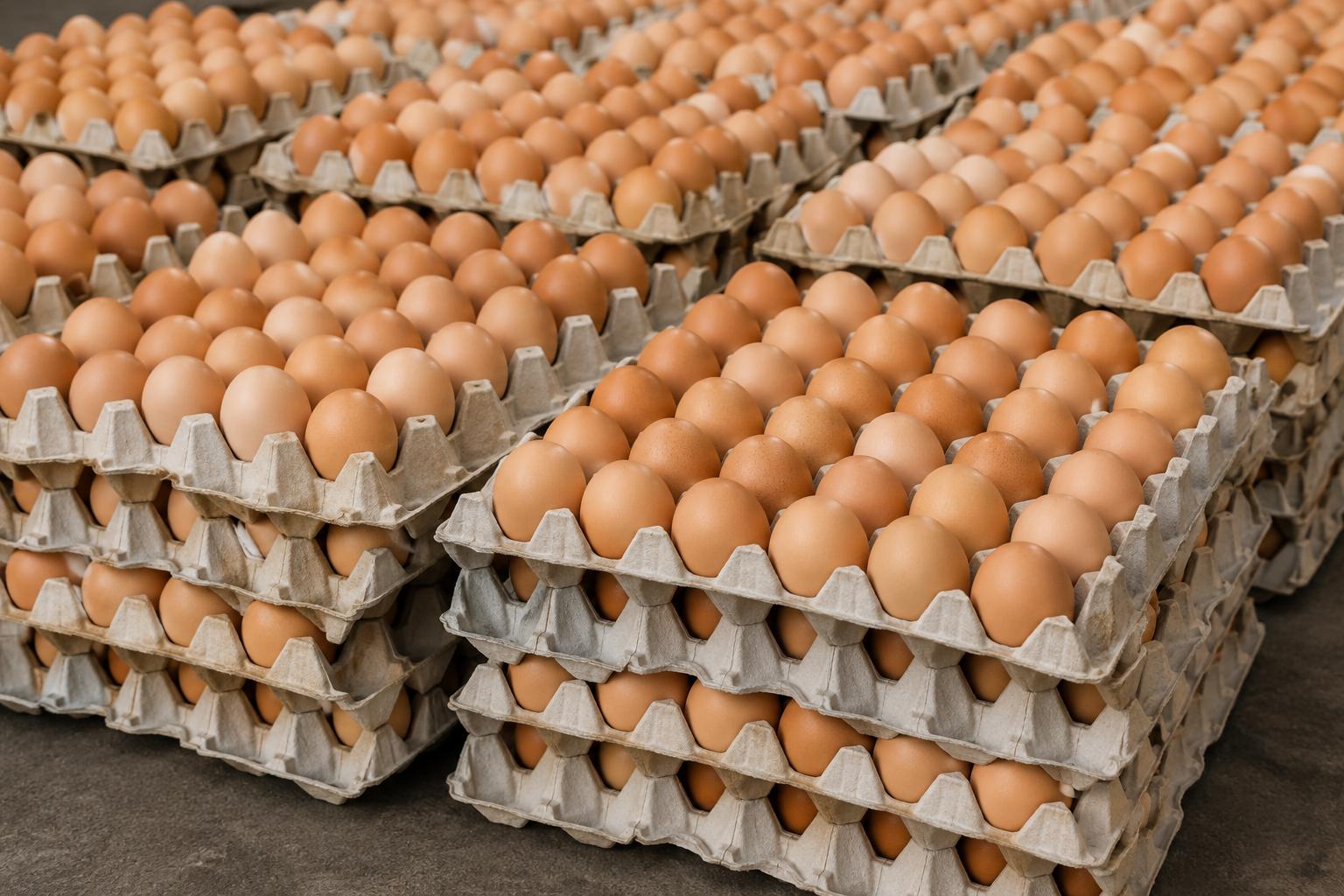
Burkina Faso’s poultry farmers are reeling from a government decision that has left the industry stunned. In a joint announcement, the Ministry of Trade and the Ministry of Animal Resources imposed a fixed retail price of 100 West African CFA francs per egg, while setting wholesale prices at 2,600 F CFA per tray and retailer prices at 2,750 F CFA. Marketed as a safeguard for household purchasing power, this price control measure, in reality, deals a severe blow to entrepreneurial freedom and threatens the survival of an already struggling economic sector.
When price controls ignore production costs
Setting a maximum selling price for a finished product while ignoring soaring raw material costs creates an unsustainable situation. Poultry farming, particularly egg production, relies heavily on animal feed—known locally as provende—which includes maize, soybean and cottonseed cakes, and mineral supplements. Over recent months, the cost of these feed inputs has skyrocketed, driven by inflation, rising transportation expenses, and supply chain disruptions.
By capping egg prices without providing substantial subsidies for provende, the government has effectively pushed producers into a corner. Enforcing an arbitrary price ceiling forces farmers to sell at a loss or operate on razor-thin margins, making it impossible to sustain their businesses.
Government interference undermines business freedom
The principle of free enterprise hinges on supply and demand dynamics and the freedom for business owners to set prices based on their operational and financial realities. When the state intervenes to dictate pricing policies for private enterprises, it doesn’t regulate—it strangles innovation and economic growth.
Why would any entrepreneur invest millions of F CFA in poultry infrastructure, secure bank loans, or hire local workers if the government reserves the right to cap revenue at a level disconnected from actual costs? This measure sends a chilling message: that business success in Burkina Faso now hinges on bureaucratic decisions rather than market forces.
Unintended consequences: scarcity and inflated black markets
History has repeatedly shown that artificial price controls often backfire, creating shortages and fueling black markets. Without the ability to operate profitably, the poultry sector faces several immediate risks:
- Collapse of small-scale producers: Unlike large industrial farms, family-owned and small-scale poultry businesses lack the financial resilience to absorb sustained losses. Many may be forced to close, eliminating thousands of jobs across the country.
- Reduced production: To cut losses, farmers may scale down their flocks or halt breeding programs, leading to a sharp decline in egg output.
- Emergence of black markets: As eggs become scarce in official markets, informal sellers will dominate, selling eggs at prices far exceeding the regulated 100 F CFA—ultimately hurting consumers more than helping them.
A better approach: supporting producers, not controlling prices
Ensuring affordable food for all Burkinabè households is a worthy goal, but it should not come at the expense of those who produce the nation’s food. Real solutions lie upstream: subsidizing feed production, waiving taxes on poultry inputs, and expanding access to low-interest credit for farmers. These measures would strengthen the industry from the ground up.
Capping egg prices while ignoring the surging cost of feed is not only economically irrational—it sends a dangerous signal to the business community. It suggests that entrepreneurial freedom in Burkina Faso is conditional, subject to the whims of decrees that disregard ground realities. To protect the poultry sector and secure the country’s food sovereignty, urgent action is needed: free the prices and invest in production.