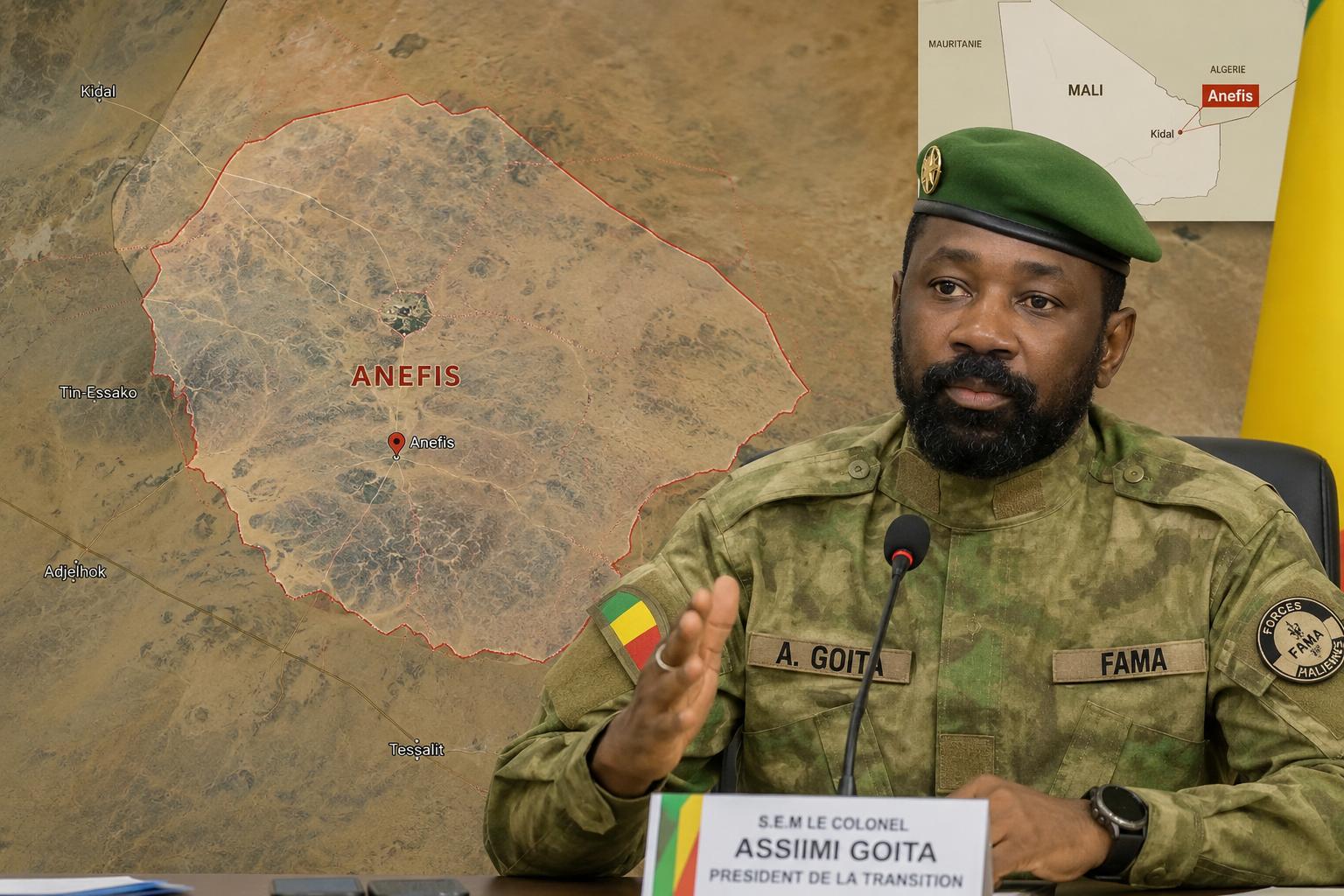
Fierce fighting erupted yesterday in Tin Araban, close to Tabankort, where a large military convoy comprising Malian armed forces (FAMa) and their Russian-backed Africa Corps allies was ambushed by a coalition of rebel and terrorist armed groups. As tensions escalate in the region, the deafening silence from Bamako’s transitional government signals a deliberate effort to obscure the worsening security crisis gripping northern Mali.
The Gao-Anéfis corridor has become the stage for an unprecedented clash. Reports indicate that a substantial military convoy, featuring around sixty logistical vehicles, armored units, and ground troops, departed Gao at the start of the week. Its mission: to resupply and reinforce the critical stronghold of Anéfis, a town in the Kidal area under relentless pressure from armed factions opposed to the central government in Bamako.
A deadly trap at Tin Araban
The ambush unfolded near Tin Araban, a barren stretch of land close to Tabankort, roughly 100 kilometers south of Anéfis. The convoy was caught in a meticulously coordinated assault involving heavy weaponry and drone strikes. Evidence suggests the attackers were a temporary alliance of Tuareg separatist forces from the Azawad Liberation Front (FLA) and jihadist elements from the Group for the Support of Islam and Muslims (JNIM), an al-Qaeda affiliate.
The day-long confrontation saw extreme violence, with both sides suffering significant losses. While no verified and independent casualty figures are available due to restricted access to the area, fragmented communications from insurgent sources point to substantial material and human tolls. Multiple FAMa transport vehicles and light armored units operated by Africa Corps (formerly Wagner Group) instructors appear to have been destroyed or captured. Partial footage also hints at the loss of aerial reconnaissance assets and dozens of casualties across both sides.
A shroud of secrecy from Bamako
Twenty-four hours after the outbreak of hostilities near Tabankort, the Directorate of Information and Public Relations of the Armed Forces (DIRPA) and the transitional government have issued no official statements. This deliberate blackout is not a matter of technical delay or tactical caution but a calculated move to conceal the true scale of Mali’s security collapse.
By refusing to acknowledge the severity of the setbacks or the intensity of the fighting in the North, the leadership in Bamako clings to a narrative of an exclusive and flawless military surge by the FAMa. This insistence on maintaining a facade of control risks spiraling into outright denial, betraying the trust of the Malian people.
The stakes at Anéfis: a battle for northern Mali’s future
The outcome of this engagement extends far beyond a tactical skirmish. Bamako’s ability to preserve and secure its supply routes between Gao and Kidal is pivotal to its long-term hold over northern Mali. If the convoy’s mission fails and reinforcements fail to reach Anéfis, the garrison could face isolation, paving the way for a sweeping counteroffensive by the region’s united armed groups. A territorial reality that the political rhetoric of Bamako will struggle increasingly to disguise behind military secrecy.
