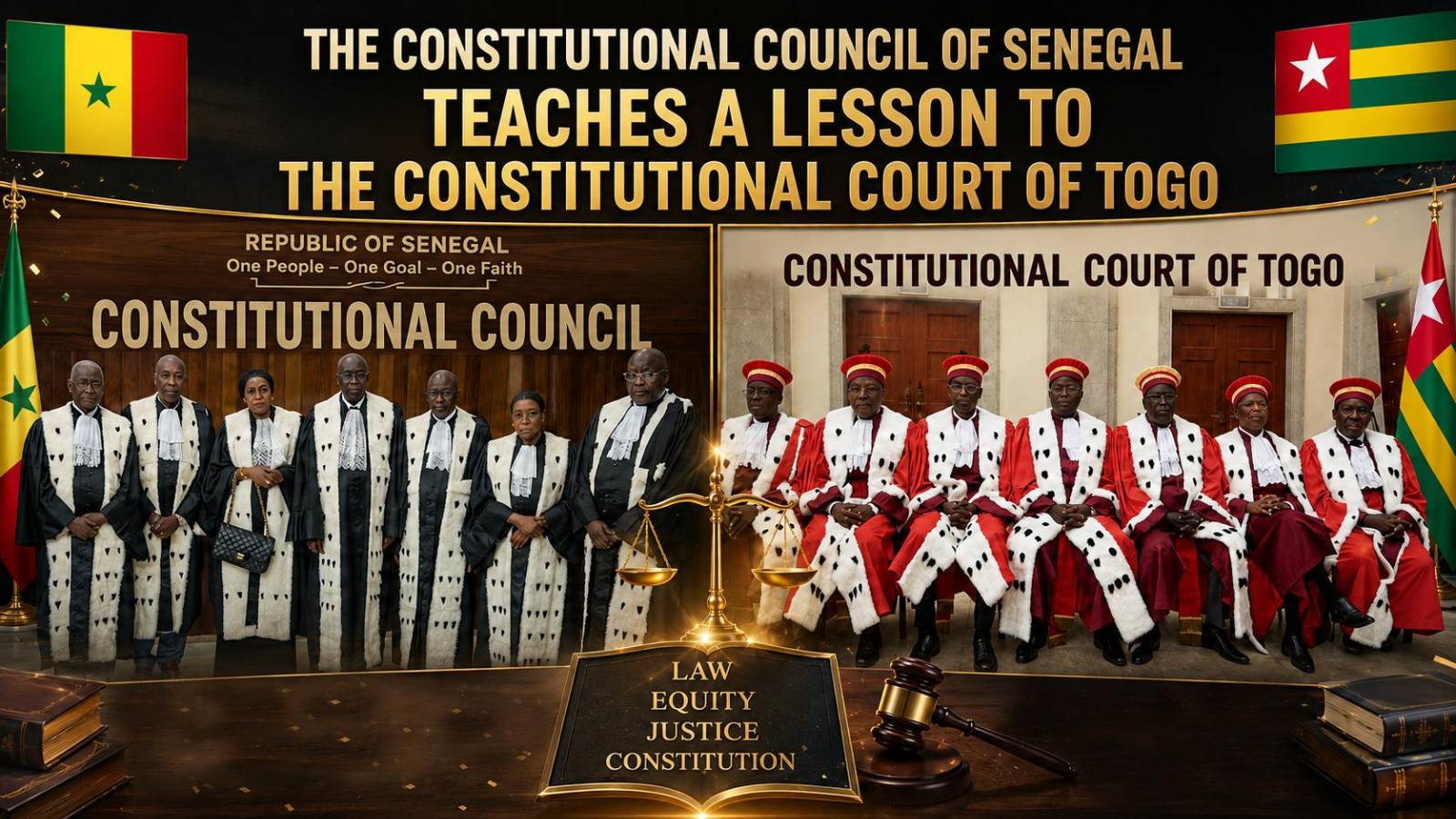
In West Africa, two capitals are charting divergent paths in their approach to constitutional governance. While Dakar and Lomé both face debates over constitutional reforms, their responses reveal fundamentally different philosophies toward the rule of law.
Judicial independence as a defining divide
The contrast between the two countries has never been more pronounced. In Senegal, the Constitutional Council has reaffirmed its role as an impartial arbiter, blocking a government-backed constitutional amendment proposed by Prime Minister Ousmane Sonko’s administration. The decision underscored a critical principle: electoral victories do not grant unlimited power. In a functional state governed by law, political legitimacy is bound by constitutional limits.
By contrast, Togo’s Constitutional Court has approved sweeping changes to the country’s foundational charter amid widespread political and legal objections. Critics, including opposition figures and legal scholars, argue that the reform process lacked broad national consultation, fundamentally altering the country’s institutional framework without sufficient consensus. A constitution, they contend, is more than a legal document—it is the social contract between a nation and its citizens. When perceived as a tool of political convenience rather than a shared agreement, its legitimacy erodes.
The price of judicial subservience
The divergence highlights a stark truth: the strength of a democracy is not measured by its constitutional text alone, but by the willingness of its institutions to enforce it without fear or favor. Independent judiciaries act as a bulwark against political crises, preventing conflicts from escalating into institutional breakdowns or legitimacy crises. When courts uphold constitutional limits—even against powerful governments—they send a powerful message: the rules apply equally to all.
This judicial firmness fosters stability, not just for institutions, but for citizens and investors alike. Predictable legal frameworks reduce uncertainty, bolster investor confidence, and enhance a nation’s credibility on the global stage. In Senegal, the Constitutional Council’s refusal to endorse an unconstitutional amendment has reinforced public trust in the judiciary’s independence.
In Togo, however, the perception that the Constitutional Court merely rubber-stamps government decisions risks undermining its moral authority. When domestic legal avenues appear ineffective, citizens and political actors may bypass national courts entirely, turning instead to regional bodies like the ECOWAS Court of Justice. Such reliance on external jurisdictions often signals a deeper institutional failure—one rooted in a loss of faith in domestic safeguards.
Constitutions as tools or foundations?
The manner in which a constitution is amended carries lasting consequences for democratic health. In mature democracies, constitutional reforms are preceded by extensive consultations, rigorous debate, and a search for broad consensus. This deliberative process is essential because a constitution is not merely a reflection of the present—it sets the rules for future leadership transitions.
When reforms are driven by short-term political calculations rather than national interest, they set dangerous precedents. Each incoming administration may feel emboldened to reshape institutions to its advantage, fostering chronic instability and concentrating power in the hands of a few. Over time, a constitution that no longer unites becomes a perpetual source of contention, transforming once-neutral institutions into battlegrounds.
Learning from Africa’s own experiences
In its pursuit of a parliamentary system, Togo has dispatched delegations to study foreign models, including those in India. While comparative constitutional research can offer valuable insights, it cannot replace the lessons drawn from Africa’s own democratic experiments. The continent has no shortage of examples where institutional strength—rather than imported blueprints—has determined democratic resilience.
Senegal stands out as a case study in how credibility is earned. Its Constitutional Council has demonstrated that an institution’s legitimacy is forged not in rhetoric, but in action—particularly when its rulings challenge the very government that appointed its members. This unwavering commitment to constitutional fidelity shapes governance quality, citizen trust, and international standing.
The stakes extend beyond domestic politics. Investors, development partners, and multilateral organizations closely monitor the stability of legal frameworks. Nations where institutions appear predictable and impartial attract greater economic engagement, while those perceived as politically malleable face skepticism. Ultimately, the distinction between Dakar and Lomé is not about the frequency of constitutional amendments, but about whether those amendments serve the nation—or the narrow interests of its leaders.