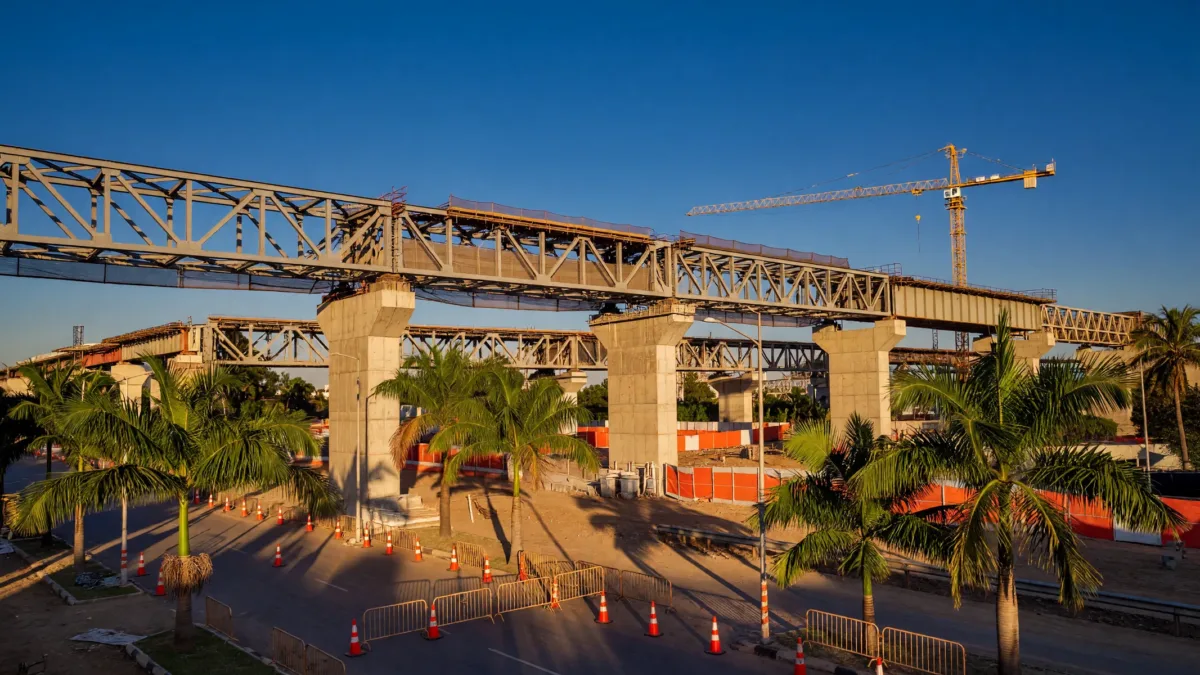
Port-Bouët’s Rue des Caraïbes, a key thoroughfare in southern Abidjan, has been completely shut to traffic since Wednesday, July 15. This closure will last two and a half months as crews work on a critical railway bridge for Abidjan Metro Line 1. Normal traffic flow is expected to resume by September 30.
The Ministry of Infrastructure and Road Maintenance confirmed the temporary closure in coordination with the Metro Project team and Ageroute. Motorists are advised to follow the designated detour routes and observe all safety signs around the construction zone. This disruption is part of the tight schedule for building Côte d’Ivoire’s first elevated metro line.
Connecting seven districts across 37.4 kilometers
Line 1 will stretch from Anyama in northern Abidjan to Félix Houphouët-Boigny International Airport in Port-Bouët, passing through seven districts along a 37.4 km route. Once operational, the fully automated system is projected to carry over 500,000 passengers daily, completing the journey in just 50 minutes—roughly eight times faster than the current peak-hour car commute.
The project includes 18 stations, 24 bridges, a lagoon-spanning viaduct, and 34 pedestrian walkways. As of last month, civil engineering work on the lagoon viaduct was nearly complete, with 12 of the 24 planned bridge decks already installed. Commercial service is slated to begin by the end of 2028.
French-led consortium driving construction
The metro is being built by a French consortium led by Bouygues Travaux Publics, in partnership with Alstom, Colas Rail, and Keolis. Bouygues oversees civil engineering and rolling stock supply, while Keolis will operate the line for 15 years after completion.
The total investment reaches approximately €1.36 billion, largely financed through French development funds and concessional loans from the French Treasury. This makes the Abidjan metro one of the largest French transport investments in West Africa.
Addressing Abidjan’s chronic congestion
Abidjan’s metropolitan area is home to about 5.5 million people. Port-Bouët, a coastal district in the south, hosts the international airport and several industrial zones. Daily gridlock plagues major arteries due to the lack of high-capacity public transit options.
The new metro aims to alleviate road congestion and provide a fast, reliable alternative to buses and shared taxis. It is also expected to generate thousands of local jobs during both construction and operation phases.
Strategic implications for France
From a French perspective, the Abidjan metro reinforces economic and diplomatic influence in Francophone Africa. The project underscores France’s strategy of funding critical infrastructure in its former colonies, where French firms maintain a strong foothold against rivals from China and Turkey.
Its success could serve as a model for similar ventures in neighboring countries like Senegal and Guinea, while also shaping debates in France about the impact and returns of concessional lending. With construction advancing steadily, the closure of Rue des Caraïbes marks one of the final critical milestones before track laying and the installation of Alstom trains across the full route.