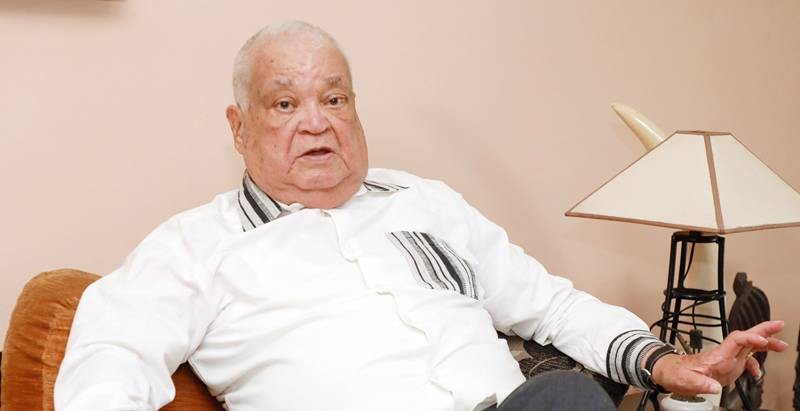
Auguste Miremont, a towering figure in Ivorian politics and media, served as the country’s first Minister of Communication (1989–1993) and as Director-General of Fraternité Matin. Now 85, he offers a rare glimpse into decades of Ivory Coast’s political landscape through his newly published memoir, Auguste Miremont: From Houphouët to Ouattara, in Complete Freedom.
In a candid conversation, Miremont shares his reflections on the nation’s transformation, his personal journey alongside Presidents Félix Houphouët-Boigny and Alassane Ouattara, and the defining moments that shaped modern Côte d’Ivoire. The book, the result of 30 hours of in-depth interviews conducted over 18 months, is less a celebration of personal achievement than a testament to legacy and national resilience.
From Houphouët-Boigny’s legacy to Ouattara’s leadership
Miremont, who resisted the idea of writing his memoirs for years, eventually embraced the project as an act of transmission rather than self-glorification. “Many urged me to document my experiences,” he explains. “At my village, even local authorities encouraged me to preserve the memory of what we built together.”
The book traces Côte d’Ivoire’s political arc from the stability of Houphouët-Boigny’s era to the turbulent transitions under Bédié, Gbagbo, and Ouattara. Miremont, who worked closely with Houphouët-Boigny as both minister and journalist, emphasizes the late president’s political genius—his ability to “listen, delay, and act at the right time”—as a cornerstone of Ivorian stability during his 33-year rule.
“Houphouët-Boigny’s strength lay in his mastery of crisis management,” Miremont reflects. “He knew how to calm tensions before they escalated. After him, the country faced far more complex challenges.” The 1999 coup d’état, which Miremont describes as “absurd” and deeply painful, marked the beginning of a prolonged institutional rupture that tested the nation’s resilience.
Ouattara’s rise: learning from history
When asked who best embodied Houphouët-Boigny’s political philosophy, Miremont points to President Alassane Ouattara. “He absorbed the most from Houphouët-Boigny—patience, listening, and decisive action. What I admire is his ability to adapt. When he was Prime Minister, he was rigorous, even severe. Today, he balances firmness with compassion, which comes with experience.”
Miremont recalls Ouattara’s tenure as Prime Minister (1990–1993) as a period of bold reforms. “He made tough decisions that were necessary for the country’s stability. He didn’t hesitate to remove collaborators who strayed from the path. It was a lesson in leadership.”
Despite praising Ouattara’s economic achievements—“the highways, hospitals, and universities built across Côte d’Ivoire speak for themselves”—Miremont cautions against overlooking social disparities. “Progress is real, but life is still expensive for many Ivorians. The government’s social programs, like vocational training and youth employment initiatives, are steps in the right direction.” He cites the “École de la deuxième chance” as a particularly impactful project, offering second chances to those who left school early.
A painful legacy: the collapse of a model
The most harrowing chapter in Miremont’s recollections is the post-1999 crisis, which saw Côte d’Ivoire’s image—once a beacon of stability and regional influence—crumble. “We went from being a country that helped others to one that inspired international concern and mockery. For those of us who lived through Houphouët-Boigny’s era, it was heartbreaking.”
Miremont reserves particular sorrow for the violence during Guéï’s transition and Gbagbo’s presidency. “The death of Robert Guéï and Emile Boga Doudou shattered me. They were men of dialogue and compromise. Their loss symbolized the collapse of what we had built.”
Personal bonds and political lessons
Beyond the macro narrative, Miremont’s memoir offers intimate insights into his relationships with Ivory Coast’s leaders. His rapport with Houphouët-Boigny was professional but respectful. “He called me ‘De Miremont’—a nod to history, I suppose. He respected my integrity and my willingness to speak my mind, even when it wasn’t convenient.”
With President Bédié, Miremont served as the leader of his parliamentary group. “We shared a long history. He was always accessible, even when his schedule was packed.” His bond with Gbagbo, initially adversarial, evolved into friendship during negotiations for a unity government. “Gbagbo supported economic pragmatism during tough times. He even helped me financially at one point—a gesture I’ve never forgotten.”
As for Ouattara, Miremont describes a relationship built on trust and admiration. “He is courteous, attentive, and deeply committed to the nation’s progress. His ability to listen and respond to individual concerns is rare in politics.”
The road ahead: unity and challenge
At 85, Miremont remains optimistic about Côte d’Ivoire’s future but insists on realism. “Ouattara is not stepping down anytime soon. His vision—a united, prosperous Ivory Coast—is clear. But we must address the cost of living and inequality. The government’s social safety nets are a good start.”
Asked about succession, Miremont deflects. “It’s too early to think about that. The focus should be on completing his current term and delivering on his promises. Côte d’Ivoire has come too far to regress now.”