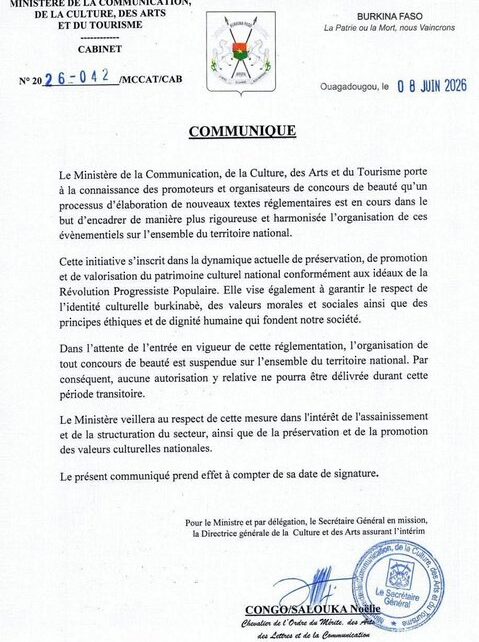
An official directive has sent shockwaves through Burkina Faso. Authorities have indefinitely suspended all beauty pageants nationwide, citing a commitment to preserving cultural values and acknowledging the nation’s ongoing security crisis. Yet beneath the surface of this decision lies a more troubling development: the steady consolidation of authoritarian rule.
Politics through distraction
The timing and target of this measure raise critical questions. In a nation grappling with severe security threats and persistent humanitarian instability, why prioritize a crackdown on beauty pageants over reclaiming territory?
Regional analysts interpret this incursion into cultural and recreational spheres as a deliberate political tactic: distraction. By redirecting public discourse toward moral and societal debates, authorities aim to obscure unfulfilled promises of stability and constitutional order.
State-sanctioned morality as a tool of control
The beauty pageant ban is not an isolated act; it reflects a broader pattern of state interference in private life and individual freedoms. Under the guise of moral recalibration, the transitional government is laying the groundwork for rigid social conformity.
A human rights advocate, speaking on condition of anonymity, expressed concern: “Today, a beauty contest is banned in the name of values. Tomorrow, what will be prohibited? A fashion choice? An artistic expression? A dissenting idea?”
The inclination to govern bodies, leisure, and cultural expression is a hallmark of autocratic regimes. The approach is insidious: it avoids overt violence, instead wielding oppressive decrees that infantilize citizens by dictating what deserves celebration.
The slow suffocation of democracy
This development transcends the cancellation of a fashion show. It signals a systematic erosion of civic and democratic space in Burkina Faso. Following the suppression of opposition parties, the silencing of independent media, and the detention of dissenting voices, the assault now targets cultural industries.
A disguised dictatorship is defined by its pervasive reach—turning arbitrariness into legality and elevating puritanism to state doctrine. By depriving youth and cultural actors of their platforms for expression and entertainment, the transitional administration sends a clear message: ideological conformity is mandatory, and even aesthetic dissent will no longer be tolerated.
Behind the rhetoric of sovereignty and moral rectitude, Burkina Faso is sliding toward a monolithic social structure where the state dictates every aspect of life for its people. Beneath a veneer of protectionism lies a familiar political phenomenon: creeping authoritarianism.