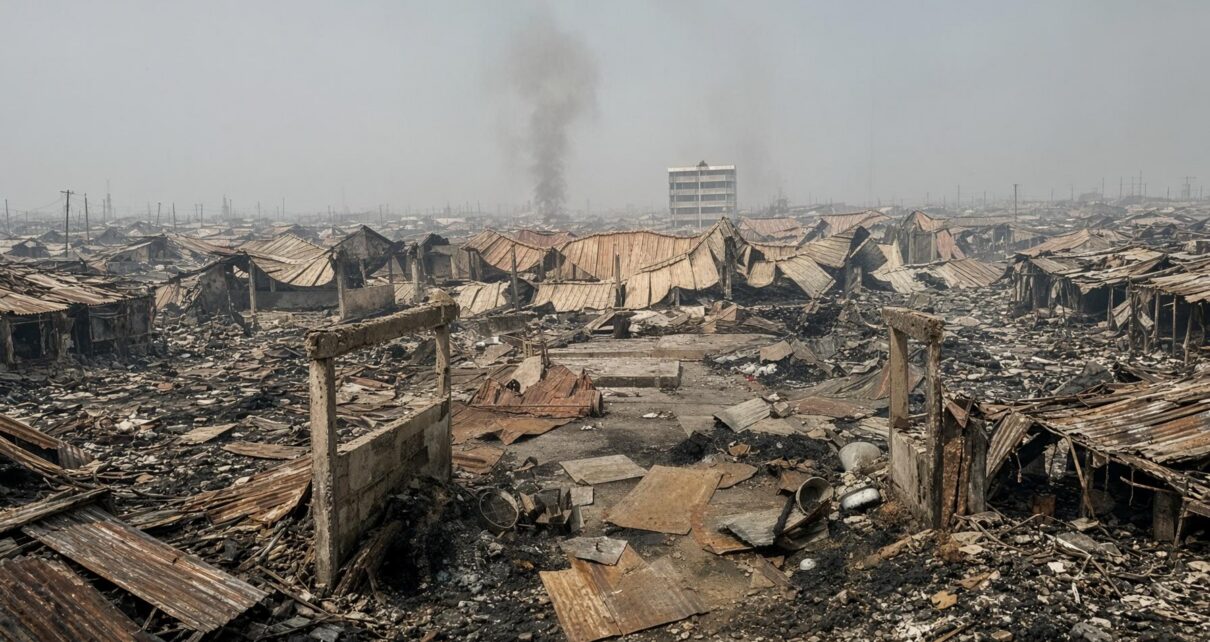
In a single night, the heart of the Plateau region’s economy lay in ruins. The main building of the Anié Grand Market was consumed by flames, leaving nothing but smoldering debris in its wake. While the miracle of no lives lost offers a fragile comfort, the aftermath is a harsh reality for hundreds of families who have lost their livelihoods overnight—merchandise, savings, and years of labor reduced to ashes.
The anatomy of a preventable disaster: why an avoidable fire spiraled out of control
The fire at Anié wasn’t an act of nature—it was the inevitable outcome of decades of stagnation and institutional neglect. Despite its central role in the regional economy, the market lacked basic modern fire safety provisions: non-functional hydrants, blocked access routes, and outdated electrical wiring that turned every stall into a potential fire hazard.
Decades of empty promises: the gap between Lomé’s vision and ground reality
The disaster in Anié is not an isolated incident but a symptom of a much larger governance failure. Since Faure Gnassingbé assumed office in 2005, the Togolese government has prioritized grand development narratives over practical infrastructure upgrades. The ‘Emerging Togo’ slogan rings hollow when traders operate in facilities that resemble relics from a bygone era—structures designed for the 1960s, not the digital age.
A regime living off borrowed time
The absence of investment in public safety reflects a deeper crisis: a leadership that governs on inertia rather than innovation. With national budgets often funneled into political survival rather than societal progress, even critical issues like fire prevention are deprioritized until catastrophe strikes. Markets in Lomé, Kara, and now Anié serve as stark reminders—glossy policy papers do little when basic safety measures are ignored.
What the ashes of Anié market reveal about Togo’s governance failure
The post-fire narrative of government aid and symbolic gestures misses the point entirely. Distributing relief packages after disasters treats the symptoms, not the disease. The true failing lies in a system that allows informal traders—vital to the national economy—to work in conditions that are structurally unsafe. By normalizing risk, the state abdicates its primary responsibility: protecting its people and their economic future.
The cost of inaction: why tomorrow’s tragedies are already written
Unless the roots of this crisis are addressed—through investment in infrastructure, enforcement of safety standards, and a rejection of governance models that prioritize control over care—another market will burn, another community will suffer, and another generation will inherit a state that fails to lead. The fire in Anié is not the first, and without real change, it won’t be the last.