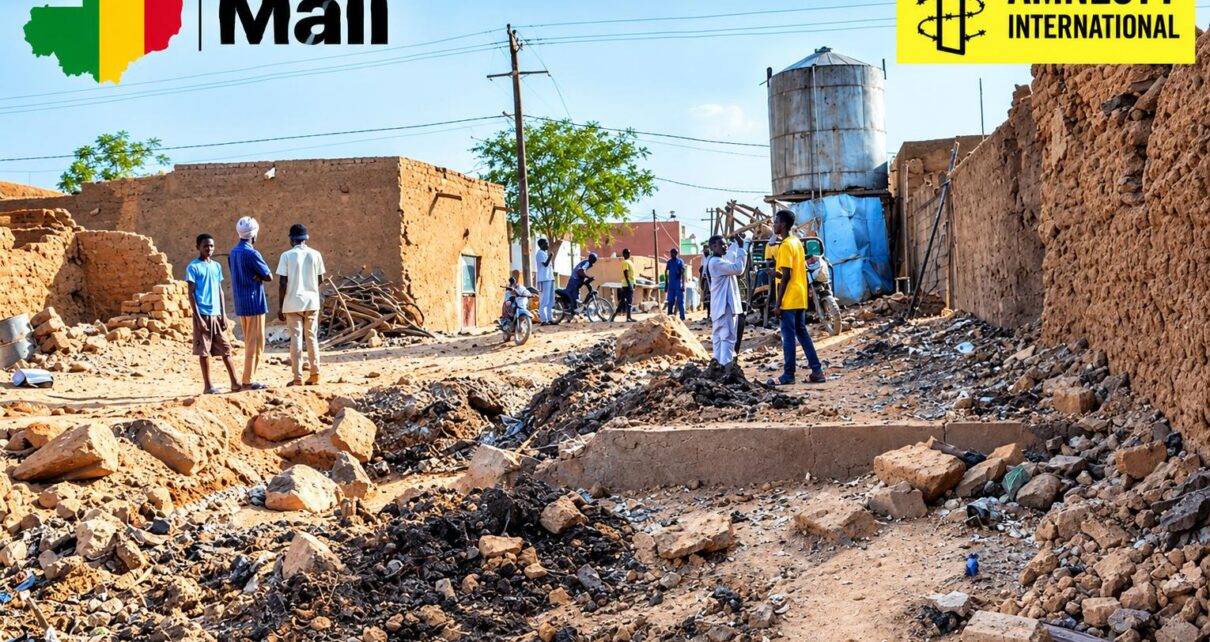
The silent toll behind Mali’s military campaigns: what happens when civilians pay the price
The government’s stated goal of restoring security in Mali has come at a devastating human cost, according to new findings that pull back the curtain on operations involving national forces and foreign allies. Between mid-2023 and late 2025, remote towns and marketplaces across Ségou, Mopti, and Tombouctou became the backdrop for what human rights investigators now characterize as systematic violations against non-combatants. The remote, often underreported nature of these attacks—ranging from drone strikes to night raids—has allowed them to slip under international radar for months, accumulating a grim tally: at least 34 civilians killed, along with documented cases of torture, forced disappearances, and mass displacement. Behind the statistics lie the unheard voices of pastoral communities, market vendors, and families caught in no man’s land between the state’s security narrative and the harsh reality on the ground.
The making of a crisis: how investigations uncovered hidden patterns of violence
Human rights monitors reached survivors and witnesses through discreet networks in refugee camps beyond Mali’s borders. By cross-referencing oral accounts with geospatial data, digital footprints of drone footage, and internal military communications later obtained, they were able to reconstruct a pattern of violations that local authorities had either downplayed or omitted entirely. The report reveals how certain regions—long suspected of harboring armed factions—were targeted with increasing precision, yet the collateral damage consistently involved people with no known ties to militant groups. Among the most vulnerable communities are Fulani, Arab, and Tuareg pastoralists, whose traditional livelihoods keep them moving across contested territory. Their mobility is now being weaponized: accusations of collusion with insurgents are spreading like wildfire, exposing entire villages to collective punishment before any evidence can be presented in court.
From the skies to the streets: the hidden cost of drone warfare in northern Mali
Two documented drone strikes in early 2025 struck civilian hubs with what investigators call “blind precision.” In one such incident at Ejdeir market on March 16, 2025, 16 people were killed and seven injured—none of whom bore insignia or weapons at the time. Military authorities, while initially claiming the strike targeted a “terrorist gathering,” later aligned their coordinates with the marketplace coordinates, essentially admitting that vital intelligence may have been missing or ignored. The absence of verifiable military objectives at the strike sites raises serious questions about whether these operations violate fundamental principles of international humanitarian law, particularly the prohibition on indiscriminate attacks.
Routine brutality inside detention centers: the human chain of accountability
The investigation also documents a parallel system of abuse inside detention facilities from Léré to Nampala, where detainees describe repeated acts of extreme torture. Survivors report being suspended by their limbs, subjected to waterboarding simulations, beaten with metal bars and batons, and given electric shocks—methods reportedly executed by foreign operatives and witnessed by local soldiers. At least five individuals reportedly died as a direct result of these abuses, while dozens more remain unaccounted for, held for weeks or months without charge or judicial recourse. The severity of the accounts suggests that torture has become a systematized method of interrogation and intimidation, rather than isolated incidents.
A shifting Russian footprint: Africa Corps takes over from Wagner—responsibility stays the same
The findings arrive at a moment of institutional reshuffling in Bamako’s security sector: Wagner Group, which had been active since late 2021, officially exited Mali in June 2025, replaced by Africa Corps, a Kremlin-linked force under Russia’s Ministry of Defense. While the entity may have changed, the report argues that accountability mechanisms have not. Amnesty International is now demanding public clarification on the legal status and operational control of Africa Corps troops operating alongside Malian forces. The call underscores a critical gap in the country’s evolving security architecture: as Bamako deepens its strategic alliance with Moscow, the absence of clear oversight could enable further violations under the guise of counterterrorism operations.
The bigger picture: when war crimes become routine, who ultimately pays the price?
It would be reductive to frame Mali’s crisis solely as a conflict between state forces and armed groups. In truth, civilians are being squeezed by a multi-layered catastrophe: from jihadist ambushes that displace entire villages to military sweeps that leave markets in smoldering ruins. Over 2,000 schools remain shuttered across the country, depriving an entire generation of education and hope. And yet, despite these mounting horrors, justice remains elusive. Official responses to the report have been absent, and a June 2026 decision to withdraw from the Rome Statute—the legal foundation of the International Criminal Court—has raised fears that accountability for war crimes may simply vanish into diplomatic limbo. While the withdrawal does not erase the Court’s prior jurisdiction over incidents predating the exit, it sends a chilling signal: investigations could be shelved, victims silenced, and perpetrators emboldened.
The precarious line between counterterrorism and collective punishment
At the heart of the crisis lies a strategic dilemma: how to fight armed groups without erasing the very communities they claim to protect. The report documents multiple cases where entire villages were razed on suspicion of sheltering insurgents, only for intelligence to later reveal no real connection. This pattern of overreach risks radicalizing previously neutral populations, turning local grievances into new recruitment grounds for militant factions. Meanwhile, the state’s insistence on portraying military operations as surgical successes clashes sharply with the lived reality of civilians navigating a landscape where hospitals, schools, and homes are routinely reduced to rubble.
An urgent call to break the cycle of violence and impunity
The report does not question Mali’s right, or even duty, to defend its citizens from armed extremists. What it insists upon is the absolute necessity of adhering to international humanitarian law. That means distinguishing combatants from civilians at all times, ensuring transparent investigations into every allegation of abuse, and holding those responsible—whether Malian soldiers, foreign contractors, or armed group commanders—to account through fair and impartial tribunals. The path forward demands more than policy statements; it requires concrete action: immediate public acknowledgment of wrongdoing, unfettered access for independent investigators, and the restoration of basic protections for Mali’s most vulnerable inhabitants. Without these steps, the cycle of violence and silence will only deepen, leaving behind a trail of broken lives and irreparable scars.