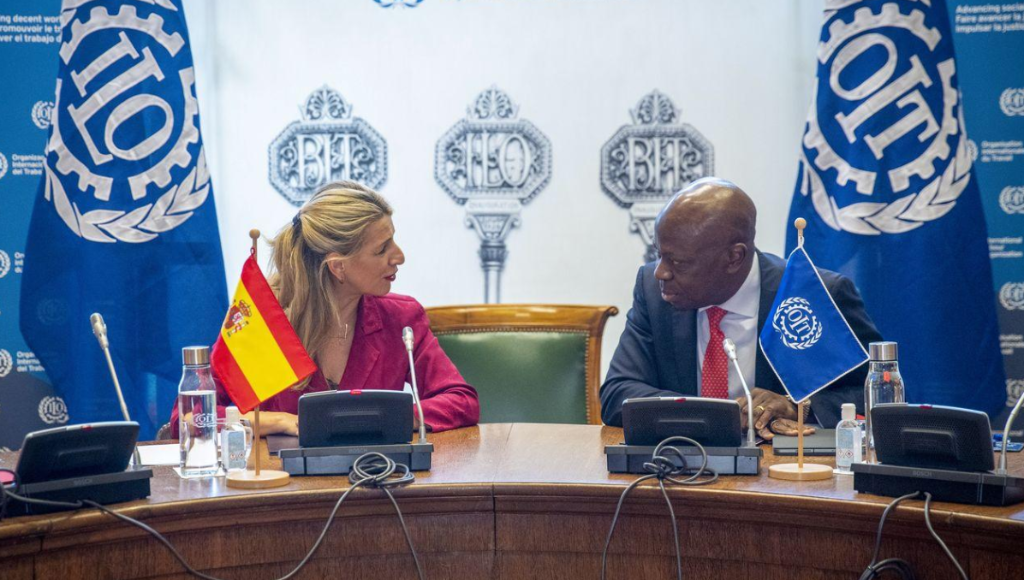
Has Gilbert Houngbo’s second term just delayed the ILO’s internal crises?
On November 16, 2026, Gilbert Houngbo secured a second five-year term as Director-General of the International Labour Organization (ILO) — not through a competitive election, but thanks to the last-minute withdrawal of his sole challenger, Spain’s Yolanda Díaz. Her decision, framed as a bid to preserve unity within the global labour movement, carried a sting: a scathing critique of the outgoing administration’s leadership, financial mismanagement, and erosion of social dialogue within the very institution tasked with defending workers’ rights worldwide.
From financial instability to broken trust: the core of Yolanda Díaz’s accusations
At the heart of Díaz’s critique lies a troubling financial picture. She describes the ILO as facing one of the most severe crises in its history — a crisis compounded by delayed and unpaid contributions from key member states, including the United States. These shortfalls have forced the organization into cost-cutting measures: staff reductions, restructuring, and operational downsizing. But Díaz argues that the burden of these reforms has fallen disproportionately on the workers themselves, undermining the institution’s core mission of social justice and labour rights.
Her concerns extend beyond balance sheets. Díaz accuses the current leadership of weakening the very foundation the ILO was built on: social dialogue. She points to strained relations between management and staff, limited consultation mechanisms, and growing disillusionment among employees — who, ironically, are meant to be beneficiaries of the dialogue they now lack within their own workplace.
The criticism is stark: an institution dedicated to protecting global labour rights is struggling to practice what it preaches internally.
Why unity trumped competition: the political calculus behind Díaz’s withdrawal
Díaz’s decision to step aside was not made lightly. Her withdrawal came shortly after that of Peru’s Javier González-Olaechea, leaving Houngbo unopposed. But political strategy, not absence of opposition, likely shaped her move. She cited the need to prevent lasting division within the international labour movement — particularly as the International Trade Union Confederation (ITUC) had already pledged its support for Houngbo’s reelection, alongside the International Organisation of Employers (IOE).
Díaz contested the authenticity of that support, suggesting it masked deep internal disagreements among unions. In her view, endorsing Houngbo failed to reflect the diversity of voices in the global labour movement. Her withdrawal was, in essence, a gesture of solidarity — one made in the hope of preserving cohesion rather than escalating conflict.
Houngbo’s legacy in question: can the ILO recover without addressing its internal fractures?
Now entering a second term, Houngbo faces a paradox: a mandate renewed by default, yet questioned by the very constituency the ILO represents. While his reappointment ensures continuity, it does nothing to silence the criticisms that preceded it. The financial strain, job insecurity among staff, and a perceived decline in social engagement all demand urgent attention.
For the next five years, the ILO’s credibility may hinge less on its global outreach than on its ability to heal its internal wounds. Can Houngbo’s leadership restore financial stability without sacrificing mission and morale? Can the organization rebuild trust with its own workforce while maintaining its role as a beacon of labour justice?
The stakes are high. The ILO’s legitimacy depends not only on the absence of opposition in its election, but on its capacity to answer the very questions raised by those who chose to withdraw rather than fight.
Key challenges for Houngbo’s second term
- Financial recovery without social cost: balancing budget cuts with protection of workers’ rights within the organization.
- Restoring internal social dialogue: rebuilding trust between leadership and staff, ensuring meaningful consultation and fair treatment.
- Rebuilding external credibility: demonstrating that reform can coexist with the ILO’s founding principles of justice and equity.