The countdown to December 2, 2026, isn’t just about a calendar date—it’s the moment when Senegal’s constitutional clock starts ticking on a high-stakes political maneuver. With the nation’s president on the brink of gaining a powerful institutional tool, the nation braces for a strategic crossroads that could redefine governance, alliances, and public trust.
The legal mechanics behind the dissolution deadline
The Senegalese Constitution, through its Article 87, sets a precise timeline for one of the president’s most consequential powers. By December 2, 2026, two full years will have elapsed since the current National Assembly—led by the Pastef party—began its term on December 2, 2024. This milestone unlocks the presidential prerogative to dissolve the legislature, effectively resetting the political landscape if exercised.
What makes the timing critical isn’t just the legal allowance—it’s the political context that has shifted dramatically since the assembly’s installation. The president, once aligned with Pastef, now leads an executive divorced from the parliamentary majority due to the party’s rupture in May 2026. As the president’s newly formed party, Kiiraay, scrambles to consolidate influence, the possibility of dissolution emerges not as a distant threat, but as a live negotiation tactic.
The dual narrative: official caution vs. ministerial boldness
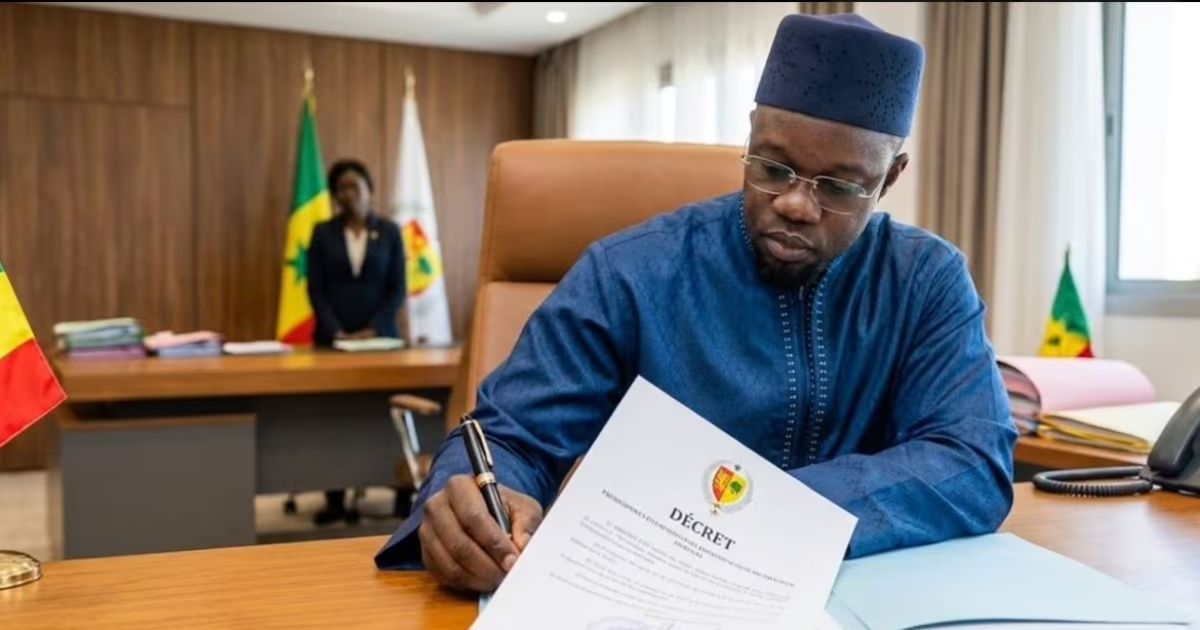
President Bassirou Diomaye Faye has maintained public ambiguity, stating in New York that no dissolution decision is finalized and that the threat remains hypothetical—at least for now. Yet within his cabinet, the tone diverges sharply. Trade Minister Serigne Guèye Diop, for instance, has framed the legislative majority as actively undermining the presidency, citing systemic rejection of presidential initiatives. This public rift between the executive’s measured tone and its ministers’ aggressive posturing underscores a calculated strategy: using the dissolution threat as leverage over parliamentary debates before it ever materializes.
If the president acts on December 2, Senegal faces a compressed election timeline. The Constitution mandates legislative elections within 60 to 90 days of dissolution, setting polls between late January and early March 2027. The 2024 precedent offers a glimpse of feasibility—after a September 12 dissolution, elections were held by November 17. However, the looming January 17, 2027, municipal elections introduce logistical and political complexity. A potential merger of the two votes, while debated among officials, clashes with legal deadlines, raising the specter of a staggered electoral calendar that could further strain resources and public patience.
Stalemate tactics: governing without a parliamentary mandate
Alternatively, the president could opt for a strategic delay, allowing the assembly to function even without majority alignment. Such a stalemate, however, is far from stable. The recent rectified finance bill linked to the IMF agreement, submitted to the assembly on September 18, has already exposed fault lines. Ousmane Sonko, leader of Pastef, demanded clarifications on the agreement’s terms and debt management, signaling an era where legislative cooperation is the exception, not the rule.
This deadlock would transform routine governance into a high-stakes negotiation. Each legislative filing becomes a bargaining chip, with the president framing the impasse as a matter for the people to arbitrate. The municipal elections of January 2027 could thus serve as the first referendum on this cohabitation’s viability—or its untenability, depending on the results.
The financial strain adds another layer of urgency. Drawing from the 2024 experience, legislative elections demand significant resources. That year, the government allocated 20 billion West African CFA francs for polls, with ballot printing and campaign materials alone exceeding 11 billion. For context, the March 2024 presidential election cost approximately 14 billion. A fresh dissolution would force another injection of public funds, triggering debate even within Kiiraay ranks. One party official in Kaolack has already cautioned against prioritizing elections over social spending, illustrating the depth of internal divisions over the strategic choice.
Power calculations: what’s at stake for the president and his rivals
For President Faye, dissolution presents a high-risk, high-reward scenario. Success would restore a parliamentary majority, enabling unencumbered governance through the remainder of his term. For Kiiraay—a party barely two months old—it’s a baptism by fire. A defeat would leave the president presiding over a reinvigorated, opposition-led assembly, potentially hostile for the duration of his mandate.
Pastef, meanwhile, starts from a position of dominance, holding 130 of the assembly’s 165 seats. In an early election, the party has little to gain in parliamentary terms—but everything to lose. A resounding victory would validate Sonko’s narrative of presidential betrayal, positioning him as the country’s de facto political center of gravity. His party has wasted no time, launching nationwide membership drives to fortify its base ahead of any potential poll.
Opposition forces crushed in 2024 see opportunity in the division. The fracture within the former majority opens space for alliances, though tactical alignments remain uncertain. Will smaller parties side with Faye’s camp or Sonko’s? Their choice may determine whether the December decision is a step toward stability—or a leap into uncharted political territory.
As the December clock ticks down, one truth emerges: December 2 isn’t a deadline—it’s a starting pistol. Whether the president fires it, waits, or keeps it holstered as leverage, the nation’s political trajectory is entering uncharted territory. And the first test may come not in a vote, but in the passage of next year’s budget and the IMF-backed reform agenda that follows.