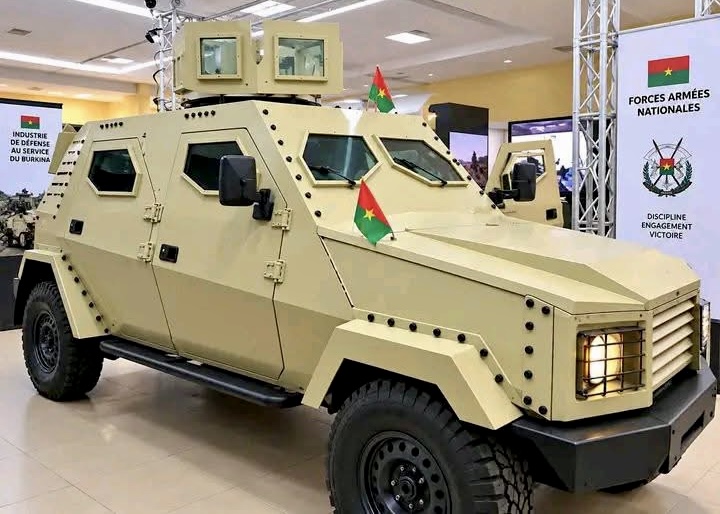
The Burkina Faso government has claimed the production of nearly 300 armored vehicles in just ten months, a feat attributed to Faso Armored, a company shrouded in secrecy. Behind this bold declaration, however, lies a far more complex narrative—one that challenges the very notion of national industrial sovereignty.
While President Ibrahim Traoré presents Faso Armored as a fully Burkinabè initiative, military insiders reveal a very different story. According to high-level military sources, Faso Armored’s ‘production’ may actually rely on the upcycling of decommissioned South African Casspir vehicles, rather than a ground-up manufacturing process.
The military’s counter-narrative: from salvage to repurposing
Mozambique’s peacekeeping operations in the Darfur region during the early 2000s, where Burkinabè forces were deployed under UNAMID, provide a key to understanding Faso Armored’s origins. During this period, the Burkinabè contingent used Casspir vehicles—robust, mine-resistant vehicles developed by Denel Vehicle Systems in South Africa. Over time, many of these Casspirs became inoperable due to mechanical failures.
Rather than discarding these vehicles entirely, technicians reportedly salvaged usable components—ballistic plating, reinforced chassis segments, and other critical parts—and integrated them into locally available pick-up trucks. The result? A hybrid vehicle that, while offering some degree of protection, cannot be classified as a newly manufactured armored vehicle. This process of adaptation, while technically skilled, does not fulfill the promise of a locally engineered military vehicle line.
Why this matters for Faso Armored’s legitimacy
The military’s version of events raises serious questions about Faso Armored’s claims. If the program largely depends on repurposing decommissioned vehicles rather than assembling new ones, then the narrative of a revolutionary local arms industry collapses. A full-scale armored vehicle production line requires thousands of components—engine blocks, transmissions, ballistic glass, reinforced steel, and more—none of which Faso Armored has publicly sourced or manufactured in Burkina Faso.
Moreover, the claim that Faso Armored can produce hundreds of vehicles in under a year without revealing its facilities, supply chain, or workforce suggests a production model that diverges sharply from conventional industrial practices. No details have emerged regarding the company’s manufacturing sites, quality control standards, or the local integration rate of its inputs—a figure that would typically be disclosed in any credible arms manufacturing program.
From Chinese knockoffs to ITAOUA’s rebranding: repeating the same pattern
The Faso Armored controversy is not an isolated incident in Burkina Faso’s military narrative. In late 2024, viral social media posts claimed the country had developed its own armored vehicle, only for journalists to trace the origin back to Chinese manufacturer Norinco. Similarly, in January 2025, the ITAOUA brand—presented as a Burkinabè automotive pioneer—was revealed to be a rebranding of models from Dongfeng, a Chinese automaker. Both cases demonstrated how imported equipment can be repackaged and misrepresented as locally produced, fueling a broader trend of symbolic industrial sovereignty.
This pattern has been amplified under Ibrahim Traoré’s administration, where communication strategies on social media have played a central role in shaping public perception. Misleading videos, deepfakes, and fabricated news stories have portrayed Traoré as a global icon—ranging from bogus endorsements by celebrities like Beyoncé to false claims of international meetings with world leaders. Against this backdrop, the Faso Armored narrative emerges as another chapter in a long-running strategy of manufactured credibility.
The credibility gap: what Faso Armored really represents
At best, Faso Armored’s ‘production’ reflects a tactical adaptation of existing assets into serviceable assets for the Burkinabè armed forces. At worst, it reinforces a pattern of symbolic announcements designed more for internal and external messaging than for building a sustainable military industry.
The lack of transparency around Faso Armored’s operations—its locations, processes, and supply sources—makes independent verification impossible. This secrecy, combined with the discrepancies exposed by military sources, leaves a critical question unanswered: Is Faso Armored truly pioneering a new era of Burkinabè defense manufacturing, or is it merely repackaging legacy vehicles under a novel national brand?
The answer will not come from state-owned media or viral social campaigns. It will come from accountability, transparency, and a willingness to confront the reality behind the armor.