The Economic Community of West African States (ECOWAS) remains committed to launching the Eco by 2027, yet regional economic disparities suggest not all member states will progress at the same pace. In this evolving landscape, Bénin has emerged as one of the most promising candidates to participate in an initial phase of monetary integration.
The Eco project: ambition meets economic realities
The concept of a single West African currency has long been a cornerstone of ECOWAS’s economic integration agenda. However, balancing political ambition with economic feasibility presents significant challenges: persistent inflation, public deficits, unsustainable debt levels, low foreign reserves, exchange rate instability, and divergent national economic policies.
Given these constraints, a phased approach to monetary union appears increasingly plausible. This would allow the most economically prepared countries to adopt the Eco first, while others continue working toward convergence criteria.
Bénin’s exceptional macroeconomic performance
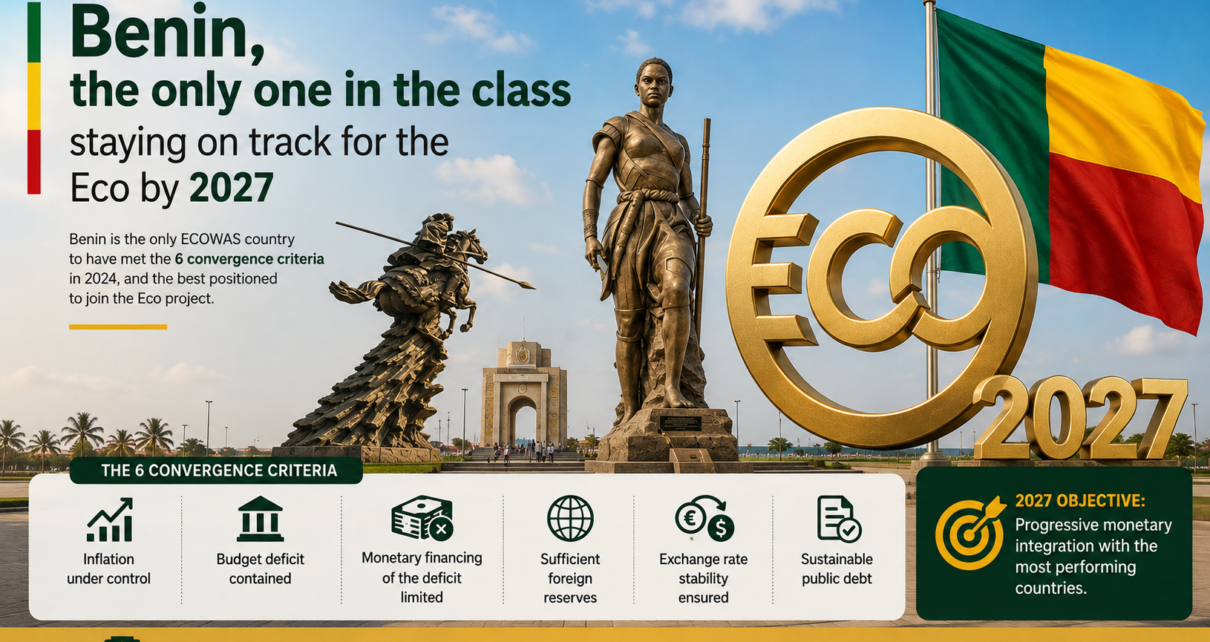
In 2024, Bénin distinguished itself as the only ECOWAS member to meet all six primary convergence criteria established for the Eco project. This achievement is particularly noteworthy because these criteria are not isolated metrics; they collectively assess a nation’s economic resilience across multiple dimensions.
Six pillars of convergence
The framework includes the following key indicators:
Inflation control: Ensuring price stability and safeguarding purchasing power.
Budgetary discipline: Limiting fiscal deficits within agreed thresholds.
Monetary financing restrictions: Preventing excessive money supply growth to fund public spending.
Foreign reserve adequacy: Maintaining sufficient reserves to cover several months of imports.
Exchange rate stability: Preserving a steady nominal rate to underpin monetary credibility.
Public debt sustainability: Keeping debt levels within sustainable boundaries.
By simultaneously fulfilling these requirements, Bénin demonstrates a coherent and disciplined macroeconomic strategy one that extends beyond short-term gains to reflect long-term economic governance.
Reforms as the foundation of progress
Bénin’s success follows years of deliberate structural reforms, including enhanced revenue mobilization, improved public financial management, and sustained investment in critical infrastructure and essential services. These efforts required careful balancing, particularly between fiscal discipline and development financing.
The true test for Cotonou will be sustaining this performance beyond a single year. Meeting convergence criteria annually sends a strong signal, but consistent adherence over multiple years will be essential to cement Bénin’s credibility as a regional leader in monetary integration.
A staggered transition: a pragmatic path forward
The heterogeneity of West African economies each with unique debt burdens, fiscal capacities, and inflationary pressures makes a uniform transition impractical. Security challenges, geopolitical tensions, and regional trade disruptions further complicate the landscape.
A gradual implementation of the Eco, prioritizing countries that meet the criteria, offers a more realistic pathway to monetary union. Rather than a simultaneous adoption by all ECOWAS members, this approach allows for a core group of compliant nations to lead the transition.
Why Bénin could be among the first
If ECOWAS adopts this progressive model, Bénin is well-positioned to be among the initial adopters. Maintaining its current macroeconomic trajectory would grant it a strategic advantage in shaping regional monetary policy, enhancing financial credibility, and boosting trade integration.
However, the road to 2027 remains uncertain. The project’s feasibility hinges not only on economic performance but also on collective political will, institutional governance, and solidarity mechanisms among member states.
Regional shifts and new challenges
The exit of several Sahelian countries from ECOWAS has introduced further complexity. The original vision of a unified monetary bloc must now adapt to a revised regional landscape, requiring revised strategies for coordination and convergence.
Sustaining the lead: no room for complacency
Bénin has earned its current advantage through disciplined economic governance, but this position is not guaranteed indefinitely. The coming years will demand continued vigilance in debt management, inflation control, and structural reform implementation.
As the 2027 deadline approaches, the challenge will extend beyond merely leading the pack. Bénin must remain at the forefront, ensuring its economic policies align with the evolving demands of a shared regional currency. Success will depend not on early adoption alone, but on sustained excellence in macroeconomic management when the Eco transitions from policy to practice.