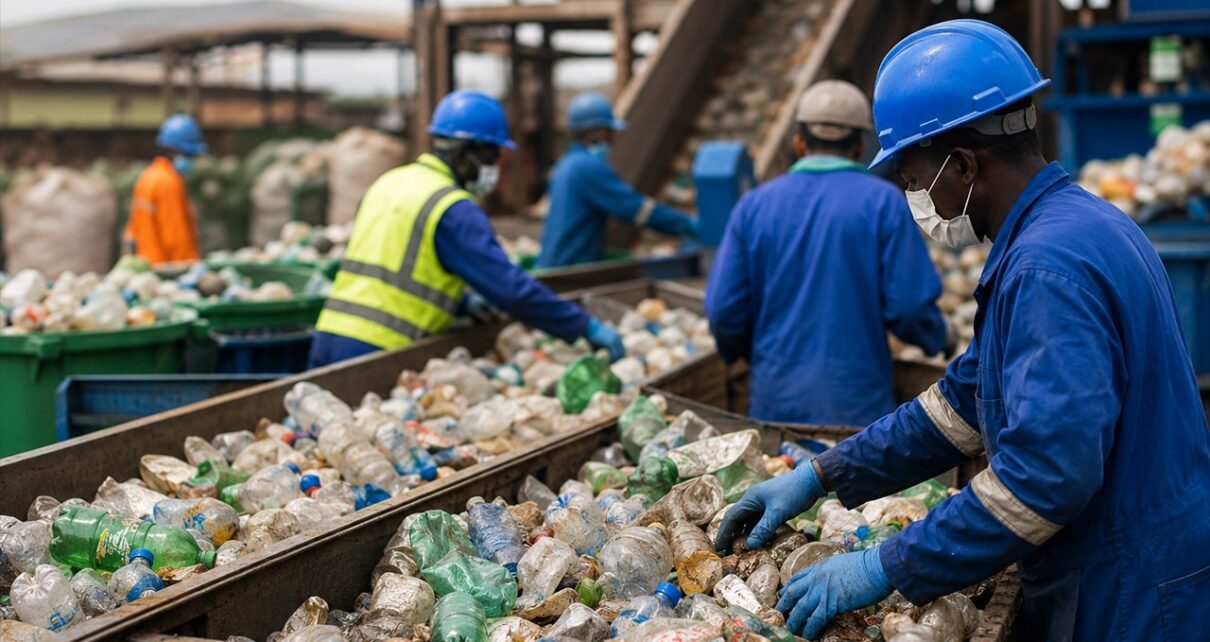
Cameroon’s bold plan to tackle urban waste with circular economy reforms
The government of Cameroon has set an ambitious target: by 2030, 2% of the national budget will be dedicated to circular economy initiatives. This commitment is outlined in the National Circular Economy Roadmap for 2025-2035, a strategic document developed by the Ministry of Economy, Planning, and Territorial Development. The roadmap provides a clear blueprint for sustainable resource management and waste valorization across the country.
Under this vision, investments in circular economy projects are projected to reach 62.8 billion FCFA in 2025, with an additional 30 billion FCFA allocated annually for waste management. Together, these amounts represent 1.27% of the national budget. By 2030, the government plans to increase this total to 2%—an increase of over 53 billion FCFA from current levels, based on the 2025 budget framework.
The scale of the waste challenge in Cameroon
Cameroon generates approximately 6 million tons of waste annually, primarily from households, markets, public services, and businesses. However, the existing waste management system is heavily skewed toward collection, with limited capacity for processing or recycling. The roadmap highlights critical gaps: a collection rate of just 50%, a recycling rate below 10%, and almost no source separation of waste.
Urban centers like Yaoundé and Douala are under increasing pressure. By 2040, waste generation in these cities is expected to exceed 2.8 million tons per year, straining already inadequate infrastructure. The document underscores systemic weaknesses: lack of source segregation, minimal waste recovery, insufficient collection and treatment facilities, weak data systems, and limited institutional capacity.
Plastic pollution remains a major concern. Daily, nearly 1,300 tons of plastic waste are discarded into the environment. Yet only 250 tons are collected each month, and a mere 180 tons are recycled—leaving a vast gap between waste generation and recovery.
Transforming waste management through policy and investment
To address these challenges, the government plans sweeping reforms and targeted investments across the entire waste management chain. Key measures include:
- Adopting a Prime Minister’s decree to embed circular economy principles into value chains;
- Updating environmental legislation and strengthening enforcement agencies;
- Clarifying roles between sectoral ministries and local governments;
- Potentially establishing a National Waste Management Agency.
On the infrastructure front, the roadmap calls for the construction and modernization of sorting centers, transfer stations, and sanitary landfills compliant with international standards. It also emphasizes the expansion of organic waste management through biodigesters and composting units.
Community-focused recycling initiatives, public awareness campaigns on source separation, and support for training and innovation in recycling professions are also prioritized. These efforts aim to curb illegal dumping and foster responsible waste practices nationwide.
A financing strategy rooted in public-private collaboration
While public funding will play a central role, the strategy also leverages private sector participation. Proposed measures include reforming municipal waste-related taxes, implementing mandatory Extended Producer Responsibility (EPR) systems to fund collection and recycling, and scaling up the National Waste Exchange—a digital platform already in operation that facilitates transactions of recyclable materials.
This platform is designed to stimulate private investment, create a vibrant market for recovered materials, and enhance transparency in waste trading. Additionally, international partners such as the African Development Bank, the African Circular Economy Facility, the World Bank, the Japan International Cooperation Agency (JICA), and several UN agencies are identified as potential sources of financial and technical support.