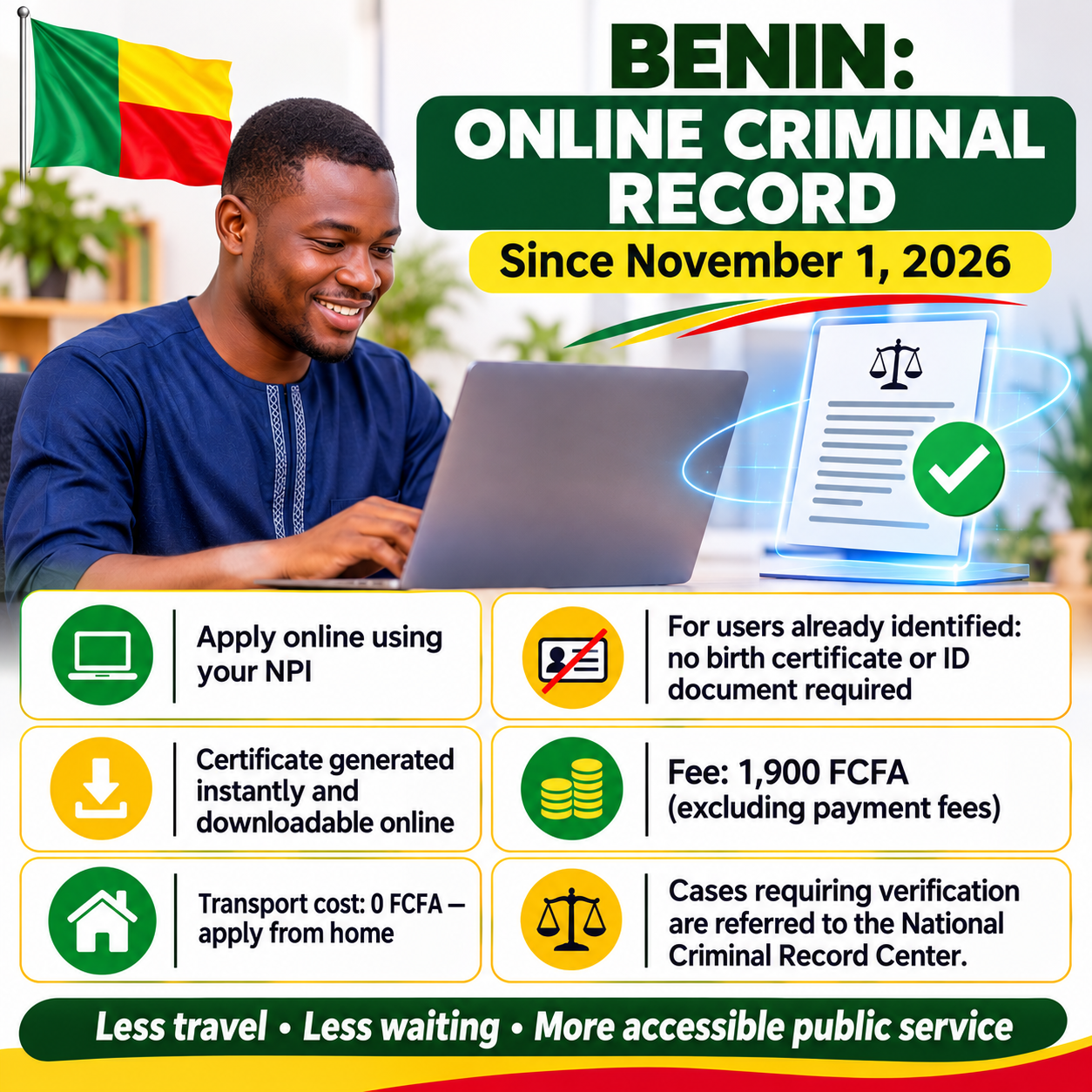
The way citizens interact with government services in Benin is undergoing a radical transformation with the digitization of the criminal record system. Since November 2026, an increasing number of citizens can now bypass lengthy bureaucratic hurdles by obtaining their bulletin instantaneously through an online portal. This shift raises a critical question: Can digital access truly simplify government bureaucracy and make it more people-centric? The answer, based on recent developments, appears to be a resounding yes.
How digital bureaucracy is breaking down barriers for citizens
Just a few years ago, obtaining a single administrative document in Benin often meant enduring a tedious process. Citizens had to travel long distances, sometimes multiple times, to government offices, pay for transportation, and spend hours waiting in queues. This system disproportionately affected people living in rural areas, those with demanding jobs, students applying for scholarships, and members of the diaspora trying to complete formalities from abroad.
The introduction of a fully online system eliminates many of these obstacles. Now, using only their Personal Identification Number (PIN), eligible citizens can request and receive their criminal record bulletin without submitting additional documents such as birth certificates or IDs provided their information is already verified in government databases. The process is streamlined, secure, and delivered directly to the user’s device.
What changes for the applicant?
Digital transformation does not mean every request is automatically approved. Cases that cannot be processed automatically are securely forwarded to the National Criminal Record Center for review. This ensures data accuracy and maintains document integrity while accelerating the majority of applications. The cost remains fixed at 1,900 FCFA (excluding payment processing fees), and the document is available for immediate download upon validation.
From hours of waiting to one click: the real cost of digitization
One of the most significant yet often overlooked benefits of this digital shift is the elimination of transportation costs. No longer do citizens need to spend money on buses, taxis, or fuel to reach a government office. More importantly, they no longer lose an entire day’s productivity or productivity of others who might accompany them. For a worker, student, or job seeker, this time saved can be reinvested in education, employment, or personal growth.
For the Beninese diaspora, this change is transformative. Instead of coordinating travel back to Benin or relying on intermediaries, they can now complete the request online from anywhere in the world. This level of accessibility reflects how modern governance should function: inclusive, efficient, and responsive to global realities.
Bénin leads by example: lessons for digital governance in Africa
The decision to digitize the criminal record system reflects a broader national strategy launched in mid-2020, when Benin began digitalizing key public services such as passports and judicial records. By building on this foundation with more intuitive, user-friendly platforms, the country is modeling how technology can serve citizens not the other way around.
The broader implication is clear: African governments at various stages of development can learn from Benin’s approach. Too many countries still treat public administration as a relic of the past slow, paper-based, and location-dependent. Yet the tools to change this now exist: secure databases, mobile connectivity, and digital identity systems. The question is no longer whether digitization is possible, but how quickly it can be implemented effectively.
Who benefits the most from this change?
The advantages of instant online access are far-reaching:
Busy professionals can avoid taking time off work to queue for documents.
Students and job seekers can prepare application files faster and submit applications on time.
Rural residents no longer face disproportionate travel burdens to access administrative services.
Members of the diaspora can fulfill obligations without planning costly trips back home.
This inclusivity aligns with the principle that public services should be a right, not a privilege limited by geography or socioeconomic status.
Ensuring no one is left behind in the digital transition
Despite these advances, challenges remain. Citizens with limited digital literacy or those whose records require updates may still face hurdles. Likewise, robust data protection measures are essential to safeguard personal information. The government must continue to offer alternative support channels such as in-person assistance in local offices and transparent correction processes to ensure that modernization does not create new forms of exclusion.
But acknowledging these concerns does not diminish the value of progress. The Beninese experience demonstrates that digital governance is not about replacing human interaction but about enhancing it making services faster, fairer, and more accessible for all.
Looking ahead: A model for smarter public administration
The digitization of the criminal record system is more than a bureaucratic improvement it’s a reflection of a deeper commitment to citizen-centered governance. When a document that once required days or weeks of effort can now be obtained in minutes with a few clicks, the message is clear: the government is listening. It understands the daily struggles of its people and is using technology not as an end in itself, but as a means to build trust, reduce inequality, and empower individuals.
As other African nations observe this evolution, they may find in Benin a blueprint for how to modernize their own systems without losing sight of their citizens’ real needs. The future of efficient governance in Africa may well be written in lines of code integrated, secure, and designed with the user in mind.
By IBRAHIM OUMAROU — Journalist