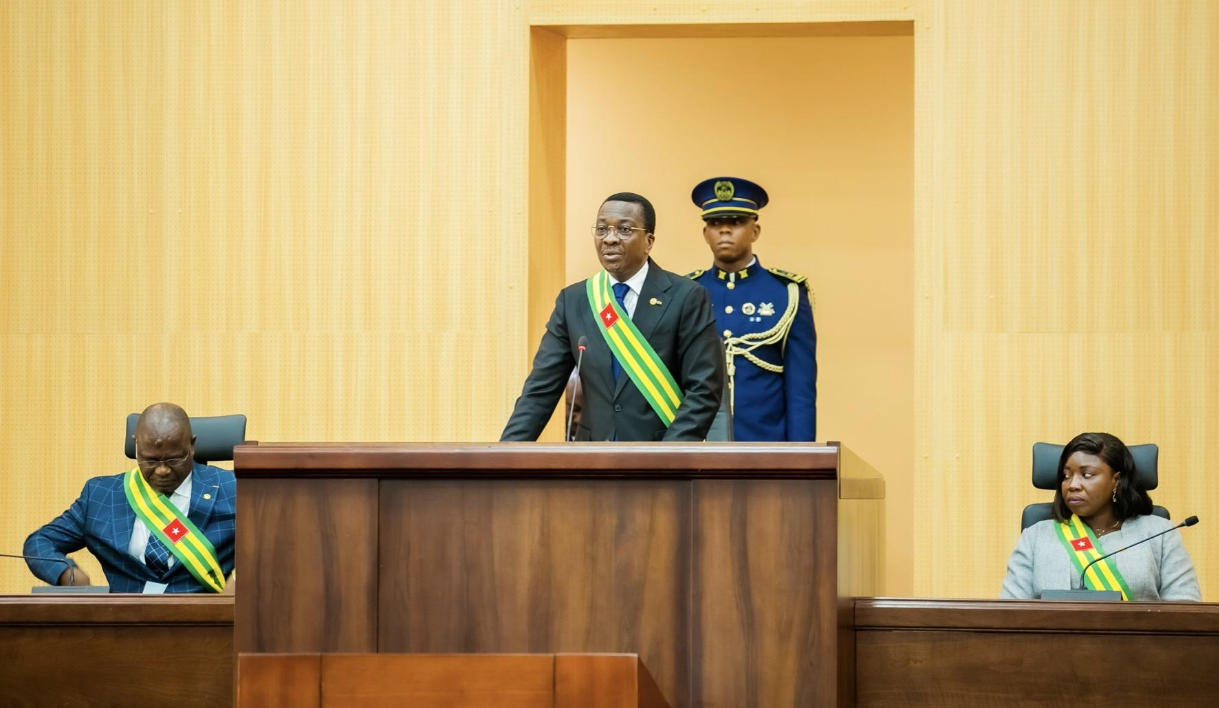
The Togolese government faces renewed pressure from the regional court over its controversial constitutional changes. Nearly nine months after a landmark ruling by the ECOWAS Court of Justice, Lomé has been formally requested to outline the steps taken to implement judicial directives. This second inquiry highlights persistent questions about the legitimacy of Togo’s Fifth Republic, the concentration of executive power under President Faure Gnassingbé, and the country’s shifting political alliances.
Maintaining Democratic Promises: What Measures Has Lomé Implemented?
The ECOWAS Court of Justice has once again turned up the heat on the Togolese government over its 2024 constitutional reform. In an official letter sent on October 23, 2026, to the Justice Minister, the court’s acting registrar, Dr. Ousmane Diallo, has demanded detailed information on the measures adopted to enforce its January 29, 2026 ruling in case ECW/CCJ/JUD/01/26.
This ruling stems from a complaint filed jointly by the Togolese Human Rights League (LTDH) and twelve other applicants, challenging the constitutionality of recent institutional changes. The court found Togo in breach of Article 23 of the African Charter on Democracy, Elections and Governance, citing failures to uphold democratic principles in constitutional revisions. While not invalidating the 2024 Constitution, the judgment stressed the need for future reforms to align with international commitments.
By invoking Article 24(2) of the Additional Act relating to the Court, the ECOWAS jurisdiction is now waiting for a formal response from the Togolese authorities. The question remains: will Lomé act on the court’s directives, or will it continue to sidestep regional democratic expectations?
From Presidential to Parliamentary Rule: A Change of Name or Substance?
The roots of this confrontation stretch back to March 25, 2024, when Togo’s National Assembly adopted a sweeping constitutional reform. The shift from a presidential to a parliamentary system significantly altered the balance of power, stripping the presidency of key executive functions and transferring them to a newly created role: President of the Council of Ministers. Initially framed as a modernization of governance, the reform has come under fierce criticism.
Opposition leaders and civil society groups argue that the change was a strategic move to allow Faure Gnassingbé to retain control after nearly two decades in power—continuing a political dynasty that began in 1967. The new system, they contend, merely relocates executive authority within parliament, where the President of the Council is chosen based on parliamentary majority. When Faure Gnassingbé assumed this position on May 3, 2025, critics saw it as proof that the reform had failed to break from authoritarian patterns.
Rather than democratizing governance, opponents claim, the transition preserved the concentration of power in the hands of one leader without recourse to direct universal suffrage. This structural continuity has fueled skepticism about whether the new system truly serves the public interest or serves as a legal facade for continued one-person rule.
Sahel Alliances: Does Lomé’s Diplomacy Undercut Regional Unity?
The ECOWAS Court’s renewed scrutiny comes at a time when Togo has strengthened ties with the military-led governments of the Alliance of Sahel States (AES)—Mali, Burkina Faso, and Niger. These countries, having emerged from coups, have promoted sovereignty narratives and rejected Western influence, often clashing with ECOWAS over transition timelines and institutional legitimacy.
In January 2025, Foreign Minister Robert Dussey hinted at the possibility of Togo joining the AES. By April 2026, Lomé had unveiled a new cooperation strategy with Sahelian nations, emphasizing political dialogue, security cooperation, and economic integration. While officials insist this alignment aims to stabilize the region and bridge divides within ECOWAS, the move has raised eyebrows.
Critics point to shared patterns between Togo’s political evolution and the AES regimes: centralized power structures, weakened checks and balances, and limited democratic space. Though Togo remains a full member of ECOWAS, its growing affinity with military-led states raises concerns about potential solidarity over regional democratic norms.
What’s Next for Togo’s Democratic Credibility?
Faure Gnassingbé’s government now stands at a crossroads. The ECOWAS Court’s demand is not just a legal formality—it is a test of Togo’s commitment to international democratic standards. While the court did not overturn the 2024 Constitution, its ruling underscores the need for future reforms to respect human rights and governance principles.
The government’s response will shape perceptions both domestically and across West Africa. Will Lomé use this moment to reinforce institutional transparency and accountability? Or will it continue down a path that reinforces perceptions of a manipulated constitutional shift designed to preserve power indefinitely?
As West Africa grapples with a wave of military takeovers and contested transitions, Togo’s trajectory may reveal much about the durability of democratic norms in a region under pressure. The ball is now in Lomé’s court—and the world is watching.