When the price of gold meets geopolitical stakes in Burkina Faso
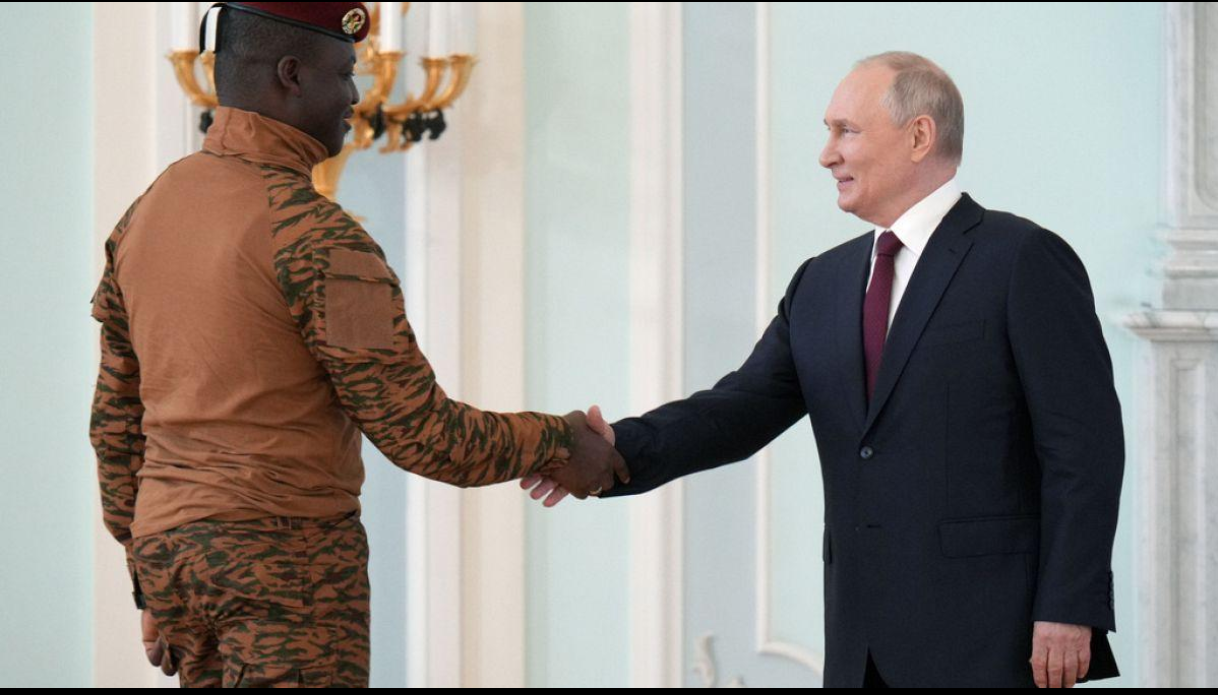
Burkina Faso’s vast gold reserves are no longer just a source of national wealth—they have become a strategic bargaining chip in the country’s evolving partnership with Moscow. Since Captain Ibrahim Traoré took power in September 2022, Ouagadougou’s pivot toward Russia has reshaped the nation’s security and economic landscape. But a critical question lingers: to what extent does Burkina Faso’s gold contribute to protecting its government?
The security of gold mines, particularly those operated by Russian firms, has become a flashpoint in this controversial alliance. At the center of this debate lies the Bissa mine, a flagship project owned by Nordgold, a company linked to Russian billionaire Alexeï Mordachov. The site has exposed deep rivalries among Russian security contractors, exposing the delicate balance between protecting mining interests, regime security, and geopolitical strategy.
The Bissa mine: a battleground beyond gold extraction
The Bissa gold mine, one of the largest in the country, is not merely a source of revenue—it is now a symbol of power and influence. The recent tug-of-war over its security contracts reflects a broader contest in which mining profitability, state sovereignty, and regime stability are intertwined. Reports indicate that a Russian security firm previously involved in protecting the site, RSB-Group, was abruptly removed from the contract and has since launched a campaign to challenge the decision.
In a series of letters obtained through independent channels, RSB-Group accused rival companies of exacerbating security risks in Peul communities near the mine. While these claims require further verification, they underscore a dangerous truth: the race to secure gold sites may be compromising the safety of local populations. This raises ethical concerns about whose interests are truly being served—those of foreign investors, the Burkinabe state, or ordinary citizens.
Moscow’s dual role: protector and profiteer in Burkina Faso
Russia’s engagement in Burkina Faso extends far beyond military cooperation. Since the failed coup attempt in September 2023, the Traoré administration has leaned heavily on external allies to reinforce its grip on power. In mid-2024, images emerged of Russian paramilitary forces stationed in Ouagadougou, deployed not only to combat jihadist threats but also to safeguard key government installations. This dual mandate—protecting both the nation and its leadership—highlights a troubling trend: the conflation of state security with regime survival.
What remains unclear is the quid pro quo. While no public agreement explicitly links the presence of Russian forces to access to gold concessions, history shows that Moscow’s interventions in Africa often carry economic incentives. The question is no longer whether Russia gains something from its partnership with Burkina Faso, but how much of it is tied to the country’s vast mineral wealth.
Nordgold and the hidden costs of Russian investments
Nordgold, a Moscow-based mining giant, operates two of Burkina Faso’s most productive gold mines: Bissa and Bouly. The company’s financial stakes in the country make it a major beneficiary of stability—but also a potential pawn in political maneuvering. In February 2023, the Burkinabe government made a controversial move by requisitioning 300 kilograms of gold from Bissa Gold, citing a state of emergency. Though compensation was promised, the decision signaled a new era in which the state treats gold as a strategic reserve, capable of shoring up finances during crises.
For Russian stakeholders, this dynamic presents both risk and opportunity. Ensuring the uninterrupted operation of these mines now goes hand in hand with securing political favors from Ouagadougou. Analysts at the Combating Terrorism Center at West Point have noted that protecting Russian mining assets in Burkina Faso may have been a key driver behind Moscow’s initial interest in the region. Yet they caution that the primary role of Russian forces deployed in the country is likely regime consolidation—not resource extraction.
A fragile alliance built on shifting sands
The rivalry at Bissa exposes a paradox in Burkina Faso-Russia relations: while Moscow provides security and political backing, its corporate actors are not unified. Competing Russian security firms vie for contracts, each deploying different strategies to curry favor with Burkinabe officials. When RSB-Group was sidelined, it resorted to behind-the-scenes lobbying and public allegations of misconduct against its rivals—moves that reveal how fragile this partnership truly is.
Local communities bear the brunt of these power struggles. The Peul villages caught in the crossfire of mining security operations face increased threats, not from jihadist groups alone, but from the very firms tasked with protecting critical infrastructure. This raises a vital question: can a regime claim legitimacy while its security arrangements inflict harm on the people it claims to protect?
The unspoken pact: security for concessions?
While no formal agreement has been made public, circumstantial evidence suggests a tacit understanding. The Traoré government gains from Russian support in quelling internal dissent and external threats, while Russian companies gain preferential access to one of Africa’s most lucrative gold reserves. This unspoken exchange reflects a broader pattern seen across the Sahel, where military partnerships often come with side agreements on natural resources.
Yet the stakes are higher in Burkina Faso, where gold accounts for nearly 70% of export earnings. Surrendering control over security at these sites is not merely an economic decision—it is a strategic concession with long-term consequences for national sovereignty.
What future for Burkina Faso’s golden dilemma?
The alliance between Ouagadougou and Moscow remains shrouded in opacity, but one thing is clear: the country’s gold is more than a commodity—it is currency in a high-stakes geopolitical game. As Russian forces deepen their footprint in the capital and mining companies jockey for influence, the people of Burkina Faso face a future where their nation’s wealth may be traded away in exchange for security they never fully consented to.
The Bissa mine is just one symbol of this broader reality. Behind its fortified walls lies a question that the world is only beginning to ask: when a government trades natural resources for protection, who ultimately pays the price?