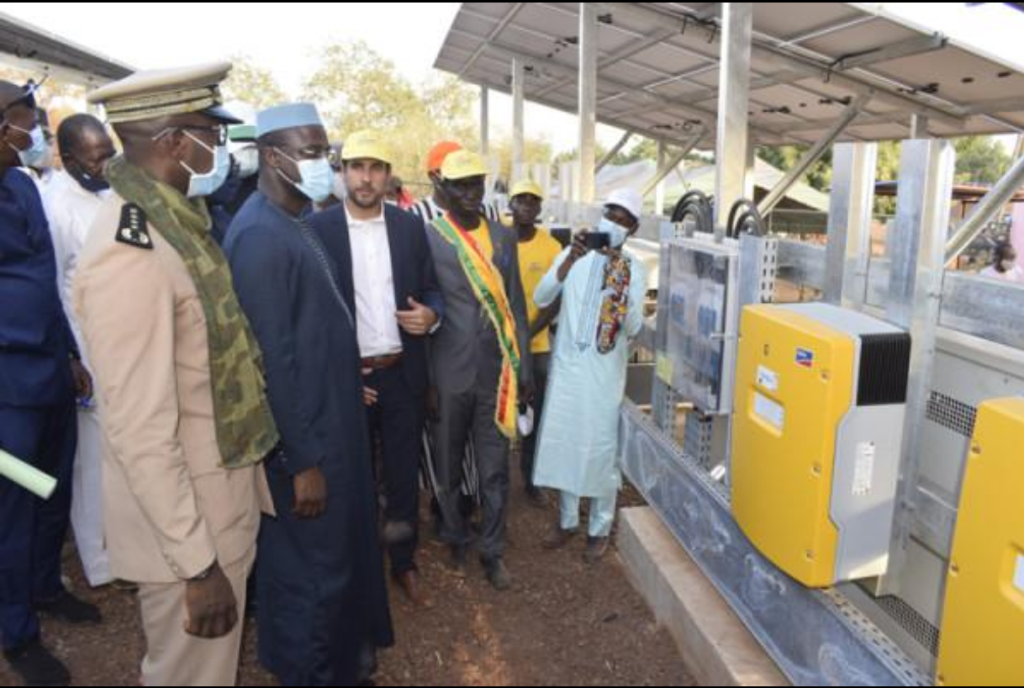
Why Bamako’s energy future hinges on a project the CEDEAO still controls
Since Mali severed ties with the Economic Community of West African States (CEDEAO), political observers have predicted stalled cooperation across every sector. Yet, deep in the Sahel, an audacious electrification initiative spearheaded by the regional bloc continues to flow electricity into Malian towns and villages—proving that power grids, once built, rarely respect diplomatic divorces.
More than three years after Bamako, Ouagadougou and Niamey exited the organisation, the ECOWAS Regional Electricity Access Project (ECOWAS-REAP) is still lighting up homes, markets and clinics across southern Mali. The paradox spotlights a critical question: when politics fracture, do development promises crumble with them?
From declaration to distribution: how the project became untouchable
The journey began in 2019, when ministers from Guinea-Bissau, The Gambia and Mali signed agreements under the CEDEAO banner. Funded with a 225-million-dollar grant from the World Bank, the scheme aimed to plug 490 energy-poor communities into the grid, bringing sustainable power to close to half a million people.
Mali’s national utility, Énergie du Mali (EDM-SA), received financing for 152 of those communities, mostly along the Niger River corridor. Despite the country’s exit from CEDEAO, infrastructure erected under the programme—transformer stations, low-voltage lines and smart meters—remains operational. Technicians from EDM-SA still attend quarterly coordination meetings in Abuja and Dakar, debating tariff harmonisation and maintenance schedules with their Gambian and Guinean counterparts.
These routine gatherings, once seen as routine diplomacy, are now stripped of formal protocol. Yet the exchange of technical data, grid maps and load-balancing algorithms continues, ensuring that electricity keeps flowing across borders that no longer respect the same political map.
Pragmatism over politics: whose project is it anyway?
Critics argue the Malian government could have repudiated the agreement after withdrawing from CEDEAO. The reality, however, is more nuanced. The 225 million dollars secured from the World Bank are channelled through a multi-country financing agreement that predates the political rupture. Cancelling Mali’s share would have triggered cross-default clauses, risking funds destined for Guinea-Bissau and The Gambia as well.
A senior EDM-SA project manager, speaking on condition of anonymity, explained: « The cables and towers do not recognise geopolitical disputes. What matters is kilowatt-hours reaching end-users before the next rainy season. »
World Bank auditors have noted that 94 % of the Malian sub-projects are either completed or under execution. Only terrain security in the Mopti and Ségou regions and late land-rights paperwork have introduced minor delays—delays the Malian energy directorate is now asking the Bank to extend by an additional 30 months.
Electricity as a non-negotiable public good
For households in rural Sikasso and urban Kayes, the lights stay on not because of treaties, but because mothers can now refrigerate vaccines, farmers run irrigation pumps at night and students study after dusk. A recent World Bank impact study found that villages connected under ECOWAS-REAP saw a 19 % rise in night-time economic activity, translating into higher petty-commerce revenues and a 12 % drop in kerosene expenses.
Oussouby Mary dit Ousmane Diarra, Mali’s director-general of energy, recently told a closed-door briefing that « energy poverty is the real crisis; political posturing is a luxury we cannot afford. » His request for a project extension underscores a quiet consensus: once infrastructure is in place, development momentum takes on a life of its own.
What the CEDEAO can—and cannot—do next
The organisation’s role is shifting from financier to facilitator. Under revised legal arrangements, CEDEAO will continue to broker technical standards and dispute-resolution mechanisms, but will no longer receive or disburse Malian tariffs. Those revenues now bypass the regional bloc, flowing directly into a dedicated escrow account managed by the World Bank and EDM-SA.
Long-term sustainability still demands two breakthroughs: stable fuel supply for thermal plants and regional wheeling agreements that let Mali import surplus power from Ivory Coast and Ghana during peak demand. Neither issue is purely technical—both hinge on restoring at least minimal diplomatic channels.
The paradox is striking: Mali’s political split has not severed its electricity lifeline, but it has narrowed the space for future cross-border cooperation. The lesson? Once the grid is built, dismantling it politically is far harder than keeping it alive.
Three takeaways for policymakers watching the Sahel
- Infrastructure survives diplomacy: even after formal withdrawal, mature projects rarely die—they merely operate under revised governance frameworks.
- Beneficiaries become stakeholders: local utilities, consumers and even private mini-grid operators now have a vested interest in keeping the lights on.
- Finance dictates the future: multi-donor facilities with cross-default clauses create an inescapable tie that outlasts political rhetoric.