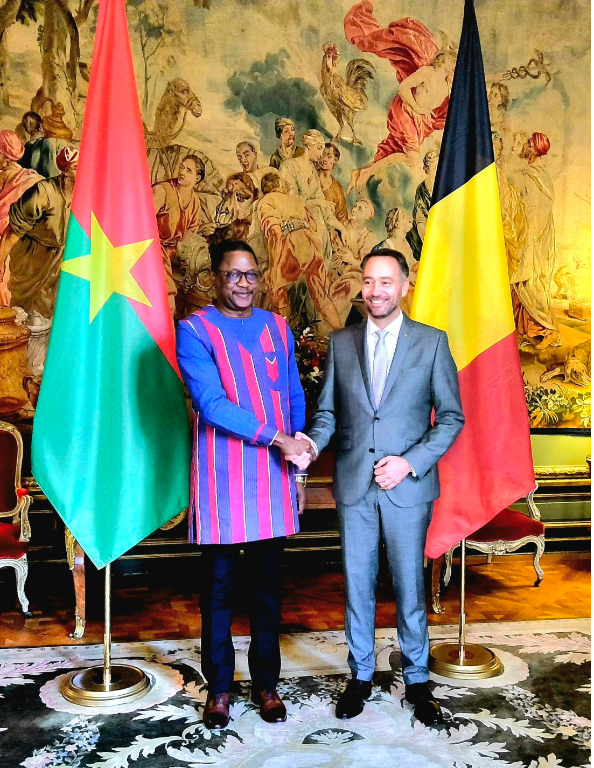
As Burkina Faso redefines its foreign partnerships and veers toward sovereignty-centric policies, Brussels emerges as an unexpected yet pragmatic ally. During a critical two-day working visit to Belgium on November 4-5, 2026, foreign minister Karamoko Jean-Marie Traoré secured a renewed commitment of 40 million euros in development aid from Belgium for the post-2027 period—raising a pressing question: can economic cooperation outlast political divergence?
Why a 40 million euro pledge matters now
The funding, pledged through Belgium’s international development agency Enabel, will extend cooperation beyond the current 2023–2027 program, which totaled 34.5 million euros. While the funds are announced for the future and not yet fully disbursed, they signal a continued Belgian willingness to invest in Burkina Faso’s development and people. In a country grappling with economic stagnation, social strain, and rising insecurity, such resources could help stabilize key sectors.
For Belgium, the move reflects strategic interests in the Sahel, where maintaining cooperative ties with transitional governments is increasingly complex. For Ouagadougou’s leadership, it demonstrates that economic pragmatism can coexist with political sovereignty—even when rhetoric pushes toward alternatives in Moscow and beyond.
A deeper look at the Brussels visit beyond the money
The minister’s agenda extended well beyond financial discussions. On November 4, Karamoko Jean-Marie Traoré met with EU High Representative Kaja Kallas to explore Burkina Faso’s evolving vision of international partnerships and its stance on regional engagements.
The following day, talks with Belgium’s foreign affairs minister Maxime Prévot covered bilateral cooperation, regional issues, and shared priorities—indicating that diplomatic channels between Ouagadougou and Western institutions remain open, despite shifting geopolitical winds.
Can sovereignty and Western funding coexist?
Since assuming power in late 2022, President Ibrahim Traoré has made national sovereignty a cornerstone of his governance model. The withdrawal of French forces, criticism of Western policies, and strengthened ties with Russia have reshaped Burkina Faso’s diplomatic landscape. Yet the announcement of continued Belgian support suggests a nuanced approach: political divergence does not automatically erase strategic cooperation.
This dual stance aligns with Burkina Faso’s broader strategy of diversifying partnerships. It is possible to strengthen relations with Moscow while maintaining constructive dialogue with Brussels—provided those engagements serve distinct national objectives.
What’s next: rapprochement or continued tension?
The 40 million euro commitment and high-level meetings do not signify a full diplomatic reset. Concrete steps such as renewed sectoral agreements, expanded technical cooperation, or accelerated project implementation would be needed to confirm a realignment. Without such milestones, the gesture remains more about continuity than transformation.
For Belgium and the EU, preserving dialogue helps secure influence in a volatile region. For Burkina Faso, the calculus balances the need for external resources with the imperative of asserting independent foreign policy choices. The result? A fragile but functional equilibrium between assertion and accommodation.
Key takeaways
- Continuity over change: The 40 million euro pledge continues existing cooperation beyond 2027, prioritizing development and social stability.
- Diplomatic resilience: High-level meetings in Brussels show that channels with Western partners remain open despite political divergences.
- Sovereign pragmatism: Burkina Faso’s government balances anti-Western rhetoric with selective engagement to meet economic and social goals.
- Unfinished equation: The announcement is a step forward, but lasting rapprochement will require follow-through beyond words.