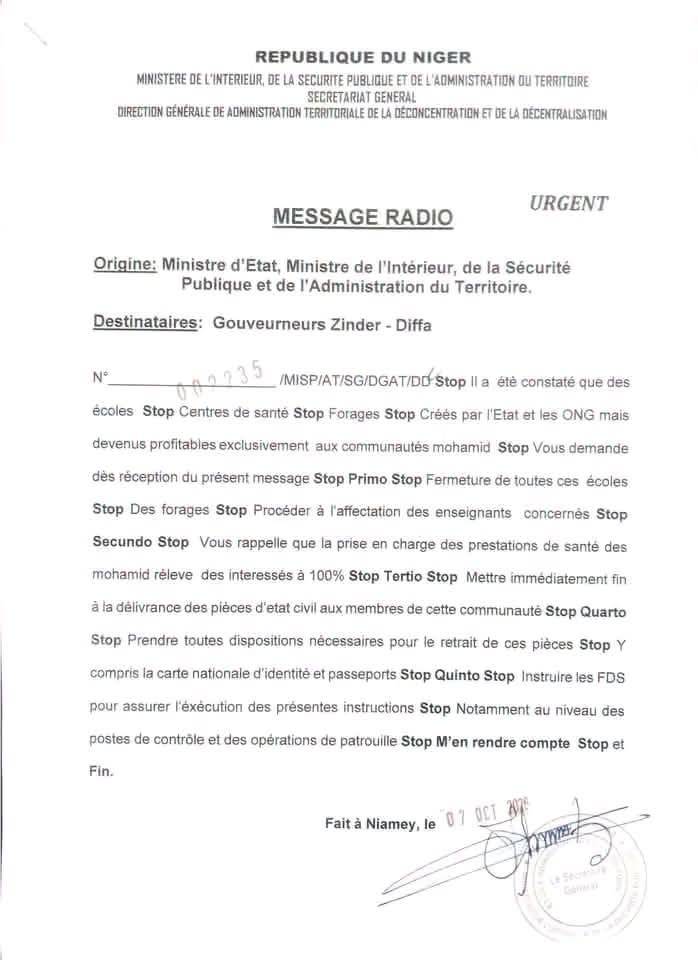
In a controversial move that has raised alarms across Niger, a radio announcement from the Ministry of Interior issued on October 7, 2026, has set in motion a series of punitive measures targeting the Mohamid Arab community. The broadcast, addressed to regional governors in Zinder and Diffa, outlines directives to close schools and water access points allegedly serving this group exclusively, reassign teachers, withdraw health coverage, and suspend the issuance of identity documents, including national ID cards and passports. Security forces have been mobilized to enforce these measures, turning rhetoric into reality for the affected families.
This decision forces a critical question upon Niger’s government: how can a nation claim to protect its citizens while stripping an entire community of its most basic rights? The implications extend far beyond administrative policy—they challenge the very foundations of citizenship, human dignity, and the rule of law under the leadership of General Abdourahamane Tiani.
The erosion of fundamental rights disguised as security policy
Access to education, clean water, healthcare, and legal identity are not privileges to be granted or revoked based on ethnicity or origin. They are essential pillars of human survival and participation in society. Yet, the closure of schools serving the Mohamid community threatens the future of generations, while cutting off water sources in the Sahel—where water scarcity is a daily struggle—puts families and livestock at risk. The suspension of collective healthcare support risks leaving countless individuals without medical care, while the revocation of identity documents creates a legal limbo that undermines personal security and social mobility.
These measures are not administrative corrections—they represent a systemic deprivation. When public services are denied not because of misconduct but because of identity, the state abandons its duty to protect all citizens equally. The law demands that any restriction be proportional, targeted, and grounded in evidence. Collective punishment is not justice; it is an abuse of power.
Security cannot be built on collective guilt
Niger faces real security threats, particularly in the Diffa region, where armed group activities and trafficking networks demand a firm response. However, combating insecurity cannot mean conflating entire communities with criminal elements. Justice in a democratic society is individual, not collective. If crimes have been committed, they must be investigated, and individuals must be held accountable based on proven evidence—not assumed guilt by association.
The principle that no one should be punished for the actions of others is a cornerstone of both national and international law. The state’s role is to maintain order while upholding the rights of every citizen, not to punish whole populations for perceived threats. The use of administrative power to sanction a community en masse raises serious concerns: what evidence justifies these measures? What legal safeguards protect the rights of those affected? The government owes the nation clear, transparent explanations.
Escalating repression under military rule
Since the July 26, 2023 coup that removed President Mohamed Bazoum, Niger has been governed by a military junta led by General Tiani. The regime has faced widespread criticism for its tightening grip on freedoms, including the dissolution of political parties, restrictions on civil society, arbitrary detentions, and censorship of the press. Recent measures, such as the revocation of nationality for opposition figures in exile, further erode public trust and legal certainty.
While the Mohamid directive differs in scale from targeted political sanctions, it reflects a troubling pattern: the use of state authority to restrict rights without due process. Such policies not only harm targeted groups but also weaken public confidence in institutions that govern with impartiality and justice. A state’s strength is measured not by its ability to impose restrictions, but by its commitment to protecting every citizen—regardless of ethnicity or social standing.
The human and economic cost of exclusion
The consequences of these measures extend beyond individual families to the very fabric of local society. The Mohamid community is deeply integrated into the economic life of Zinder and Diffa through trade, transport, and livestock rearing. Disrupting their access to education, healthcare, and legal recognition risks destabilizing livelihoods that entire regions depend on. Children lose their right to learn, families face water shortages, and sick individuals go untreated—while traders and transporters face mounting barriers to conducting business.
Moreover, the arbitrary withdrawal of identity documents creates bureaucratic nightmares for those already marginalized. Without legal proof of citizenship, individuals become invisible in their own country—denied access to banking, travel, and legal recourse. The long-term damage to social cohesion and economic stability could far outlast the initial intent of the policy.
Time for accountability and corrective action
Niger deserves security and stability, but not at the expense of its moral and legal principles. The government must reassess the blanket measures against the Mohamid community, ensuring uninterrupted access to education, water, and healthcare. Any withdrawal of identity documents must follow individualized, transparent legal procedures—not collective sanctions. An independent review of the October 7 directive is necessary to assess its legality, its humanitarian impact, and the chain of responsibility behind its implementation.
Citizenship is not a privilege—it is a right. A nation that allows entire communities to be punished collectively for the alleged actions of a few betrays its own democratic values. The question now facing Niger is not just about the Mohamid people. It is about the future of justice, equality, and the rule of law in a country that must unite all its people in security and dignity.